


Each solution shows how the type of sequence is decided, the formula, and the arithmetic for the requested term, followed by a check. If your answer differs, compare the common difference or ratio first, since most errors start there.
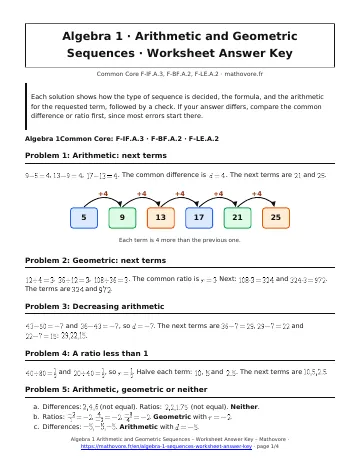
Problem 1: Arithmetic: next terms
\(9-5=4\), \(13-9=4\), \(17-13=4\). The common difference is \(d=4\). The next terms are \(21\) and \(25\).
Problem 2: Geometric: next terms
\(12: 4=3\), \(36: 12=3\), \(108: 36=3\). The common ratio is \(r=3\). Next: \(108\cdot 3=324\) and \(324\cdot 3=972\). The terms are \(324\) and \(972\).
Problem 3: Decreasing arithmetic
\(43-50=-7\) and \(36-43=-7\), so \(d=-7\). The next terms are \(36-7=29\), \(29-7=22\) and \(22-7=15\): \(29, 22, 15\).
Problem 4: A ratio less than 1
\(40: 80=\frac{1}{2}\) and \(20: 40=\frac{1}{2}\), so \(r=\frac{1}{2}\). Halve each term: \(10\), \(5\) and \(2.5\). The next terms are \(10, 5, 2.5\).
Problem 5: Arithmetic, geometric or neither
- Differences: \(2,4,6\) (not equal). Ratios: \(2,2,1.75\) (not equal). Neither.
- Ratios: \(\frac{-2}{1}=-2\), \(\frac{4}{-2}=-2\), \(\frac{-8}{4}=-2\). Geometric with \(r=-2\).
- Differences: \(-5,-5,-5\). Arithmetic with \(d=-5\).
Problem 6: Explicit rule: arithmetic
\(a_{1}=6\) and \(d=5\). Then \(a_{n}=6+5(n-1)=5n+1\). The formula is \(a_{n}=6+5(n-1)\).
\(a_{20}=6+5(19)=6+95=101\). The 20th term is \(101\).
Problem 7: Explicit rule: geometric
\(a_{1}=5\) and \(r=2\). The formula is \(a_{n}=5\cdot 2^{n-1}\).
\(a_{8}=5\cdot 2^{7}=5\cdot 128=640\). The 8th term is \(640\).
Problem 8: Recursive: arithmetic
\(d=17-20=-3\). The recursive formula is \(a_{1}=20,\quad a_{n}=a_{n-1}-3\).
Continue: \(11-3=8\), \(8-3=5\). So \(a_{6}=5\). Check: \(20+5(-3)=5\).
Problem 9: Recursive: geometric
\(r=3: 1.5=2\). The recursive formula is \(a_{1}=1.5,\quad a_{n}=2\cdot a_{n-1}\).
The terms are \(1.5,3,6,12,24,48,96\), so \(a_{7}=96\). Check: \(1.5\cdot 2^{6}=1.5\cdot 64=96\).
Problem 10: Use a_1 and d
\(a_{n}=-8+6(n-1)=6n-14\). The formula is \(a_{n}=-8+6(n-1)\).
\(a_{15}=-8+6(14)=-8+84=76\). So \(a_{15}=76\).
Problem 11: From a recursive rule
- \(a_{1}=4\), \(a_{2}=12\), \(a_{3}=36\), \(a_{4}=108\), \(a_{5}=324\).
- The sequence is geometric with \(r=3\): \(a_{n}=4\cdot 3^{n-1}\). Then \(a_{5}=4\cdot 3^{4}=4\cdot 81=324\), which matches.
Problem 12: Find the rule from two terms
From term 3 to term 7 there are 4 steps, so \(4d=27-11=16\) and \(d=4\). Then \(a_{1}=a_{3}-2d=11-8=3\). The formula is \(a_{n}=3+4(n-1)=4n-1\).
Check: \(a_{3}=4(3)-1=11\) and \(a_{7}=4(7)-1=27\).
Problem 13: Geometric from two terms
From term 2 to term 5 the ratio is used 3 times : \(r^{3}=\frac{162}{6}=27\), so \(r=3\). Then \(a_{1}=6: 3=2\). The formula is \(a_{n}=2\cdot 3^{n-1}\).
Check: \(a_{5}=2\cdot 3^{4}=2\cdot 81=162\).
Problem 14: Which term?
\(a_{n}=4+6(n-1)\). Set it equal to 154: \(4+6(n-1)=154\), so \(6(n-1)=150\) and \(n-1=25\). Then \(n=26\). The 26th term is 154.
Problem 15: Sequence from a graph
- The terms are \(10,7,4,1\). The differences are all \(-3\), so it is arithmetic with \(d=-3\).
- \(a_{n}=10-3(n-1)=13-3n\). Then \(a_{8}=13-3(8)=-11\), so \(a_{8}=-11\).
Problem 16: Decay by a third
\(a_{n}=243(\frac{1}{3})^{n-1}\). So \(a_{6}=243(\frac{1}{3})^{5}=\frac{243}{243}=1\). The answer is \(a_{6}=1\). Check by listing: \(243,81,27,9,3,1\).
Problem 17: Weekly savings
- \(a_{n}=15+6(n-1)=6n+9\).
- \(a_{12}=15+6(11)=15+66=81\). He deposits $81.
- \(15+6(n-1)>100\) gives \(6(n-1)>85\), so \(n-1>14.17\) and \(n=16\). Check: \(a_{15}=99\) is too small and \(a_{16}=105\) works. It is week 16.
Problem 18: Doubling views
- Recursive: \(a_{1}=50,\quad a_{n}=2\cdot a_{n-1}\). Explicit: \(a_{n}=50\cdot 2^{n-1}\).
- \(a_{7}=50\cdot 2^{6}=50\cdot 64=3200\). The video gets 3,200 views on day 7.
Problem 19: Stadium rows
- \(a_{n}=18+2(n-1)=2n+16\).
- \(a_{25}=18+2(24)=66\). Row 25 has 66 seats.
- \(18+2(n-1)=50\), so \(2(n-1)=32\) and \(n=17\). It is row 17.
Problem 20: Car depreciation
- Losing 15% leaves 85%, so \(r=0.85\): \(a_{n}=20000(0.85)^{n-1}\).
- \(a_{4}=20000(0.85)^{3}=20000(0.614125)=12282.5\). The value is $12,282.50.
- \(a_{5}=20000(0.85)^{4}\approx 10440.13\) is still above $10,000, and \(a_{6}=20000(0.85)^{5}\approx 8874.11\) is below. It happens at the start of year 6.
Problem 21: Two growth plans
- Plan A (arithmetic): \(A_{n}=100+25(n-1)\). Plan B (geometric): \(B_{n}=10\cdot 2^{n-1}\).
- Compare month by month. Month 5: \(A_{5}=200\) and \(B_{5}=160\). Month 6: \(A_{6}=225\) and \(B_{6}=320\). Plan B first exceeds Plan A in month 6.
Problem 22: Bouncing ball
- \(a_{n}=16(\frac{3}{4})^{n-1}\).
- \(a_{4}=16(\frac{3}{4})^{3}=16\cdot\frac{27}{64}=\frac{27}{4}=6.75\). The 4th bounce reaches 6.75 feet.
See every chapter on the Algebra 1 math page.