Key takeaway: This precalculus vectors test answer key collects each worked solution to the 20-point test and a rubric for partial credit. Graders may credit a sound setup, because a late arithmetic error should not erase earlier work. Equivalent exact forms are accepted. The key supports N-VM.A.3, and it highlights the direction angle checks that decide many marks.
Use this answer key to grade the vectors test. Each solution shows full work, and the scoring note after it explains how every point is earned. Give partial credit only where the scoring note allows it; the maximum total is 20 points.
Precalculus Vectors Test Answer Key: questions 1–5
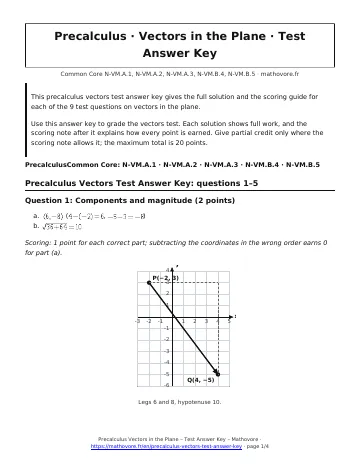
1. Components and magnitude (2 points)
- \(\langle 6, -8\rangle\) (\(4-(-2)=6\), \(-5-3=-8\))
- \(\sqrt{36+64}=10\)
Scoring: 1 point for each correct part; subtracting the coordinates in the wrong order earns 0 for part (a).
2. Magnitude and direction (2 points)
- \(\sqrt{9+27}=\sqrt{36}=6\)
- \(\tan\theta=\frac{3\sqrt{3}}{-3}=-\sqrt{3}\), reference angle \(60^{\circ}\), quadrant II: \(\theta=120^{\circ}\)
Scoring: 1 point for each part; for part (b) award the point only if the angle is in the correct quadrant (60° earns 0).
3. Combining vectors (2 points)
- \(\langle 6-8,\ -15+6\rangle=\langle -2, -9\rangle\)
- \(\langle 2+8,\ -5-6\rangle=\langle 10, -11\rangle\)
Scoring: 1 point for each correct vector; 0 for a part with a sign error in the subtraction.
4. Parallelogram rule (3 points)
- \(\vec{a}=\langle 3, 2\rangle\), \(\vec{b}=\langle -1, 3\rangle\), so \(\vec{a}+\vec{b}=\langle 2, 5\rangle\)
- \(\vec{a}-\vec{b}=\langle 4, -1\rangle\)
- \(\sqrt{4+25}=\sqrt{29}\)
Scoring: 1 point per part. In part (a) the point requires correct components for both vectors and the sum.
5. Unit vector (2 points)
- \(\sqrt{81+144}=15\)
- \(\frac{1}{15}\langle -9, 12\rangle=\langle -\frac{3}{5}, \frac{4}{5}\rangle\)
Scoring: 1 point per part; part (b) requires dividing every component by the magnitude.
Precalculus Vectors Test Answer Key: questions 6–9
6. Dot product and angle (3 points)
- \(2(-1)+4(3)=10\)
- \(|\vec{u}|=\sqrt{20}=2\sqrt{5}\) and \(|\vec{v}|=\sqrt{10}\)
- \(\cos\theta=\frac{10}{\sqrt{20}\sqrt{10}}=\frac{10}{\sqrt{200}}=\frac{\sqrt{2}}{2}\), so \(\theta=45^{\circ}\)
Scoring: 1 point per part.
7. Perpendicular vectors (2 points)
Perpendicular means dot product 0: \(10k-20=0\) (1 point), so \(k=2\). Check: \(\langle 2, 5\rangle\cdot\langle 10, -4\rangle=20-20=0\).
Scoring: 1 point for the equation, 1 point for the value and the check.
8. Airplane and wind (2 points)
Ground velocity \(\langle 70, 240\rangle\), speed \(\sqrt{4900+57600}=\sqrt{62500}=\)250 mph (1 point).
Direction: \(\tan^{-1}(\frac{70}{240})\approx\) \(16.3^{\circ}\) east of north (1 point).
Scoring: 1 point for the speed, 1 point for the angle.
9. Two forces (2 points)
\(\vec{F_{1}}=\langle 20, 0\rangle\), \(\vec{F_{2}}=\langle 20\cos 120^{\circ},\ 20\sin 120^{\circ}\rangle=\langle -10,\ 10\sqrt{3}\rangle\) (1 point).
Resultant \(\langle 10,\ 10\sqrt{3}\rangle\), magnitude \(\sqrt{100+300}=\)20 pounds, direction \(\tan^{-1}(\sqrt{3})=\)\(60^{\circ}\) (1 point).
Scoring: 1 point for the components and sum, 1 point for magnitude and direction.
Scoring summary
20 points: add the points of every question of this precalculus vectors test answer key.
Which answers open the key?
For question 1, \(\vec{PQ}=\langle6,-8\rangle\) and its magnitude is 10. Question 2 gives magnitude 6 and angle \(120^{\circ}\). In question 3, \(3\vec{u}+2\vec{v}\) equals \(\langle-2,-9\rangle\).
How do you grade the dot product question?
The dot product \(10\) earns one point. The magnitudes \(\sqrt{20}\) and \(\sqrt{10}\) earn another. The final point goes to the angle \(45^{\circ}\). However, a student who skips the magnitudes but guesses \(45^{\circ}\) should not receive the last mark.
What does the precalculus vectors test key say about questions 5, 7 and 8?
Question 5 gives magnitude 15 and unit vector \(\langle-\frac{3}{5},\frac{4}{5}\rangle\). In question 7, \(10k-20=0\) leads to \(k=2\). Question 8 gives a ground speed of 250 mph, and the bearing east of north has tangent \(\frac{7}{24}\).
Which common slips lose a point?
The first is a reversed subtraction, which flips both signs. Next comes a missing unit, such as mph. Finally, a unit vector that still has length 1.2 shows the division step was skipped.
How can teachers use the rubric afterward?
Record which rubric line was missed most. Reteach that idea with a fresh pair of vectors on the board. After that, assign a three-question retest and compare the class average with the first result.

See every chapter on the Precalculus math page.