Key takeaway: The grade 5 multiply test answer key presents full worked solutions and shows how the 20 points are awarded. Lean on the point notes to split credit whenever the plan is sound and only a calculation goes astray. Look for an improper fraction conversion before any mixed-number product. That step shows understanding even when the final number is off.
This answer key shows full worked solutions and how the 20 points are awarded. Use the scoring notes to give partial credit when the method is right but the arithmetic has a slip.
Grade 5 Multiply Test Answer Key: questions 1–5
1. Division and fractions (2 points)
- \(17 : 5 = \frac{17}{5} = 3\frac{2}{5}\)
- \(4 : 7 = \frac{4}{7}\) pound
Scoring: 1 point for each part. Give the point for \(\frac{17}{5}\) only if it is converted to a mixed number.
2. Whole numbers and fractions (2 points)
- \(5 \times \frac{3}{10} = \frac{15}{10} = \frac{3}{2} = 1\frac{1}{2}\)
- \(\frac{7}{12} \times 8 = \frac{56}{12} = \frac{14}{3} = 4\frac{2}{3}\)
Scoring: 1 point per part for a correct simplified answer. If the product is correct but not simplified or not converted to a mixed number, award no more than half the point and round the question total down.
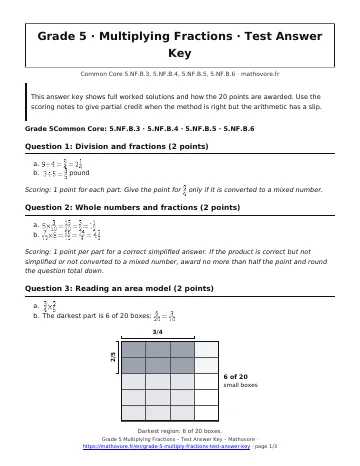
3. Reading an area model (2 points)
- \(\frac{3}{4} \times \frac{2}{5}\)
- The darkest part is 6 of 20 boxes: \(\frac{6}{20} = \frac{3}{10}\)
Scoring: 1 point for a correct sentence (either order of factors). 1 point for \(\frac{3}{10}\).
4. Multiplying fractions (2 points)
- \(\frac{4}{9} \times \frac{3}{8} = \frac{12}{72} = \frac{1}{6}\)
- \(\frac{5}{6} \times \frac{9}{10} = \frac{45}{60} = \frac{3}{4}\)
Scoring: 1 point for each correct simplified product.
5. Area of a rectangle (2 points)
- \(\frac{7}{8} \times \frac{2}{3} = \frac{14}{24} = \frac{7}{12}\) square foot
- Both rectangles have the same height, and \(1\frac{1}{4} > \frac{7}{8}\). Rectangle B is wider, so its area is greater. (Area of B: \(\frac{5}{4} \times \frac{2}{3} = \frac{10}{12} = \frac{5}{6}\), and \(\frac{5}{6} > \frac{7}{12}\).)
Scoring: Part a: 1 point for \(\frac{7}{12}\) with units. Part b: 1 point for ‘greater’ with a valid reason (wider with equal height, or the computed areas).
Grade 5 Multiply Test Answer Key: questions 6–9
6. Size of a product (2 points)
- \(\frac{3}{4} < 1\), so the product is less than \(\frac{2}{3}\): <
- \(1\frac{3}{8} > 1\), so the product is greater than 6: >
Scoring: 1 point per correct symbol. A correct symbol with a wrong explanation still earns the point.
7. Mixed number products (2 points)
- \(\frac{5}{2} \times \frac{8}{5} = \frac{40}{10} = 4\)
- \(\frac{10}{3} \times \frac{9}{4} = \frac{90}{12} = \frac{15}{2} = 7\frac{1}{2}\)
Scoring: 1 point per part. No point if the whole numbers and fractions are multiplied separately.
8. Hiking trail (3 points)
- \(2\frac{1}{4} = \frac{9}{4}\). \(\frac{2}{3} \times \frac{9}{4} = \frac{18}{12} = \frac{3}{2} = 1\frac{1}{2}\) miles
- \(\frac{9}{4} – \frac{3}{2} = \frac{9}{4} – \frac{6}{4} = \frac{3}{4}\) mile
Scoring: Part a: 1 point for converting to \(\frac{9}{4}\) and setting up the product, 1 point for \(1\frac{1}{2}\). Part b: 1 point for \(\frac{3}{4}\) (follow-through allowed).
9. Ribbon for a project (3 points)
- \(\frac{2}{3} \times \frac{9}{2} = \frac{18}{6} = 3\) yards
- Rest: \(\frac{9}{2} – 3 = \frac{3}{2}\) yards. \(\frac{5}{6} \times \frac{3}{2} = \frac{15}{12} = \frac{5}{4} = 1\frac{1}{4}\) yards
- \(\frac{3}{2} – \frac{5}{4} = \frac{6}{4} – \frac{5}{4} = \frac{1}{4}\) yard
Scoring: 1 point per part; follow-through is allowed from an earlier error if the method is correct.
Scoring summary
20 points: add the points of every question of this grade 5 multiply test answer key.
What are the answers to the opening items?
Seventeen divided by 5 is \(3\frac{2}{5}\), and four pounds among 7 friends is \(\frac{4}{7}\) pound each. The product \(5 \times \frac{3}{10}\) is \(\frac{3}{2}\), and \(\frac{7}{12} \times 8\) is \(4\frac{2}{3}\). For the next part, \(\frac{4}{9} \times \frac{3}{8}\) is \(\frac{1}{6}\), and \(\frac{5}{6} \times \frac{9}{10}\) is \(\frac{3}{4}\). Each part is worth one point.
How do you score the mixed numbers and stories?
The product \(2\frac{1}{2} \times 1\frac{3}{5}\) is 4, and \(3\frac{1}{3} \times 2\frac{1}{4}\) is \(7\frac{1}{2}\). Give one point for each correct conversion even if the final product is wrong. Liam hikes \(1\frac{1}{2}\) miles, and the three-point trail problem awards a point for the setup, one for the product and one for the unit.
How should a grade 5 multiply test answer key handle size comparisons?
A comparison earns the point only when the reasoning mentions the factor. A student who says that \(\frac{3}{4} \times \frac{2}{3}\) is less than \(\frac{2}{3}\) because \(\frac{3}{4}\) is below 1 has the idea. In contrast, a student who computes the full product has also answered correctly but missed the lesson goal. Give the point, then note the shortcut in the margin.
How can teachers act on these scores?
Record which items cost the most points and mark the cause beside each. Reteach conversions with area models when that cause leads. Then offer the quiz as a retest.

See every chapter on the Grade 5 math page.