


Full worked solutions with a scoring guide for every question. Award the points shown, give partial credit for correct method with an arithmetic slip, and total the score out of 20. Equivalent forms of an answer are acceptable.
Question 1: Operations on functions (2 points)
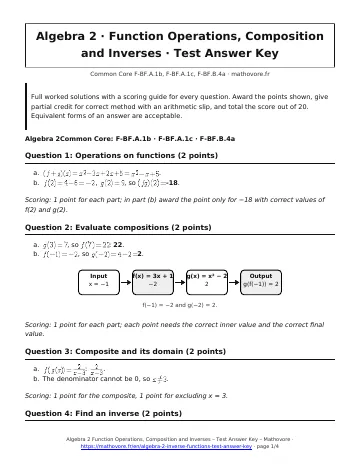
- \((f+g)(x)=x^{2}-3x+2x+5=\)\(x^{2}-x+5\).
- \(f(2)=4-6=-2\), \(g(2)=9\), so \((fg)(2)=\)-18.
Scoring: 1 point for each part; in part (b) award the point only for −18 with correct values of f(2) and g(2).
Question 2: Evaluate compositions (2 points)
- \(g(3)=7\), so \(f(7)=22\): 22.
- \(f(-1)=-2\), so \(g(-2)=4-2=\)2.
Scoring: 1 point for each part; each point needs the correct inner value and the correct final value.
Question 3: Composite and its domain (2 points)
- \(f(g(x))=\frac{2}{x-3}\): \(\frac{2}{x-3}\).
- The denominator cannot be 0, so \(x\neq 3\).
Scoring: 1 point for the composite, 1 point for excluding x = 3.
Question 4: Find an inverse (2 points)
Write \(y=\frac{5x-1}{2}\), swap: \(x=\frac{5y-1}{2}\). Then \(2x=5y-1\), \(5y=2x+1\), so \(f^{-1}(x)=\frac{2x+1}{5}\). Check: \(f(1)=2\) and \(f^{-1}(2)=\frac{5}{5}=1\).
Scoring: 1 point for swapping the variables, 1 point for the correct solved form.
Question 5: Verify inverse functions (2 points)
\(f(g(x))=\frac{3x-12}{3}+4=x-4+4=x\) (1 point).
\(g(f(x))=3(\frac{x}{3}+4)-12=x+12-12=x\) (1 point).
Both compositions equal \(x\), so they are inverses.
Scoring: 1 point for each composition worked correctly.
Question 6: Inverse from a graph (2 points)
- Swap coordinates: \(A^{\prime}(-3,0)\), \(B^{\prime}(1,2)\), \(C^{\prime}(3,3)\).
- The line has slope \(\frac{1-(-3)}{2-0}=2\) and \(y\)-intercept \(-3\), so \(f(x)=2x-3\). Swapping gives \(x=2y-3\), so \(f^{-1}(x)=\frac{x+3}{2}\).
Scoring: 1 point for the three swapped points; 1 point for the correct formula (accept an equivalent form).
Question 7: Restrict the domain (3 points)
- The horizontal line \(y=0\) meets the graph twice, at \(x=-3\) and \(x=1\), so \(f\) is not one-to-one.
- Restrict to \(x\ge -1\). Write \(x=(y+1)^{2}-4\), so \(y+1=\sqrt{x+4}\) and \(f^{-1}(x)=-1+\sqrt{x+4}\).
- Domain: \(x\ge -4\). Range: \(y\ge -1\).
Scoring: 1 point for the two-point horizontal line argument; 1 point for a valid restriction with the correct inverse; 1 point for domain and range (accept the restriction x ≤ −1 only with the matching inverse).
Question 8: Taxi fare inverse (3 points)
- Write \(F=2.50+1.75m\), so \(1.75m=F-2.50\) and \(m(F)=\frac{F-2.50}{1.75}\).
- \(m(20)=\frac{17.50}{1.75}=10\): 10 miles. Check: \(2.50+1.75(10)=20\).
- The inverse takes a fare in dollars and returns the length of the ride in miles.
Scoring: 1 point for each part.
Question 9: Growing circle (2 points)
- \(A(r(t))=\pi(4t)^{2}=\)\(16\pi t^{2}\).
- \(A(r(3))=16\pi(9)=\)\(144\pi\) square inches. Check: \(r(3)=12\) and \(\pi\cdot 144=144\pi\).
Scoring: 1 point for each part.
20 points
See every chapter on the Algebra 2 math page.