


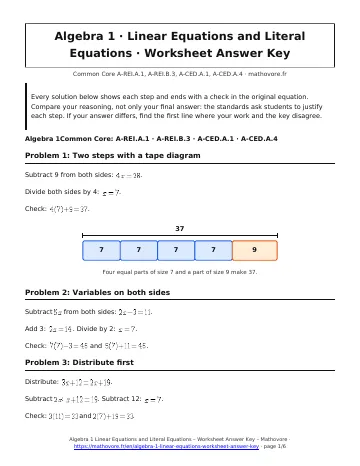
Every solution below shows each step and ends with a check in the original equation. Compare your reasoning, not only your final answer: the standards ask students to justify each step. If your answer differs, find the first line where your work and the key disagree.
Problem 1: Two steps with a tape diagram
Subtract 9 from both sides: \(4x=28\).
Divide both sides by 4: \(x=7\).
Check: \(4(7)+9=37\).
Problem 2: Variables on both sides
Subtract \(5x\) from both sides: \(2x-3=11\).
Add 3: \(2x=14\). Divide by 2: \(x=7\).
Check: \(7(7)-3=46\) and \(5(7)+11=46\).
Problem 3: Distribute first
Distribute: \(3x+12=2x+19\).
Subtract \(2x\): \(x+12=19\). Subtract 12: \(x=7\).
Check: \(3(11)=33\) and \(2(7)+19=33\).
Problem 4: Fractional coefficient
Add 5: \(\frac{2}{3}x=12\).
Multiply by the reciprocal \(\frac{3}{2}\): \(x=12\cdot\frac{3}{2}\), so \(x=18\).
Check: \(\frac{2}{3}(18)-5=12-5=7\).
Problem 5: Fractions with a common denominator
Multiply every term by the least common denominator 6: \(3x+2x=60\).
Combine: \(5x=60\). Divide by 5: \(x=12\).
Check: \(6+4=10\).
Problem 6: Fractions on both sides
Multiply both sides by 12: \(3(x+3)=4(2x-1)\).
Distribute: \(3x+9=8x-4\). Subtract \(3x\): \(9=5x-4\). Add 4: \(13=5x\).
Divide by 5: \(x=\frac{13}{5}\).
Check: \(\frac{13/5+3}{4}=\frac{28/5}{4}=\frac{7}{5}\) and \(\frac{26/5-1}{3}=\frac{21/5}{3}=\frac{7}{5}\).
Problem 7: Decimals on both sides
Subtract \(0.4x\): \(1.2=0.3x-0.3\). Add 0.3: \(1.5=0.3x\).
Divide by 0.3: \(x=5\).
Check: \(0.4(5)+1.2=3.2\) and \(0.7(5)-0.3=3.2\).
Problem 8: Give the reasons
Step 2: distributive property. Step 3: combine like terms. Step 4: subtraction property of equality (subtract \(x\) from both sides). Step 5: addition property of equality (add 1 to both sides).
Check: \(x=8\) gives \(2(5)+5=15\) and \(8+7=15\).
Problem 9: Find the error
Jamal multiplied only the first term. The distributive property gives \(3x-6=12\).
Add 6: \(3x=18\). Divide by 3: \(x=6\).
Check: \(3(6-2)=12\).
Problem 10: No solution or not?
Distribute: \(2x+6=2x+5\). Subtract \(2x\): \(6=5\).
This is false for every \(x\), so the equation has no solution.
Problem 11: Infinitely many solutions?
Distribute and combine: \(4x-8+3=4x-5\), so \(4x-5=4x-5\).
Both sides are identical, so the statement is always true: infinitely many solutions (all real numbers).
Test \(x=0\): \(-5=-5\).
Problem 12: Solve by graphing
The lines cross at \((2,3)\), so \(x=2\).
Algebra: add \(x\): \(3x-1=5\); add 1: \(3x=6\); divide: \(x=2\).
Problem 13: Solve for the height
Multiply both sides by 2: \(2A=bh\). Divide by \(b\): \(h=\frac{2A}{b}\).
Substitute: \(h=\frac{2(36)}{9}=8\).
Problem 14: Solve for width
Subtract \(2l\): \(P-2l=2w\). Divide by 2: \(w=\frac{P-2l}{2}\).
Substitute: \(w=\frac{50-30}{2}=10\).
Problem 15: Standard form to y
Subtract \(2x\): \(3y=12-2x\). Divide every term by 3: \(y=4-\frac{2}{3}x\).
When \(x=3\): \(y=4-2=2\). Check: \(2(3)+3(2)=12\).
Problem 16: Temperature formula
Multiply by \(\frac{9}{5}\): \(\frac{9}{5}C=F-32\). Add 32: \(F=\frac{9}{5}C+32\).
Substitute \(C=35\): \(F=63+32=95\), so \(35^{\circ}\text{C}=95^{\circ}\text{F}\).
Problem 17: Taxi fare
Let \(m\) be the miles: \(3.50+2.25m=17\).
Subtract 3.50: \(2.25m=13.50\). Divide: \(m=6\) miles.
Check: \(3.50+2.25(6)=17\).
Problem 18: Gym plans
Let \(n\) be months: \(60+25n=40n\).
Subtract \(25n\): \(60=15n\). Divide: \(n=4\) months.
Cost: \(60+25(4)=160\) and \(40(4)=160\), so \(\$160\) each.
Problem 19: Garden fence
Let \(w\) be the width, so the length is \(2w+3\).
Perimeter: \(2(w+2w+3)=54\), so \(6w+6=54\). Subtract 6 and divide: \(w=8\).
Width 8 ft, length 19 ft. Check: \(2(8+19)=54\).
Problem 20: Consecutive odd integers
Let the integers be \(n\), \(n+2\), \(n+4\).
\(3n+6=87\), so \(3n=81\) and \(n=27\).
27, 29 and 31. Check: \(27+29+31=87\).
Problem 21: Trapezoid base
Multiply by 2: \(2A=(b_1+b_2)h\). Divide by \(h\): \(\frac{2A}{h}=b_1+b_2\). Subtract \(b_2\): \(b_1=\frac{2A}{h}-b_2\).
Substitute: \(b_1=\frac{168}{8}-9=21-9=12\).
Problem 22: Shopping with fractions
Let \(s\) be his savings: \(s-\frac{s}{3}-\frac{s}{4}=35\).
Multiply by 12: \(12s-4s-3s=420\), so \(5s=420\) and \(s=\$84\).
Check: \(84-28-21=35\).
See every chapter on the Algebra 1 math page.