



Worked solutions and scoring guides for all eight questions, 20 points in total. Award each point separately. Accept any correct equivalent form, such as 1.25 for a quarterly rate written as a decimal, as long as the work is clear.
Question 1: Table to equation (2 points)
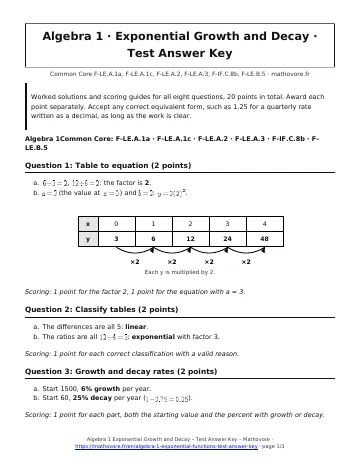
- \(6: 3=2\), \(12: 6=2\): the factor is 2.
- \(a=3\) (the value at \(x=0\)) and \(b=2\): \(y=3(2)^{x}\).
Scoring: 1 point for the factor 2, 1 point for the equation with a = 3.
Question 2: Classify tables (2 points)
- The differences are all 5: linear.
- The ratios are all \(12: 4=3\): exponential with factor 3.
Scoring: 1 point for each correct classification with a valid reason.
Question 3: Growth and decay rates (2 points)
- Start 1500, 6% growth per year.
- Start 60, 25% decay per year (\(1-0.75=0.25\)).
Scoring: 1 point for each part, both the starting value and the percent with growth or decay.
Question 4: Write and use exponential models (3 points)
- \(P(t)=8000(1.025)^{t}\)
- \(8000(1.025)^{10}=8000\times 1.2801\approx\)\(10,241\) people.
- \(V(t)=18000(0.88)^{t}\)
Scoring: 1 point for each part. In (a) and (c), 0 points if the factor is 2.5 or 12 or 0.12.
Question 5: Reading an exponential graph (3 points)
- \(a=4\) (the \(y\)-intercept) and \(b=2: 4=\frac{1}{2}\).
- \(y=4(\frac{1}{2})^{x}\). Check: \(4(\frac{1}{2})^{2}=1\).
- \(y\) decreases and gets closer and closer to 0 but never reaches it.
Scoring: 1 point for a and b, 1 point for the equation, 1 point for describing decay toward 0 without reaching it.
Question 6: Compound interest (3 points)
- \(P=3000\), \(r=0.04\), \(n=4\), \(t=2\): \(A=3000(1+\frac{0.04}{4})^{8}=3000(1.01)^{8}\).
- \(1.01^{8}\approx1.082857\), so \(A\approx\)\(\$3,248.57\).
- \(3248.57-3000=\)\(\$248.57\).
Scoring: 1 point for correct substitution (n = 4, exponent 8), 1 point for the balance, 1 point for the interest.
Question 7: Exponential versus linear (3 points)
- Curve A: it curves upward and multiplies by 3 for each step in \(x\); Curve B is a straight line that adds 10 each step.
- \(x=3\): \(32>27\). \(x=4\): \(81>42\). The first whole number is \(x=4\).
- Each step adds 10 to the line, but each step multiplies Curve A by 3, adding at least \(2\cdot3^{4}=162\) at the next step. The gap only widens.
Scoring: 1 point for Curve A with a reason, 1 point for x = 4 with both values shown, 1 point for an explanation that compares constant addition with multiplication.
Question 8: Interpret a model (2 points)
- 1200 is the number of subscribers at launch (\(t=0\)). 1.15 means the count grows to 115% each month, a 15% increase per month.
- \(1200(1.15)^{3}=1200\times 1.520875=\)\(1,825\) subscribers.
Scoring: 1 point for both meanings, 1 point for 1,825.
20 points
See every chapter on the Algebra 1 math page.