



Use this answer key and scoring guide to grade the test out of 20 points. Each solution shows the full reasoning, and the scoring notes explain where partial credit applies. Accept equivalent forms of an answer, such as 0.25 and 25%, as long as the interpretation is correct.
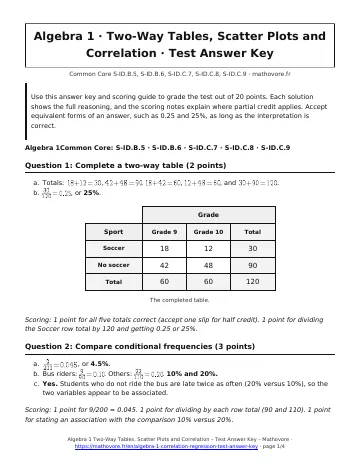
Question 1: Complete a two-way table (2 points)
- Totals: \(18+12=30\), \(42+48=90\), \(18+42=60\), \(12+48=60\), and \(30+90=120\).
- \(\frac{30}{120}=0.25\), or 25%.
Scoring: 1 point for all five totals correct (accept one slip for half credit). 1 point for dividing the Soccer row total by 120 and getting 0.25 or 25%.
Question 2: Compare conditional frequencies (3 points)
- \(\frac{9}{200}=0.045\), or 4.5%.
- Bus riders: \(\frac{9}{90}=0.10\). Others: \(\frac{22}{110}=0.20\). 10% and 20%.
- Yes. Students who do not ride the bus are late twice as often (20% versus 10%), so the two variables appear to be associated.
Scoring: 1 point for 9/200 = 0.045. 1 point for dividing by each row total (90 and 110). 1 point for stating an association with the comparison 10% versus 20%.
Question 3: Describe a scatter plot (2 points)
- The association is negative (older laptops cost less), strong and linear.
- r = -0.98: the points fall close to a straight line (calculated \(r\approx -0.98\)).
Scoring: 1 point for naming direction, strength and form (any two correct earn half credit). 1 point for -0.98 with a reason based on the negative direction and tight pattern.
Question 4: Line of fit and prediction (3 points)
- Slope: \(\frac{48-30}{8-2}=\frac{18}{6}=3\). Then \(30=3(2)+b\) gives \(b=24\). y=3x+24.
- Each extra hour of weekly practice is associated with a predicted gain of 3 words per minute.
- \(y=3(10)+24=54\). About 54 words per minute.
Scoring: 1 point for slope 3 and intercept 24 (half credit for a correct slope only). 1 point for a statement with units and the phrase predicted change per hour. 1 point for 54.
Question 5: Compute residuals (3 points)
-
x Actual Predicted Residual 2 15 13 +2 4 17 18 -1 6 26 23 +3 8 27 28 -1 - The largest positive residual is +3, so (6, 26) is farthest above the line.
Scoring: 1 point for four correct predicted values (13, 18, 23, 28). 1 point for four correct residuals (actual minus predicted: 2, -1, 3, -1). 1 point for naming (6, 26).
Question 6: Interpret a residual plot (2 points)
- No. The residuals form a clear arch (negative, then positive, then negative) instead of a random scatter, so the data are curved and a quadratic model is likely better.
- The residuals would be scattered randomly above and below zero with no pattern.
Scoring: 1 point for answering no and citing the arch or non-random pattern. 1 point for describing random scatter around zero.
Question 7: Interpret the correlation coefficient (2 points)
- The relationship is negative and strong: students who play more tend to have a lower GPA.
- The first study. Strength depends on the distance from 0, and \(|-0.84|=0.84\) is greater than \(0.31\).
Scoring: 1 point for negative and strong. 1 point for choosing the first study using absolute values (or distance from 0), not the sign.
Question 8: Correlation and causation (2 points)
- No. Correlation does not prove causation. Both quantities can increase because of something else.
- The size of the fire: bigger fires need more trucks and also cause more damage.
Scoring: 1 point for no with the reason that correlation is not causation. 1 point for a reasonable lurking variable such as fire size or severity.
Question 9: Extrapolation (1 point)
\(y=-14(10)+100=-40\). A battery cannot be at -40%, so the prediction is not reasonable: 10 hours is far outside the data (0 to 6 hours), which makes it an extrapolation.
Scoring: 1 point for computing -40 and explaining that it is impossible because 10 hours is an extrapolation. Award no point for a bare calculation.
20 points
See every chapter on the Algebra 1 math page.