
This grade 5 multiply whole lesson explains multiplying multi-digit whole numbers in one printable page, with definitions, a method and a worked example.
Multiplying multi-digit whole numbers means finding the product of numbers with two or more digits. The standard algorithm multiplies the top number by each digit of the bottom number, shifts every row to match that digit’s place value, and adds the rows. Estimating first shows whether the answer is reasonable.
Grade 5 Multiply Whole Lesson: key facts
- A partial product multiplies one place-value part of a factor by one part of the other factor.
- In the standard algorithm, a placeholder zero shifts the tens row one place left.
- Round each factor to one nonzero digit to estimate a product quickly.
- A zero inside a factor still holds a place and must be handled in each row.
- The area model and the standard algorithm give the same partial products.
What does it mean to multiply multi-digit numbers?
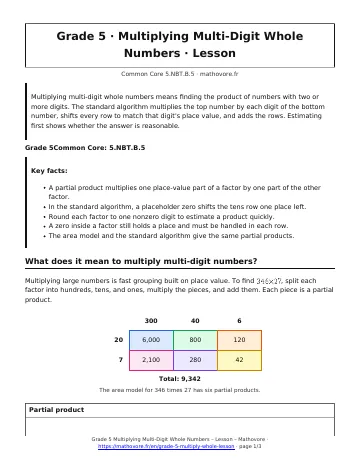
Multiplying large numbers is fast grouping built on place value. To find \(346 \times 27\), split each factor into hundreds, tens, and ones, multiply the pieces, and add them. Each piece is a partial product.
A partial product is the product of one part of a factor and one part of the other factor, such as \(40 \times 20 = 800\). Add all the partial products to get the full product.
How does the standard algorithm work?
The standard algorithm records the same partial products in a short vertical form. Each digit of the bottom number gets its own row, and its place value decides how far the row shifts left.
- Line up the digits by place value, with the larger number on top.
- Multiply 346 by the 7 ones: \(346 \times 7 = 2{,}422\).
- Write a placeholder zero, then multiply 346 by the 2 tens: \(346 \times 2 = 692\), so the row reads 6,920.
- Add the rows: \(2{,}422 + 6{,}920 = 9{,}342\).
| Digit in 27 | Its value | Row |
|---|---|---|
| 7 | 7 ones | 2,422 |
| 2 | 2 tens = 20 | 6,920 |
How can you tell whether a product makes sense?
Round each factor to one nonzero digit and multiply. Since 346 is close to 300 and 27 is close to 30, \(300 \times 30 = 9{,}000\). The exact answer, 9,342, is near 9,000, so it is reasonable. An answer like 934 or 93,420 would be ten times too small or too big.
What happens when a factor has zeros?
A zero is still a digit, so it holds its place. For \(408 \times 6\): \(8 \times 6 = 48\), write 8 and carry 4; \(0 \times 6 = 0\), plus 4 is 4; \(4 \times 6 = 24\). The product is 2,448.
Try a word problem. A theater has 18 rows with 126 seats in each row.
\(126 \times 8 = 1{,}008\) and \(126 \times 10 = 1{,}260\), so the theater has \(1{,}008 + 1{,}260 = 2{,}268\) seats.
Multiplying Multi-Digit Whole Numbers: frequently asked questions
Why do you write a zero in the second row?
The digit in the tens place stands for tens, so its row is worth ten times as much. The zero keeps every digit of that row in the correct place value column.
How do you multiply a four-digit number by a two-digit number?
Multiply the four-digit number by the ones digit, then by the tens digit with a placeholder zero. Add the two rows. The method is the same as for smaller numbers, with more carrying.
Does the order of the factors matter?
No. Multiplying 346 by 27 gives the same product as multiplying 27 by 346. Putting the number with more digits on top usually means fewer rows to write.
What is the difference between an area model and the standard algorithm?
The area model shows every partial product in its own box. The standard algorithm combines the partial products for each digit into one row. Both use place value and give the same answer.
How can I check that my product is correct?
Estimate by rounding each factor to one nonzero digit, then see whether your answer is close. You can also multiply the factors in the opposite order and compare the results.
How to use this grade 5 multiply whole lesson
Use this grade 5 multiply whole lesson before the worksheet, then check what you learned with the quiz.

See every chapter on the Grade 5 math page.