This algebra 1 systems worksheet answer key solves all 24 problems of the systems of linear equations worksheet step by step.
Every solution below shows the setup, the algebra and a check in the original equations. Compare each step with your own work, and look at the graphs to see why the algebra and the picture agree. Mark an answer correct only when the whole pair matches.
Algebra 1 Systems Worksheet Answer Key: problems 1–5
Problem 1: Check an ordered pair
Substitute \(x=3\) and \(y=2\) into each equation.
First equation: \(3+2=5\). True.
Second equation: \(2(3)-2=6-2=4\). True.
The pair makes both equations true, so yes, \((3, 2)\) is a solution.
Problem 2: Test a second pair
First equation: \(3(4)-1=12-1=11\). True.
Second equation: \(4+2(1)=4+2=6\), and \(6\neq 7\). False.
The pair fails the second equation, so no, \((4, 1)\) is not a solution.
Problem 3: Read a graph
The lines cross at \((2, 3)\).
Check in \(y=x+1\): \(3=2+1\). True.
Check in \(y=-x+5\): \(3=-2+5\). True.
The solution is \((2, 3)\).
Problem 4: Solve by graphing
Line 1 has y-intercept \(-3\) and slope \(2\): it passes through \((0, -3)\), \((1, -1)\) and \((2, 1)\).
Line 2 has y-intercept \(3\) and slope \(-1\): it passes through \((0, 3)\), \((1, 2)\) and \((2, 1)\).
They cross at \((2, 1)\). Check: \(2(2)-3=1\) and \(-2+3=1\).
The solution is \((2, 1)\).
Problem 5: Substitute y = 3x
Replace \(y\) with \(3x\): \(x+3x=20\).
Combine: \(4x=20\), so \(x=5\).
Then \(y=3(5)=15\).
Check: \(5+15=20\). True.
The solution is \((5, 15)\).
Algebra 1 Systems Worksheet Answer Key: problems 6–10
Problem 6: Substitute an expression
Replace \(y\) with \(x+4\): \(2x+(x+4)=19\).
Combine: \(3x+4=19\), so \(3x=15\) and \(x=5\).
Then \(y=5+4=9\).
Check: \(2(5)+9=19\). True.
The solution is \((5, 9)\).
Problem 7: Isolate a variable first
Solve the first equation for \(x\): \(x=11-2y\).
Substitute into the second: \(3(11-2y)-y=12\).
Distribute: \(33-6y-y=12\), so \(33-7y=12\) and \(7y=21\). Then \(y=3\).
Then \(x=11-2(3)=5\).
Check: \(5+6=11\) and \(15-3=12\).
The solution is \((5, 3)\).
Problem 8: Substitution with a fraction
Substitute: \(3x+2(\frac{1}{2}x+3)=18\).
Distribute: \(3x+x+6=18\), so \(4x=12\) and \(x=3\).
Then \(y=\frac{1}{2}(3)+3=\frac{9}{2}\).
Check: \(3(3)+2(\frac{9}{2})=9+9=18\).
The solution is \((3, \frac{9}{2})\).
Problem 9: Add the equations
The \(y\)-terms are opposites. Add the equations: \(2x=12\), so \(x=6\).
Substitute into \(x+y=9\): \(6+y=9\), so \(y=3\).
Check: \(6-3=3\). True.
The solution is \((6, 3)\).
Problem 10: Eliminate y
Add the equations: \(8x=32\), so \(x=4\).
Substitute into the first equation: \(3(4)+2y=16\), so \(2y=4\) and \(y=2\).
Check the second equation: \(5(4)-2(2)=20-4=16\).
The solution is \((4, 2)\).
Algebra 1 Systems Worksheet Answer Key: problems 11–15
Problem 11: Multiply one equation
Multiply the second equation by \(3\): \(6x-3y=3\).
Add to the first equation: \(10x=20\), so \(x=2\).
Substitute into \(2x-y=1\): \(4-y=1\), so \(y=3\).
Check the first equation: \(4(2)+3(3)=8+9=17\).
The solution is \((2, 3)\).
Problem 12: Multiply both equations
Multiply the first equation by \(2\): \(6x+8y=2\). Multiply the second by \(3\): \(6x+15y=9\).
Subtract the first from the second: \(7y=7\), so \(y=1\).
Substitute into \(3x+4y=1\): \(3x+4=1\), so \(x=-1\).
Check the second equation: \(2(-1)+5(1)=3\).
The solution is \((-1, 1)\).
Problem 13: Parallel lines
Both lines have slope \(2\), but the y-intercepts are \(1\) and \(-4\). The lines are parallel and never meet.
Setting the expressions equal gives \(2x+1=2x-4\), which simplifies to \(1=-4\). That is false for every \(x\).
The system has no solution.
Problem 14: Same line twice
Divide every term of the first equation by \(2\): \(x+2y=4\).
This is exactly the second equation, so both equations describe the same line.
Every point on the line, such as \((0, 2)\) or \((4, 0)\), is a solution. The system has infinitely many solutions.
Problem 15: Classify three systems
- Rewrite \(6x-2y=4\): \(-2y=-6x+4\), so \(y=3x-2\). It is the same line: infinitely many solutions.
- Rewrite \(2x+2y=5\): \(y=-x+\frac{5}{2}\). Same slope \(-1\), different intercepts \(1\) and \(\frac{5}{2}\): no solution.
- The slopes \(1\) and \(2\) differ, so there is one solution. Setting \(x+3=2x+3\) gives \(x=0\), so the solution is \((0, 3)\).
Algebra 1 Systems Worksheet Answer Key: problems 16–20
Problem 16: Why elimination works
- Adding left sides and right sides: \((x+y)+(x-y)=3+1\), which simplifies to \(2x=4\).
- Substitute \(x=2\): \(2(2)=4\). True.
- If a pair makes \(A=B\) true and \(C=D\) true, then adding equal amounts to equal amounts gives \(A+C=B+D\). The pair therefore makes the sum true too.
Problem 17: Line and parabola
The graphs meet at \((-2, 4)\) and \((3, 9)\), so the solutions are the x-coordinates \(x=-2\) and \(x=3\).
Verify \(x=-2\): \((-2)^{2}=4\) and \(-2+6=4\).
Verify \(x=3\): \(3^{2}=9\) and \(3+6=9\).
The solutions are \(x=-2\) and \(x=3\).
Problem 18: Line and exponential
For \(2^{x}\): \(1, 2, 4, 8\). For \(6-x\): \(6, 5, 4, 3\). The values match only at \(x=2\), where both equal \(4\).
The function \(2^{x}\) keeps increasing and \(6-x\) keeps decreasing, so they can meet only once.
The solution is \(x=2\).
Problem 19: Ticket sales
Let \(a\) be adult tickets and \(s\) student tickets: \(a+s=120\) and \(8a+5s=795\).
Substitute \(s=120-a\): \(8a+5(120-a)=795\), so \(3a+600=795\) and \(3a=195\). Then \(a=65\).
Then \(s=120-65=55\).
Check: \(8(65)+5(55)=520+275=795\).
65 adult tickets and 55 student tickets.
Problem 20: Coffee blend
Let \(x\) be pounds at \(\$6\) and \(y\) pounds at \(\$9\). The blend costs \(7\times 30=210\) dollars.
\(x+y=30\) and \(6x+9y=210\).
Substitute \(y=30-x\): \(6x+9(30-x)=210\), so \(270-3x=210\) and \(x=20\). Then \(y=10\).
Check: \(6(20)+9(10)=120+90=210\).
20 pounds at \(\$6\) and 10 pounds at \(\$9\).
Algebra 1 Systems Worksheet Answer Key: problems 21–24
Problem 21: Phone plans
Set the costs equal: \(20+0.10m=5+0.25m\). Then \(15=0.15m\), so \(m=100\).
Cost: \(20+0.10(100)=30\) dollars, and \(5+0.25(100)=30\) dollars.
At 150 minutes, Plan A costs \(20+15=35\) dollars and Plan B costs \(5+37.5=42.5\) dollars.
The plans match at 100 minutes for \(\$30\); Plan A is cheaper at 150 minutes.
Problem 22: Animals on a farm
Let \(c\) be chickens and \(w\) cows: \(c+w=40\) and \(2c+4w=110\).
Substitute \(c=40-w\): \(2(40-w)+4w=110\), so \(80+2w=110\) and \(w=15\).
Then \(c=25\).
Check: \(2(25)+4(15)=50+60=110\).
25 chickens and 15 cows.
Problem 23: Boat and current
Downstream speed: \(24: 2=12\) mph. Upstream speed: \(24: 3=8\) mph.
Let \(b\) be the boat speed and \(c\) the current: \(b+c=12\) and \(b-c=8\).
Add: \(2b=20\), so \(b=10\). Then \(c=2\).
Check: \(10+2=12\) and \(10-2=8\).
The boat goes 10 mph in still water and the current is 2 mph.
Problem 24: Saving for a bike
After \(w\) weeks: Maya has \(12+6w\) and Jamal has \(40+2w\).
Set equal: \(12+6w=40+2w\), so \(4w=28\) and \(w=7\).
Amount: \(12+6(7)=54\) and \(40+2(7)=54\).
After 7 weeks, each has \(\$54\).
How to use this algebra 1 systems worksheet answer key
Read this algebra 1 systems worksheet answer key after trying each problem yourself, and redo any problem you missed.

Printable PDF · Worksheet Answer Key
Algebra 1 Systems of Linear Equations worksheet answer key
Download the PDF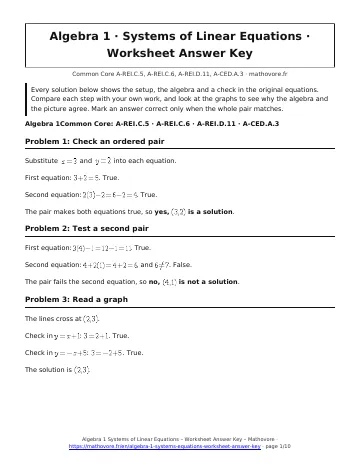
See every chapter on the Algebra 1 math page.