


This algebra 1 expressions test answer key gives the full solution and the scoring guide for each of the 8 test questions on interpreting expressions and real numbers.
Use this key to grade the test. Each solution lists the work and a scoring guide, so partial credit can be given when the setup is right but a calculation slips. The total possible score is 20 points.
Algebra 1 Expressions Test Answer Key: questions 1–5
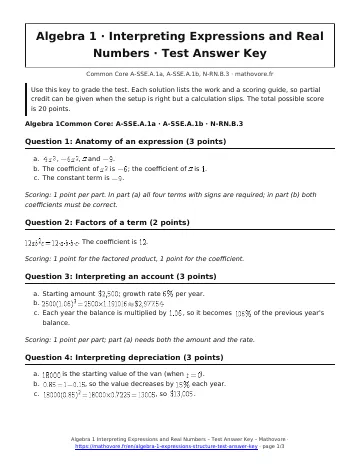
Question 1: Anatomy of an expression (3 points)
- \(4x^{3}\), \(-6x^{2}\), \(x\) and \(-9\).
- The coefficient of \(x^{2}\) is \(-6\); the coefficient of \(x\) is \(1\).
- The constant term is \(-9\).
Scoring: 1 point per part. In part (a) all four terms with signs are required; in part (b) both coefficients must be correct.
Question 2: Factors of a term (2 points)
\(12ab^{2}c=12\cdot a\cdot b\cdot b\cdot c\). The coefficient is \(12\).
Scoring: 1 point for the factored product, 1 point for the coefficient.
Question 3: Interpreting an account (3 points)
- Starting amount \(\$2,500\); growth rate \(6\%\) per year.
- \(2500(1.06)^{3}=2500\times 1.191016\approx\$2,977.54\).
- Each year the balance is multiplied by \(1.06\), so it becomes \(106\%\) of the previous year’s balance.
Scoring: 1 point per part; part (a) needs both the amount and the rate.
Question 4: Interpreting depreciation (3 points)
- \(18000\) is the starting value of the van (when \(t=0\)).
- \(0.85=1-0.15\), so the value decreases by \(15\%\) each year.
- \(18000(0.85)^{2}=18000\times 0.7225=13005\), so \(\$13,005\).
Scoring: 1 point per part.
Question 5: Classify and justify (3 points)
- Irrational: a rational plus an irrational is irrational.
- Irrational: a nonzero rational times an irrational is irrational.
- \(\sqrt{3}\cdot\sqrt{12}=\sqrt{36}=6\), rational.
Scoring: for each part, award the point only when the classification and a valid reason are both given.
Algebra 1 Expressions Test Answer Key: questions 6–8
Question 6: Sum of irrationals (2 points)
No. For example, \((3+\sqrt{7})+(5-\sqrt{7})=8\), which is rational, because the irrational parts cancel.
Scoring: 1 point for no, 1 point for a correct example with its sum.
Question 7: A square's perimeter (2 points)
- \(\sqrt{72}=\sqrt{36\cdot 2}=6\sqrt{2}\text{ in}\).
- \(4\cdot 6\sqrt{2}=24\sqrt{2}\approx 33.94\text{ in}\), irrational.
Scoring: 1 point per part.
Question 8: Total cost expression (2 points)
The terms are \(1.07p\) and \(4.95\). The factor \(1.07\) means the price plus \(7\%\) tax; \(4.95\) is a flat shipping charge.
\(T=1.07(30)+4.95=32.10+4.95=37.05\), so \(\$37.05\).
Scoring: 1 point for the terms and the two interpretations, 1 point for \(\$37.05\).
Scoring summary
20 points: add the points of every question of this algebra 1 expressions test answer key.
How to use this algebra 1 expressions test answer key
Use this algebra 1 expressions test answer key to score the test fairly and to see which skills need more practice.

See every chapter on the Algebra 1 math page.