Key takeaway: This precalculus polar parametric test answer key explains every solution and the grading rubric for the 20-point unit test. Teachers can award each point as listed, while students see where marks were won or lost. Equivalent exact forms count, and so does any polar name that obeys the stated restrictions. Standards N-CN.B.4 and F-IF.C.7 frame the nine questions, and the rubric notes explain each tricky decision.
Worked solutions and a scoring guide for the 20-point test. Award points exactly as described, and accept equivalent exact forms and equivalent polar names for a point that meet the stated restrictions.
Precalculus Polar Parametric Test Answer Key: questions 1–5
1. Polar to rectangular (2 points)
- \(x=8\cos\frac{5\pi}{6}=-4\sqrt{3}\), \(y=8\sin\frac{5\pi}{6}=4\): \((-4\sqrt{3},4)\)
- \(x=3\sqrt{2}\cdot\frac{\sqrt{2}}{2}=3\), \(y=3\sqrt{2}\cdot(-\frac{\sqrt{2}}{2})=-3\): \((3,-3)\)
Scoring: 1 point for each correct point; both coordinates must be correct.
2. Rectangular to polar (2 points)
- \(r=\sqrt{3+1}=2\); \(\tan\theta=-\frac{1}{\sqrt{3}}\) in Quadrant II, so \(\theta=\frac{5\pi}{6}\): \((2,\frac{5\pi}{6})\)
- The point is on the negative y-axis: \((7,\frac{3\pi}{2})\)
Scoring: 1 point for each correct pair (correct r and correct angle).
3. Convert equations (2 points)
- \(x^{2}+y^{2}=4x\) gives \(r^{2}=4r\cos\theta\): \(r=4\cos\theta\)
- \(r^{2}=-6r\cos\theta\) gives \(x^{2}+y^{2}=-6x\): \((x+3)^{2}+y^{2}=9\)
Scoring: 1 point for each equation; an equivalent form such as \(x^{2}+y^{2}=-6x\) earns full credit.
4. Identify a rose (2 points)
- 4 petals
- The tips lie on the diagonals, not on the axes, so the curve uses sine: \(r=3\sin 2\theta\) (4 petals needs \(n=2\), length \(a=3\)).
Scoring: 1 point for the petal count; 1 point for the equation with \(a=3\) and \(n=2\) and sine.
5. Analyze a limaçon (2 points)
- \(a=1< b=2\): limaçon with an inner loop
- \(r=3\), \(r=1\), \(r=-1\): 3, 1, -1
Scoring: 1 point for the type; 1 point for all three values (award 0 if one value is wrong).
Precalculus Polar Parametric Test Answer Key: questions 6–9
6. Eliminate the parameter (2 points)
- \(t=\frac{x-3}{2}\), so \(y=\frac{(x-3)^{2}}{4}\)
- \(x=-1\), \(y=4\): \((-1,4)\). Check: \(\frac{(-4)^{2}}{4}=4\).
Scoring: 1 point for each part.
7. Parametric circle (3 points)
- \(\cos t=\frac{x+1}{2}\), \(\sin t=\frac{y-3}{2}\), so \((x+1)^{2}+(y-3)^{2}=4\)
- Center \((-1,3)\), radius 2
- A circle through \((1,3)\), \((-1,5)\), \((-3,3)\), \((-1,1)\), traced counterclockwise from \((1,3)\).
Scoring: 1 point for each part; in part (c) the circle and the direction must both be shown.
8. Projectile motion (3 points)
- \(48t-16t^{2}=16t(3-t)=0\): \(t=3\) s
- \(x=15(3)=\) 45 ft
- The vertex is at \(t=1.5\): \(y=72-36=\) 36 ft
Scoring: 1 point for each part.
9. Two hikers (2 points)
- The rays differ by \(75^{\circ}-15^{\circ}=60^{\circ}\). \(d^{2}=36+64-2(6)(8)\cos 60^{\circ}=100-48=52\): \(d=2\sqrt{13}\) mi
- \(\approx 7.21\) mi
Scoring: 1 point for each part.
Scoring summary
20 points: add the points of every question of this precalculus polar parametric test answer key.
How do you award partial credit?
Each part of Question 1 is worth 1 point. Give the point for a correct exact coordinate, even if the decimal check is missing. However, withhold it when the angle is right but the sign of \(x\) is wrong, because that shows a quadrant error.
Which equivalent answers should you accept?
For Question 2, \((2,\frac{5\pi}{6})\) is the expected name for \((-\sqrt{3},1)\). A name such as \((-2,\frac{11\pi}{6})\) names the same point, but it breaks the \(r>0\) rule. So do not give the point.
What does a full-credit answer for Question 8 look like?
The ball lands when \(48t-16t^2=0\), so \(t=3\) s. Then \(x=15\cdot 3=45\) ft. A full answer includes both numbers with units. In contrast, a bare \(t=3\) earns only part of the credit.
Why use a precalculus polar parametric test key?
The key tells you which skill failed. Question 7 gives \((x+1)^2+(y-3)^2=4\), so a wrong center signals a sign mistake when moving terms.
How do you grade the two-point hiker question?
Question 9 places a ranger station at the pole, with hikers at known distances and angles. Award one point for the angle difference, then one point for the final distance. If a student subtracts the radii instead, mark it wrong, because that ignores the angle between the hikers.
How can students use these solutions?
Rewrite every lost question on a fresh page, closing the key first. Then compare your new work with the solution line by line. As a final step, explain the error aloud to a partner, since teaching it locks it in.

Printable PDF · Test Answer Key
Precalculus Polar Coordinates and Parametric Equations test answer key
Download the PDF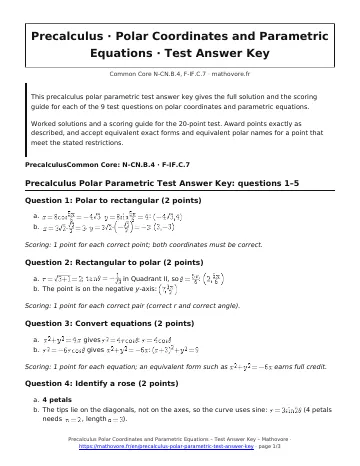
See every chapter on the Precalculus math page.