



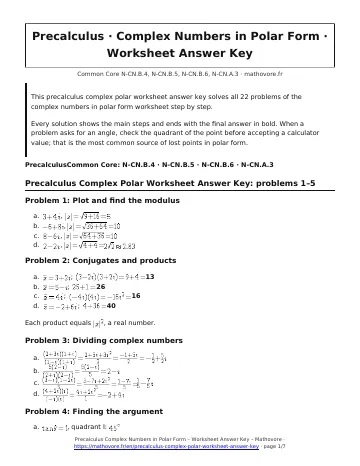
This precalculus complex polar worksheet answer key solves all 22 problems of the complex numbers in polar form worksheet step by step.
Every solution shows the main steps and ends with the final answer in bold. When a problem asks for an angle, check the quadrant of the point before accepting a calculator value; that is the most common source of lost points in polar form.
Precalculus Complex Polar Worksheet Answer Key: problems 1–5
Problem 1: Plot and find the modulus
- \(3+4i\), \(|z|=\sqrt{9+16}=\)\(5\)
- \(-6+8i\), \(|z|=\sqrt{36+64}=\)\(10\)
- \(8-6i\), \(|z|=\sqrt{64+36}=\)\(10\)
- \(2-2i\), \(|z|=\sqrt{4+4}=\)\(2\sqrt{2}\approx 2.83\)
Problem 2: Conjugates and products
- \(\overline{z}=3+2i\); \((3-2i)(3+2i)=9+4=\)13
- \(\overline{z}=5-i\); \(25+1=\)26
- \(\overline{z}=4i\); \((-4i)(4i)=-16i^{2}=\)16
- \(\overline{z}=-2+6i\); \(4+36=\)40
Each product equals \(|z|^{2}\), a real number.
Problem 3: Dividing complex numbers
- \(\frac{(2+3i)(1+i)}{(1-i)(1+i)}=\frac{2+5i+3i^{2}}{2}=\frac{-1+5i}{2}=\)\(-\frac{1}{2}+\frac{5}{2}i\)
- \(\frac{5(2-i)}{(2+i)(2-i)}=\frac{5(2-i)}{5}=\)\(2-i\)
- \(\frac{(3-i)(1-2i)}{5}=\frac{3-7i+2i^{2}}{5}=\frac{1-7i}{5}=\)\(\frac{1}{5}-\frac{7}{5}i\)
- \(\frac{(4+2i)(i)}{(-i)(i)}=\frac{4i+2i^{2}}{1}=\)\(-2+4i\)
Problem 4: Finding the argument
- \(\tan\theta=1\), quadrant I: \(45^{\circ}\)
- Reference angle \(45^{\circ}\), quadrant II: \(135^{\circ}\)
- \(\tan\theta=\frac{-1}{-\sqrt{3}}=\frac{1}{\sqrt{3}}\), reference \(30^{\circ}\), quadrant III: \(180^{\circ}+30^{\circ}=\)\(210^{\circ}\)
- \(\tan\theta=-\sqrt{3}\), reference \(60^{\circ}\), quadrant IV: \(360^{\circ}-60^{\circ}=\)\(300^{\circ}\)
Problem 5: Rectangular to polar form
- \(r=\sqrt{27+9}=6\), \(\tan\theta=\frac{3}{3\sqrt{3}}=\frac{1}{\sqrt{3}}\), \(\theta=30^{\circ}\): \(6(\cos 30^{\circ}+i\sin 30^{\circ})\)
- \(r=\sqrt{8}=2\sqrt{2}\), quadrant II, \(\theta=135^{\circ}\): \(2\sqrt{2}(\cos 135^{\circ}+i\sin 135^{\circ})\)
- \(r=5\), on the negative imaginary axis, \(\theta=270^{\circ}\): \(5(\cos 270^{\circ}+i\sin 270^{\circ})\)
- \(r=\sqrt{1+3}=2\), quadrant IV, \(\theta=300^{\circ}\): \(2(\cos 300^{\circ}+i\sin 300^{\circ})\)
Precalculus Complex Polar Worksheet Answer Key: problems 6–10
Problem 6: Polar to rectangular form
- \(4\cdot\frac{1}{2}+4\cdot\frac{\sqrt{3}}{2}i=\)\(2+2\sqrt{3}\,i\)
- \(10(-1)+10(0)i=\)\(-10\)
- \(6(-\frac{\sqrt{2}}{2})+6(-\frac{\sqrt{2}}{2})i=\)\(-3\sqrt{2}-3\sqrt{2}\,i\)
- \(2\sqrt{2}\cdot\frac{\sqrt{2}}{2}+2\sqrt{2}(-\frac{\sqrt{2}}{2})i=\)\(2-2i\)
Problem 7: Radian measure
- \(2\cdot\frac{\sqrt{3}}{2}+2\cdot\frac{1}{2}i=\)\(\sqrt{3}+i\)
- \(5(0)+5(1)i=\)\(5i\)
- \(8\cdot\frac{1}{2}+8(-\frac{\sqrt{3}}{2})i=\)\(4-4\sqrt{3}\,i\)
- \(6(-\frac{\sqrt{2}}{2})+6\cdot\frac{\sqrt{2}}{2}i=\)\(-3\sqrt{2}+3\sqrt{2}\,i\)
Problem 8: Conjugate in polar form
- Conjugation reflects across the real axis, so the modulus stays 6 and the angle changes sign: \(-50^{\circ}\), which is the same as \(310^{\circ}\). \(6(\cos 310^{\circ}+i\sin 310^{\circ})\)
- Multiply moduli, add angles: \(6\cdot 6=36\) and \(50^{\circ}+310^{\circ}=360^{\circ}\), so \(36(\cos 360^{\circ}+i\sin 360^{\circ})=\)\(36\), which equals \(|z|^{2}\).
Problem 9: Multiplying in polar form
- \(14(\cos 60^{\circ}+i\sin 60^{\circ})=\)\(7+7\sqrt{3}\,i\)
- \(12(\cos 180^{\circ}+i\sin 180^{\circ})=\)\(-12\)
- \(2(\cos 360^{\circ}+i\sin 360^{\circ})=\)\(2\)
Problem 10: Dividing in polar form
- \(4(\cos 120^{\circ}+i\sin 120^{\circ})=\)\(-2+2\sqrt{3}\,i\)
- \(2(\cos(-45^{\circ})+i\sin(-45^{\circ}))=2(\cos 315^{\circ}+i\sin 315^{\circ})=\)\(\sqrt{2}-\sqrt{2}\,i\)
- \(3(\cos\frac{\pi}{2}+i\sin\frac{\pi}{2})=\)\(3i\)
Precalculus Complex Polar Worksheet Answer Key: problems 11–15
Problem 11: Check a product two ways
- \((1+i)(\sqrt{3}+i)=\sqrt{3}+i+\sqrt{3}\,i+i^{2}=\)\((\sqrt{3}-1)+(\sqrt{3}+1)i\)
- \(z_{1}=\sqrt{2}(\cos 45^{\circ}+i\sin 45^{\circ})\), \(z_{2}=2(\cos 30^{\circ}+i\sin 30^{\circ})\), so \(z_{1}z_{2}=\)\(2\sqrt{2}(\cos 75^{\circ}+i\sin 75^{\circ})\)
- \(2\sqrt{2}\cos 75^{\circ}\approx 2.828\times 0.2588\approx 0.73\) and \(\sqrt{3}-1\approx 0.73\). They agree.
Problem 12: Rotation and scaling
\(2i(4+2i)=8i+4i^{2}=\)\(-4+8i\).
The modulus of \(z\) is \(\sqrt{20}=2\sqrt{5}\) and the modulus of the result is \(\sqrt{16+64}=4\sqrt{5}\): it doubled. The argument grew by \(90^{\circ}\) because \(2i\) has modulus 2 and argument \(90^{\circ}\).
Problem 13: Modulus of products and quotients
- \((3+4i)(5-12i)=15-36i+20i-48i^{2}=\)\(63-16i\), and \(|63-16i|=\sqrt{3969+256}=\sqrt{4225}=65\).
- \(|z_{1}|=5\) and \(|z_{2}|=13\), and \(5\times 13=65\). Verified.
- \(\frac{|z_{1}|}{|z_{2}|}=\)\(\frac{5}{13}\)
Problem 14: De Moivre's theorem: basics
- \(\cos 180^{\circ}+i\sin 180^{\circ}=\)\(-1\)
- \(2^{4}(\cos 60^{\circ}+i\sin 60^{\circ})=16(\frac{1}{2}+\frac{\sqrt{3}}{2}i)=\)\(8+8\sqrt{3}\,i\)
- \(\cos\frac{\pi}{2}+i\sin\frac{\pi}{2}=\)\(i\)
Problem 15: Powers of complex numbers
- \(r=\sqrt{2}\), \(\theta=45^{\circ}\): \((\sqrt{2})^{8}(\cos 360^{\circ}+i\sin 360^{\circ})=\)\(16\)
- \(r=\sqrt{2}\), \(\theta=-45^{\circ}\): \((\sqrt{2})^{6}[\cos(-270^{\circ})+i\sin(-270^{\circ})]=8(0+i)=\)\(8i\)
- \(r=2\), \(\theta=120^{\circ}\): \(2^{3}(\cos 360^{\circ}+i\sin 360^{\circ})=\)\(8\)
- \(r=2\), \(\theta=30^{\circ}\): \(2^{5}(\cos 150^{\circ}+i\sin 150^{\circ})=32(-\frac{\sqrt{3}}{2}+\frac{1}{2}i)=\)\(-16\sqrt{3}+16i\)
Precalculus Complex Polar Worksheet Answer Key: problems 16–20
Problem 16: Distance in the complex plane
- \(|(1+2i)-(5+5i)|=|-4-3i|=\sqrt{16+9}=\)5
- \(|(-3+4i)-(2-8i)|=|-5+12i|=\sqrt{25+144}=\)13
- \(|(7-i)-(-1+5i)|=|8-6i|=\sqrt{64+36}=\)10
Problem 17: Midpoints
- \(\frac{(1+2i)+(5+5i)}{2}=\frac{6+7i}{2}=\)\(3+3.5i\)
- \(\frac{-2+4i}{2}=\)\(-1+2i\)
- The midpoint is the average, so \(w=2(1+4i)-(3-i)=2+8i-3+i=\)\(-1+9i\). Check: \(\frac{(3-i)+(-1+9i)}{2}=1+4i\).
Problem 18: Triangle in the complex plane
\(|3+4i-0|=5\) and \(|(3+4i)-6|=|-3+4i|=5\), so two sides have length 5: isosceles. The base \(|6-0|=6\).
Perimeter \(5+5+6=\)16. The height is the imaginary part, 4, so the area is \(\frac{1}{2}(6)(4)=\)12 square units.
Problem 19: Circle in the complex plane
The distance from \(z\) to \(2+i\) is always 3, so the center is \(2+i\) and the radius is 3.
- \(|3|=3\): on the circle
- \(|-3|=3\): on the circle
- \(|3i|=3\): on the circle
- \(|2+2i|=\sqrt{8}\approx 2.83 < 3\): inside the circle
Problem 20: Robot vacuum rotation
Multiplying by \(i\) rotates by \(90^{\circ}\): \(i(2+3i)=2i+3i^{2}=\)\(-3+2i\).
For \(30^{\circ}\) multiply by \(\cos 30^{\circ}+i\sin 30^{\circ}=\frac{\sqrt{3}}{2}+\frac{1}{2}i\): real part \(\sqrt{3}-\frac{3}{2}\approx 0.23\), imaginary part \(1+\frac{3\sqrt{3}}{2}\approx 3.60\). The position is about \(0.23+3.60i\).
Check: the distance from the dock stays \(\sqrt{13}\approx 3.61\) ft.
Precalculus Complex Polar Worksheet Answer Key: problems 21–22
Problem 21: AC circuit impedance
\(|Z|=\sqrt{64+36}=\)10 ohms. Phase angle \(\tan^{-1}(\frac{6}{8})\approx\) \(36.87^{\circ}\).
\(I=\frac{120(8-6i)}{(8+6i)(8-6i)}=\frac{960-720i}{100}=\)\(9.6-7.2i\) amperes.
\(|I|=\sqrt{92.16+51.84}=\sqrt{144}=\)12 amperes, which also equals \(\frac{120}{10}\).
Problem 22: Powers: multi-step
- \(r=2\), \(\theta=-30^{\circ}\): \(2^{6}(\cos(-180^{\circ})+i\sin(-180^{\circ}))=64(-1+0i)=\)\(-64\)
- We need \(40n\) to be a multiple of 360, so the smallest positive solution of \(40n=360\) is \(n=9\) since \(40\times 9=360\). \(n=9\)
- The argument \(30n^{\circ}\) must equal \(90^{\circ}\) (or \(270^{\circ}\), and so on). \(n=1,2\) give \(30^{\circ}\) and \(60^{\circ}\), which are not on the imaginary axis; \(n=3\) gives \(90^{\circ}\): \((\sqrt{3}+i)^{3}=8i\). \(n=3\)
How to use this precalculus complex polar worksheet answer key
Read this precalculus complex polar worksheet answer key after trying each problem yourself, and redo any problem you missed.

See every chapter on the Precalculus math page.