
Key takeaway: In this grade 5 divide worksheet answer key, each solution shows partial quotients and subtraction steps, then a multiplication check, with the final answer in bold. Students who get a different quotient can recheck each subtraction and the place value of each partial quotient. The key covers all 23 problems, from area models to bead bracelets, and fits CCSS 5.NBT.B.6.
Each solution shows partial quotients and subtraction steps, then a check by multiplication. The final answer is in bold. If your quotient is different, recheck each subtraction and the place value of each partial quotient.
Grade 5 Divide Worksheet Answer Key: problems 1–5
1. Area model warm-up
- \(6 \times 100 = 600\), and \(756 – 600 = 156\).
- \(6 \times 20 = 120\), and \(156 – 120 = 36\).
- \(6 \times 6 = 36\), and \(36 – 36 = 0\).
Check: \(6 imes 126 = 756\).
126
2. Two-digit divisor
- \(15 \times 60 = 900\), and \(960 – 900 = 60\).
- \(15 \times 4 = 60\), and \(60 – 60 = 0\).
Check: \(15 imes 64 = 960\).
64
3. One-digit divisor
- \(4 \times 300 = 1{,}200\), and \(1{,}248 – 1{,}200 = 48\).
- \(4 \times 10 = 40\), and \(48 – 40 = 8\).
- \(4 \times 2 = 8\), and \(8 – 8 = 0\).
Check: \(4 imes 312 = 1{,}248\).
312
4. Place-value pattern
4,200 is 420 tens and 60 is 6 tens. \(420 : 6 = 70\).
Check: \(60 \times 70 = 4{,}200\).
70
5. Exact division
- \(24 \times 30 = 720\), and \(744 – 720 = 24\).
- \(24 \times 1 = 24\), and \(24 – 24 = 0\).
Check: \(24 imes 31 = 744\).
31
Grade 5 Divide Worksheet Answer Key: problems 6–10
6. A remainder
- \(7 \times 100 = 700\), and \(905 – 700 = 205\).
- \(7 \times 20 = 140\), and \(205 – 140 = 65\).
- \(7 \times 9 = 63\), and \(65 – 63 = 2\).
Check: \(7 imes 129 = 903\), and \(903 + 2 = 905\).
129 R 2
7. Four digits, two-digit divisor
- \(35 \times 60 = 2{,}100\), and \(2{,}415 – 2{,}100 = 315\).
- \(35 \times 9 = 315\), and \(315 – 315 = 0\).
Check: \(35 imes 69 = 2{,}415\).
69
8. Partial quotients
- \(21 \times 70 = 1{,}470\), and \(1{,}596 – 1{,}470 = 126\).
- \(21 \times 6 = 126\), and \(126 – 126 = 0\).
Check: \(21 imes 76 = 1{,}596\).
76
9. Divide 3,078 by 18
- \(18 \times 100 = 1{,}800\), and \(3{,}078 – 1{,}800 = 1{,}278\).
- \(18 \times 70 = 1{,}260\), and \(1{,}278 – 1{,}260 = 18\).
- \(18 \times 1 = 18\), and \(18 – 18 = 0\).
Check: \(18 imes 171 = 3{,}078\).
171
10. A zero in the quotient
- \(42 \times 100 = 4{,}200\), and \(4{,}284 – 4{,}200 = 84\).
- \(42 \times 2 = 84\), and \(84 – 84 = 0\).
Check: \(42 imes 102 = 4{,}284\).
102
Grade 5 Divide Worksheet Answer Key: problems 11–15
11. Divide 5,238 by 54
- \(54 \times 90 = 4{,}860\), and \(5{,}238 – 4{,}860 = 378\).
- \(54 \times 7 = 378\), and \(378 – 378 = 0\).
Check: \(54 imes 97 = 5{,}238\).
97
12. Divide with zeros
- \(25 \times 200 = 5{,}000\), and \(6{,}500 – 5{,}000 = 1{,}500\).
- \(25 \times 60 = 1{,}500\), and \(1{,}500 – 1{,}500 = 0\).
Check: \(25 imes 260 = 6{,}500\).
260
13. Estimate with compatible numbers
4,187 is close to 4,000 and 52 is close to 50. Estimate: \(4{,}000 : 50 = 80\).
- \(52 \times 80 = 4{,}160\), and \(4{,}187 – 4{,}160 = 27\).
Check: \(52 imes 80 = 4{,}160\), and \(4{,}160 + 27 = 4{,}187\).
80 R 27
The exact answer is close to the estimate, so it is reasonable.
14. A remainder with two digits
- \(31 \times 60 = 1{,}860\), and \(2{,}009 – 1{,}860 = 149\).
- \(31 \times 4 = 124\), and \(149 – 124 = 25\).
Check: \(31 imes 64 = 1{,}984\), and \(1{,}984 + 25 = 2{,}009\).
64 R 25
15. Check with multiplication
Check: \(43 \times 183 = 7{,}869\). That is not 7,863, so Diego is wrong.
- \(43 \times 100 = 4{,}300\), and \(7{,}863 – 4{,}300 = 3{,}563\).
- \(43 \times 80 = 3{,}440\), and \(3{,}563 – 3{,}440 = 123\).
- \(43 \times 2 = 86\), and \(123 – 86 = 37\).
Check: \(43 imes 182 = 7{,}826\), and \(7{,}826 + 37 = 7{,}863\).
182 R 37
Grade 5 Divide Worksheet Answer Key: problems 16–20
16. Fill the division area model
- \(24 \times 100 = 2{,}400\), and \(3{,}696 – 2{,}400 = 1{,}296\).
- \(24 \times 50 = 1{,}200\), and \(1{,}296 – 1{,}200 = 96\).
- \(24 \times 4 = 96\), and \(96 – 96 = 0\).
Check: \(24 imes 154 = 3{,}696\).
154
17. Find the mistake
Check: \(15 \times 21 = 315\), not 3,150. Ana left out a zero: 15 does not go into 31 twice, 3,150 is 315 tens, and \(315 : 15 = 21\) tens.
\(15 \times 200 = 3{,}000\) and \(15 \times 10 = 150\), so \(3{,}150 : 15 = 210\).
Ana dropped the zero (the ones digit); the quotient is 210.
18. Cookie boxes
- \(12 \times 20 = 240\), and \(288 – 240 = 48\).
- \(12 \times 4 = 48\), and \(48 – 48 = 0\).
Check: \(12 imes 24 = 288\).
24 boxes.
19. Buses for a field trip
- \(46 \times 20 = 920\), and \(1{,}100 – 920 = 180\).
- \(46 \times 3 = 138\), and \(180 – 138 = 42\).
Check: \(46 imes 23 = 1{,}058\), and \(1{,}058 + 42 = 1{,}100\).
The 42 students left over still need a bus, so one more bus is needed: 23 + 1 = 24.
24 buses.
20. Bags of apples
Step 1: bags.
- \(15 \times 100 = 1{,}500\), and \(2{,}550 – 1{,}500 = 1{,}050\).
- \(15 \times 70 = 1{,}050\), and \(1{,}050 – 1{,}050 = 0\).
Check: \(15 imes 170 = 2{,}550\).
Step 2: \(170 \times 4 = 680\).
$680.
Grade 5 Divide Worksheet Answer Key: problems 21–23
21. Road trip speed
- \(21 \times 60 = 1{,}260\), and \(1{,}365 – 1{,}260 = 105\).
- \(21 \times 5 = 105\), and \(105 – 105 = 0\).
Check: \(21 imes 65 = 1{,}365\).
65 miles per hour.
22. Baseballs for teams
Step 1: cases.
- \(24 \times 60 = 1{,}440\), and \(1{,}440 – 1{,}440 = 0\).
Check: \(24 imes 60 = 1{,}440\).
Step 2: \(60 : 15 = 4\).
4 cases.
23. Bead bracelets
- \(36 \times 50 = 1{,}800\), and \(1{,}874 – 1{,}800 = 74\).
- \(36 \times 2 = 72\), and \(74 – 72 = 2\).
Check: \(36 imes 52 = 1{,}872\), and \(1{,}872 + 2 = 1{,}874\).
52 bracelets with 2 beads left over.
How do you read the long division answers?
The answer to 960 divided by 15 is 64, because 15 times 60 is 900 and 15 times 4 is 60. For 1,248 divided by 4 the key gives 312, and for 744 divided by 24 it gives 31. Problem 6 is 129 remainder 2. Problem 7 gives 69, because 35 times 69 equals 2,415.
Which answers are most often missed?
The zero in problem 10 gives 102 rather than 12. In problem 14, 2,009 divided by 31 equals 64 remainder 25, and students sometimes write 65 because 25 is close to 31. Problem 15 shows that 43 times 183 is 7,869, not 7,863, so Diego’s answer is off, and the correct quotient is 182 remainder 37. Ana’s mistake in problem 17 is that the answer should be 210, not 21.
How should you use a grade 5 divide worksheet answer key with word problems?
Check the question being asked. In problem 19, 1,100 divided by 46 leaves 23 full buses and 42 students, so 24 buses are needed. In problem 20, 2,550 divided by 15 equals 170 bags, and 170 times $4 gives $680. In problem 23, Mei makes 52 bracelets with 2 beads left. Problem 21 gives 65 miles per hour.
Which habits keep long division tidy?
- Because place value drives the method, line up the digits first.
- Then ask how many times the divisor fits into the first digits.
- Also, write that digit directly above the last digit used.
- If the divisor does not fit, put a zero in the quotient.
- However, never skip the zero in a problem like problem 10.
- So 102 and 12 are very different answers.
- When you subtract, write the result below the line.
- Therefore the remainder must stay smaller than the divisor.
- After that, bring down the next digit.
- For example, 960 divided by 15 starts with 96 tens.
- Meanwhile, 15 times 6 makes 90, so the first digit is 6.
- As a result, 64 appears after one more step.
- Instead of guessing, estimate with friendly numbers.
- Finally, multiply back to confirm.
How do you handle remainders in the key?
- Because some quotients are not exact, write the leftover amount.
- Then check that it is less than the divisor.
- Also, remember that 2,009 divided by 31 leaves 25.
- If the remainder were 31 or more, the quotient would be too small.
- However, a bigger quotient may overshoot.
- So test the product against the dividend.
- For instance, 31 times 65 is 2,015, which is too large.
- Therefore 64 is correct.
- Likewise, problem 6 ends with 129 remainder 2.
- In addition, the check 129 times a divisor plus 2 returns the dividend.
- Since multiplication undoes division, this test never fails.
- Meanwhile, a calculator can confirm but not teach.
- Later, redo the steps by hand.
- After that, explain each remainder in words.
What do the word problem answers mean?
- Because the question names the unit, read it twice.
- Then decide whether the remainder matters.
- Also, a bus cannot hold 0.2 of a student group.
- If 23 buses are full and 42 students remain, a 24th bus is needed.
- Therefore the answer rounds up in problem 19.
- However, bracelets in problem 23 leave 2 beads unused.
- So the remainder simply stays as leftovers.
- Meanwhile, problem 20 divides evenly into 170 bags.
- As a result, nothing is left over.
- Next, multiply by the price per bag if the question asks.
- For example, the total cost follows from one multiplication.
- Since problem 21 asks for a rate, divide distance by time.
- Thus 65 miles per hour comes from one clean division.
- Finally, write the answer with its unit.
Why do some answers go wrong?
- Because digits slip, many errors start with a misplaced subtraction.
- Then every later step inherits the mistake.
- Also, students sometimes divide the wrong way around.
- If the divisor is larger, the quotient is smaller than the dividend digit by digit.
- However, Ana in problem 17 drops a zero.
- So her 21 should read 210.
- Meanwhile, Diego in problem 15 checks with the wrong product.
- Therefore the key shows 43 times 183 equals 7,869.
- As a result, his quotient must be 182 remainder 37.
- For instance, compare the product with the dividend directly.
- Since a difference of six signals a slip, hunt for it.
- After that, rewrite the multiplication on its own line.
- Later, repeat the division from the start.
- In other words, a second pass finds the slip.
How should you study after reading the key?
- Because practice builds speed, redo three problems.
- Then time yourself on each one.
- Also, switch to a new divisor each day.
- If a step feels slow, name it aloud.
- However, do not rush the estimate.
- So keep a short list of friendly multiples.
- For example, list 24, 48, 72 and 96 for the divisor 24.
- Therefore problem 3 becomes faster.
- Meanwhile, the list supports 744 divided by 24.
- As a result, 31 appears quickly.
- Finally, return to the lesson for the area model.
- Later, compare it with the standard method.
- In addition, ask a friend to check your answers.
What should you note down while checking?
Write the first wrong subtraction in each missed problem and fix it in a different color. Next, try a similar problem without help. After that, explain your zero-in-the-quotient step to a friend.

Printable PDF · Worksheet Answer Key
Grade 5 Dividing Whole Numbers worksheet answer key
Download the PDF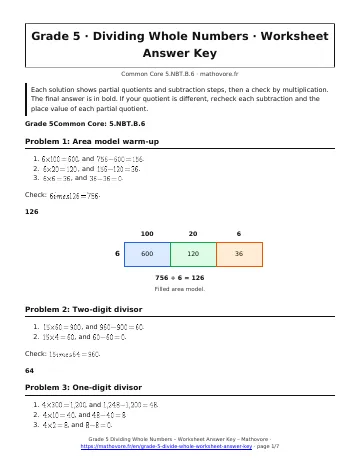
See every chapter on the Grade 5 math page.