


This grade 2 add subtract 1000 lesson explains adding and subtracting within 1,000 in one printable page, with definitions, a method and a worked example.
To add or subtract within 1,000, work one place at a time: ones, then tens, then hundreds. When a column has 10 or more, trade 10 for 1 of the next bigger group. When a top digit is too small, trade from the left. Add 10 or 100 in your head by changing one digit.
Grade 2 Add Subtract 1000 Lesson: key facts
- Add or subtract ones first, then tens, then hundreds.
- 10 ones make 1 ten, and 10 tens make 1 hundred.
- When adding, carry 1 to the next column if a column has 10 or more.
- When subtracting, trade from the next column on the left if the top digit is too small.
- Adding 10 changes the tens digit. Adding 100 changes the hundreds digit.
How do you add three-digit numbers?
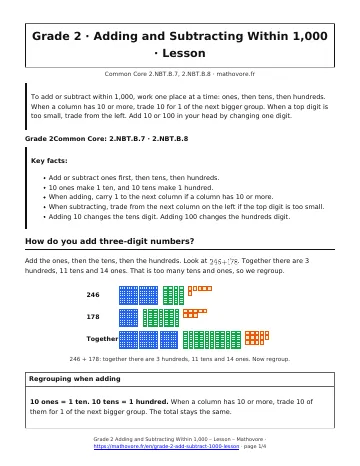
Add the ones, then the tens, then the hundreds. Look at \(246 + 178\). Together there are 3 hundreds, 11 tens and 14 ones. That is too many tens and ones, so we regroup.
10 ones = 1 ten. 10 tens = 1 hundred. When a column has 10 or more, trade 10 of them for 1 of the next bigger group. The total stays the same.
Step by step: \(6 + 8 = 14\) ones, which is 1 ten and 4 ones. Then \(4 + 7 + 1 = 12\) tens, which is 1 hundred and 2 tens. Then \(2 + 1 + 1 = 4\) hundreds. The sum is \(424\).
How do you subtract three-digit numbers?
Subtract ones, tens and hundreds. If the top digit is too small, trade from the next column on the left. Try \(352 – 165\).
- Ones: \(2\) is less than \(5\). Trade 1 ten for 10 ones. Now \(12 – 5 = 7\).
- Tens: now there are only 4 tens, and \(4\) is less than \(6\). Trade 1 hundred for 10 tens. Now \(14 – 6 = 8\).
- Hundreds: \(2 – 1 = 1\).
The difference is \(187\).
How can you add or subtract 10 or 100 in your head?
Adding 10 changes the tens digit by 1. Adding 100 changes the hundreds digit by 1. Subtracting works the same way.
| Problem | What changes | Answer |
|---|---|---|
| \(350 + 10\) | tens go up 1 | \(360\) |
| \(350 + 100\) | hundreds go up 1 | \(450\) |
| \(520 – 100\) | hundreds go down 1 | \(420\) |
| \(390 + 10\) | 9 tens + 1 ten = 10 tens | \(400\) |
How can you check your answer?
Use the partner operation. To check \(424 – 178\), add back: if \(246 + 178 = 424\), then the answer \(246\) is right. Counting on or using blocks can also show that a strategy works, because each step keeps the same total.
Adding and Subtracting Within 1,000: frequently asked questions
What is regrouping when you add?
Regrouping means trading 10 of one group for 1 of the next group. For example, 14 ones is 1 ten and 4 ones. The total stays the same.
How do you add 246 and 178?
Add the ones: 6 + 8 = 14. Write 4 and carry 1 ten. Add the tens: 4 + 7 + 1 = 12. Write 2 and carry 1 hundred. Add the hundreds: 2 + 1 + 1 = 4. The sum is 424.
How do you add 10 or 100 to a number in your head?
To add 10, make the tens digit 1 bigger. To add 100, make the hundreds digit 1 bigger. So 350 + 10 = 360 and 350 + 100 = 450. To subtract, make the digit 1 smaller.
What do you do when there is a 0 in the tens place?
Trade from the hundreds first. For 400 – 153, trade 1 hundred for 10 tens, then trade 1 ten for 10 ones. That makes 3 hundreds, 9 tens and 10 ones. The answer is 247.
How can I check an addition or subtraction answer?
Use the partner operation. If 352 – 165 = 187, then 187 + 165 must equal 352. If it does not, look for a missed trade or carry.
How to use this grade 2 add subtract 1000 lesson
Use this grade 2 add subtract 1000 lesson before the worksheet, then check what you learned with the quiz.

See every chapter on the Grade 2 math page.