


This grade 2 shapes equal shares lesson explains shapes and equal shares in one printable page, with definitions, a method and a worked example.
A shape is named by its number of sides: a triangle has 3, a quadrilateral has 4, a pentagon has 5, and a hexagon has 6. Second graders also learn that a cube has 6 square faces, that rectangles split into equal rows and columns of squares, and that equal shares are halves, thirds, and fourths.
Grade 2 Shapes Equal Shares Lesson: key facts
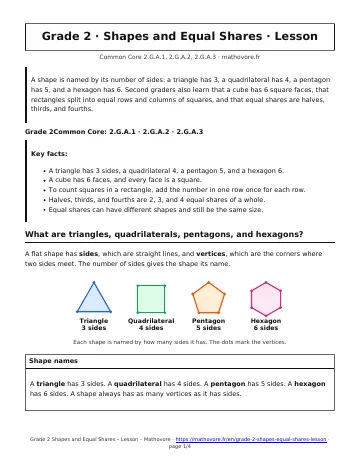
- A triangle has 3 sides, a quadrilateral 4, a pentagon 5, and a hexagon 6.
- A cube has 6 faces, and every face is a square.
- To count squares in a rectangle, add the number in one row once for each row.
- Halves, thirds, and fourths are 2, 3, and 4 equal shares of a whole.
- Equal shares can have different shapes and still be the same size.
What are triangles, quadrilaterals, pentagons, and hexagons?
A flat shape has sides, which are straight lines, and vertices, which are the corners where two sides meet. The number of sides gives the shape its name.
A triangle has 3 sides. A quadrilateral has 4 sides. A pentagon has 5 sides. A hexagon has 6 sides. A shape always has as many vertices as it has sides.
Which shapes are quadrilaterals?
Any shape with 4 sides is a quadrilateral. Squares, rectangles, rhombuses, and trapezoids all have 4 sides, so they are all quadrilaterals. A square also has 4 equal sides and 4 square corners.
What is a cube?
A cube is a solid shape, not a flat one. It has 6 flat faces, and every face is a square. A number cube used in board games is a cube.
How do you count the squares in a rectangle?
A rectangle can be split into rows that go across and columns that go up and down. All the squares are the same size, with no gaps and no overlaps.
- Count the squares in one row. Here, 1 row has 5 squares.
- Count the rows. Here, there are 3 rows.
- Add the same number once for every row: \(5 + 5 + 5 = 15\).
- Write the total: the rectangle has 15 squares.
What are halves, thirds, and fourths?
Equal shares are parts of a whole that are exactly the same size. Cut a whole into 2 equal shares and each one is a half. Cut it into 3 equal shares and each one is a third. Cut it into 4 equal shares and each one is a fourth.
Two halves make the whole. Three thirds make the whole. Four fourths make the whole. The words half of, a third of, and a fourth of tell which equal share you mean.
Can equal shares have different shapes?
Yes. Shares are equal when they cover the same amount of space, even if they look different. A square cut into fourths can give four strips, four small squares, or four triangles. Each fourth is still one of 4 equal shares.
Shapes and Equal Shares: frequently asked questions
What is a quadrilateral?
A quadrilateral is any flat shape with 4 sides and 4 vertices. Squares, rectangles, rhombuses, and trapezoids are all quadrilaterals.
How many faces does a cube have?
A cube has 6 faces. Every face is a square, and all the faces are the same size.
How do you find how many squares are in a rectangle?
Count the squares in one row, count the rows, and add the row number once for each row. For 4 rows of 3, write 3 + 3 + 3 + 3 = 12.
How many fourths make a whole?
Four fourths make one whole. In the same way, two halves make a whole and three thirds make a whole.
Do equal shares have to look the same?
No. Equal shares must be the same size, but they can have different shapes. Two halves of a square can be rectangles or triangles.
How to use this grade 2 shapes equal shares lesson
Use this grade 2 shapes equal shares lesson before the worksheet, then check what you learned with the quiz.

See every chapter on the Grade 2 math page.