Key takeaway: A grade 2 add within 100 lesson shows second graders how to add two-digit numbers by combining tens with tens and ones with ones. When the ones reach 10 or more, ten of them regroup into a new ten.
An open number line gives a second picture. For example, 53 + 29 is a jump of 20 and then a jump of 9.
To add two-digit numbers, add the tens and add the ones, then combine the results. When the ones make 10 or more, regroup: 10 ones become 1 ten. In 38 + 27 the ones are 8 + 7 = 15, so the sum is 65. You can also add three or four two-digit numbers.
Grade 2 Add Within 100 Lesson: key facts
- Add tens to tens and ones to ones, then combine the parts.
- Regroup when the ones make 10 or more: 10 ones become 1 ten.
- An open number line adds by jumping tens first and then ones.
- Numbers can be added in any order, so group the easy pairs first.
- Add three or four two-digit numbers two at a time.
How do you add two-digit numbers without regrouping?
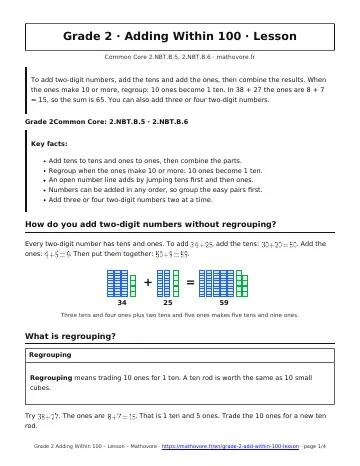
Every two-digit number has tens and ones. To add \(34+25\), add the tens: \(30+20=50\). Add the ones: \(4+5=9\). Then put them together: \(50+9=59\).
What is regrouping?
Regrouping means trading 10 ones for 1 ten. A ten rod is worth the same as 10 small cubes.
Try \(38+27\). The ones are \(8+7=15\). That is 1 ten and 5 ones. Trade the 10 ones for a new ten rod.
- Add the ones.
- If there are 10 or more ones, regroup 10 ones as 1 ten.
- Add the tens, and include the new ten.
- Write the tens and ones together.
Example: \(47+36\). The ones are \(7+6=13\), which is 1 ten and 3 ones. The tens are \(4+3+1=8\). The sum is \(83\).
How can an open number line help?
Start at the first number. Jump by tens, then jump by ones. To find \(46+28\), jump 20 and then 8.
How do you add three or four two-digit numbers?
Add two numbers at a time. Look for pairs that are easy. Because you can add numbers in any order, you can group the pairs you like.
Numbers can be added in any order, and any two can be added first. The sum stays the same.
| Strategy | Example |
|---|---|
| Break apart tens and ones | \(46+37=(40+30)+(6+7)=70+13=83\) |
| Jump on an open number line | \(46+28: 46, 66, 74\) |
| Add pairs first | \(12+23+31+14=35+45=80\) |
Adding Within 100: frequently asked questions
What does regroup mean when adding?
Regroup means trading 10 ones for 1 ten. In \(38+27\), the ones make 15, so 10 ones become 1 more ten and 5 ones stay.
When do I need to regroup?
Regroup when the ones add up to 10 or more. For \(24+35\), \(4+5=9\), so no regrouping is needed.
How do I add three two-digit numbers?
Add the first two numbers, then add the third to that sum. For \(20+30+40\), add \(20+30=50\) and then \(50+40=90\).
Can I add numbers in any order?
Yes. The order does not change the sum. You can add the pair that is easiest first, such as \(18+22=40\) before adding other numbers.
How can I check my answer?
Use subtraction. If \(64+19=83\), then \(83-19\) must equal 64. If it does not, look for a missed regroup.
How do you add two-digit numbers without regrouping?
Add the tens, add the ones, and then put the two parts together. For 34 + 25, the tens give 50 and the ones give 9, so the sum is 59. Because no column goes past nine, nothing needs to move.
What does regrouping mean in a grade 2 add within 100 lesson?
Regrouping means swapping ten ones for one ten. Take 38 + 7. The ones make 15, which is one ten and five ones. So the tens digit grows from 3 to 4, and the sum is 45. In other words, the extra ten joins the tens.
How can an open number line help?
Start at the first number and make jumps. To add 46 + 28, jump 20 to reach 66, and then jump 8 to reach 74. This method avoids a written carry, so it suits children who like pictures.
How do you add three or four numbers?
Look for pairs that are easy to combine. In 24 + 31 + 18, add 24 + 31 first to get 55, and then add 18 to reach 73. For four numbers, add two pairs and then combine the pair sums.
What should students do after this lesson?
Pick two favorite two-digit numbers, and add them on a number line and with blocks. Do both methods agree? Then try the printable page, which includes stories about apples, pages and buses.

See every chapter on the Grade 2 math page.