Key takeaway: This geometry parallel lines test answer key shows a complete solution and a point breakdown for every question. Award partial credit using the breakdown after each solution. A correct reason counts even when the arithmetic has a small slip.
This answer key shows a complete solution and a scoring guide for each question of the parallel lines and transversals test. Award partial credit using the point breakdown listed after each solution.
Geometry Parallel Lines Test Answer Key: questions 1–5
1. Name the angle pairs (2 points)
- \(\angle 4\) and \(\angle 6\) are between the lines on the same side of the transversal: same-side interior angles.
- \(\angle 1\) and \(\angle 8\) are outside the lines on opposite sides: alternate exterior angles.
Scoring: 1 point for each correct name.
2. Find missing angles (2 points)
- \(m\angle 6\) = \(54^{\circ}\) (alternate interior angles are equal).
- \(m\angle 5\) = \(180-54=126\) (same-side interior angles are supplementary). \(m\angle 8\) = \(126^{\circ}\) because \(\angle 8\) and \(\angle 5\) are vertical angles. Both are \(126^{\circ}\).
Scoring: 1 point for part (a). 1 point for part (b): 0.5 for each angle.
3. Corresponding angles and x (2 points)
Corresponding angles are equal: \(7x-9=4x+24\). Then \(3x=33\), so \(x=11\).
\(7(11)-9=68\) and \(4(11)+24=68\). Each angle is \(68^{\circ}\).
Scoring: 1 point for the correct equation, 1 point for \(x=11\) and both angle measures.
4. Same-side interior angles and x (2 points)
Same-side interior angles are supplementary: \((3x+12)+(5x-8)=180\). Then \(8x+4=180\) and \(8x=176\), so \(x=22\).
\(3(22)+12=78\) and \(5(22)-8=102\). The angles are \(78^{\circ}\) and \(102^{\circ}\).
Scoring: 1 point for the correct equation and \(x=22\), 1 point for both angle measures.
5. Decide if lines are parallel (2 points)
- Yes. The alternate interior angles are equal, so \(a \parallel b\) by the Alternate Interior Angles Converse.
- No. \(100+70=170\), which is not \(180^{\circ}\), so the same-side interior angles are not supplementary.
Scoring: 1 point per part: 0.5 for the decision and 0.5 for the reason.
Geometry Parallel Lines Test Answer Key: questions 6–9
6. Proof that lines are parallel (3 points)
| Statements | Reasons |
|---|---|
| \(m\angle 2\) = \(m\angle 7\) | Given |
| \(m\angle 2\) = \(m\angle 3\) | Vertical Angles Theorem |
| \(m\angle 3\) = \(m\angle 7\) | Substitution Property of Equality |
| \(a \parallel b\) | Corresponding Angles Converse |
Scoring: 1 point for \(m\angle 2\) = \(m\angle 3\) with its reason, 1 point for \(m\angle 3\) = \(m\angle 7\), 1 point for the conclusion with the correct converse. Other valid chains also earn full credit.
7. Perpendicular Bisector Theorem proof (3 points)
| Statements | Reasons |
|---|---|
| \(AM=BM\) | Definition of bisector (M is the midpoint) |
| \(m\angle PMA\) = \(m\angle PMB\) = \(90^{\circ}\) | Definition of perpendicular lines |
| \(PM=PM\) | Reflexive Property |
| \(\triangle PMA\) is congruent to \(\triangle PMB\) | SAS (two sides and the included angle) |
| \(PA=PB\) | Corresponding parts of congruent triangles are congruent |
Scoring: 1 point for the two equal sides and the equal right angles, 1 point for triangle congruence by SAS, 1 point for the conclusion with the CPCTC reason.
8. Equidistant point (2 points)
\(PA=PB\), so \(4x-3=2x+13\). Then \(2x=16\), so \(x=8\).
\(PA=4(8)-3=29\) (and \(PB=2(8)+13=29\)).
Scoring: 1 point for the equation and \(x=8\), 1 point for \(PA=29\).
9. Parallel avenues (2 points)
The angles are alternate exterior angles, so they are equal: \(2x+15=3x-10\). Then \(x=25\).
Each angle is \(2(25)+15=65\) degrees. The northwest angle at Cedar forms a linear pair with the northeast angle: \(180-65=115\). It measures \(115^{\circ}\).
Scoring: 1 point for \(x=25\) with the correct equation, 1 point for \(115^{\circ}\).
Scoring summary
20 points: add the points of every question of this geometry parallel lines test answer key.
How do you score the parallel lines test?
In the same-side item, \((3x+12)+(5x-8)=180\) gives \(x=22\), so the angles are \(78^{\circ}\) and \(102^{\circ}\). The equation earns a point, and the angle values earn the other. The equidistant item sets \(4x-3=2x+13\), so \(x=8\) and \(PA=29\).
Where does partial credit apply?
For each proof, give one point for the givens, one for the key statements and one for the final conclusion with a converse reason. A proof that cites the theorem instead of its converse earns two points. Meanwhile, a street problem answer needs both x and the angle to score fully.
What should you reteach?
If students miss the same-side item, they probably set the two angles equal. Therefore, show that their sum is a straight angle.
How can you use these scores?
List which theorem each lost point involved. Then pair students who lost points on the same theorem. Next, offer the short quiz to see whether the idea has settled.

Printable PDF · Test Answer Key
Geometry Parallel Lines, Transversals and Proofs test answer key
Download the PDF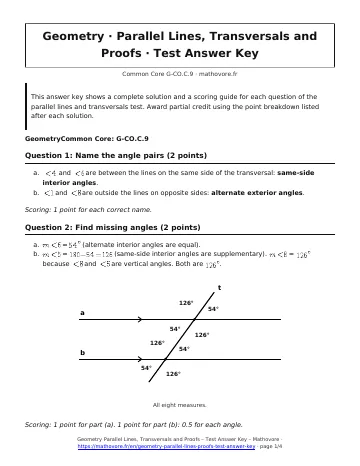
See every chapter on the Geometry math page.