Key takeaway: This AP Statistics probability test answer key solves every question in full and adds a grading plan for the 20 points. On the AP exam, a probability needs a correct setup, not only a number, so award a point when the notation or formula shows how the answer was found. Interpretations must refer to the context. It tracks AP Statistics Unit 2 and marks the setup point in each part.
Each question is solved in full with a scoring guide. On the AP exam, a probability answer needs a correct setup, not only a number, so award a point when the notation or the formula shows how the answer was found. Interpretations must refer to the context.
AP Statistics Probability Test Answer Key: questions 1–5
1. Gym members (3 points)
- Joint: \(\frac{90}{300}=0.30\).
- Marginal: \(\frac{105}{300}=0.35\).
- Conditional on the 60 class members: \(\frac{30}{60}=0.50\).
Scoring: 1 point each. (a) 0.30 from 90 over 300. (b) 0.35 from the column total. (c) 0.50, with denominator 60 and not 300.
2. Time and activity (2 points)
- \(P(\text{weights})=\frac{135}{300}=0.45\) and \(P(\text{weights}|\text{morning})=\frac{45}{135}\approx 0.333\).
- The probabilities differ (0.45 versus 0.333), so the events are not independent: knowing a member visits in the morning changes the probability that the member lifts weights.
Scoring: (a) 1 point for both values. (b) 1 point for “not independent” with a comparison of the two probabilities.
3. Bakery customers (2 points)
- \(P(\text{both})=0.55+0.30-0.70=0.15\).
- Since \(0.15\neq 0\), the events are not mutually exclusive. Since \(0.55\times 0.30=0.165\neq 0.15\), they are not independent.
Scoring: (a) 1 point. (b) 1 point for both conclusions with the supporting calculation.
4. Late bus (3 points)
- \(P(\text{rain and late})=0.3\times 0.2=0.06\).
- \(P(\text{late})=0.06+0.7\times 0.05=0.06+0.035=0.095\).
- \(P(\text{rain}|\text{late})=\frac{0.06}{0.095}\approx 0.632\).
Scoring: (a) 1 point for the product. (b) 1 point for adding both late branches. (c) 1 point for conditional probability as a ratio, 0.632.
5. Guessing on a quiz (2 points)
- Let digits 0 and 1 mean a correct guess (2 of 10 digits = 20%) and 2 to 9 an incorrect guess. Read 4 digits per trial and count the correct guesses; repeat many times .
- At least 2 correct occurred in \(6+1+0=7\) of 40 trials: \(\frac{7}{40}=0.175\).
Scoring: (a) 1 point for a digit assignment with the correct 20% and 4 digits per trial. (b) 1 point for 7 out of 40 = 0.175.
AP Statistics Probability Test Answer Key: questions 6–8
6. Online orders (3 points)
- \(0.10+0.25+0.35+k+0.10=1\), so \(k=0.20\).
- \(\mu_X=0+0.25+0.70+0.60+0.40=1.95\) orders.
- \(\sigma_X^{2}=(1.95)^{2}(0.10)+(0.95)^{2}(0.25)+(0.05)^{2}(0.35)+(1.05)^{2}(0.20)+(2.05)^{2}(0.10)=0.38025+0.225625+0.000875+0.2205+0.42025=1.2475\), so \(\sigma_X\approx 1.12\) orders.
Scoring: 1 point each. (a) 0.20. (b) 1.95 with the sum of products. (c) 1.12, with correct weighted squared deviations.
7. Carnival wheel (2 points)
- \(\mu=20\cdot\frac{1}{8}+5\cdot\frac{2}{8}+0\cdot\frac{5}{8}=2.50+1.25=3.75\) dollars.
- \(3.75-4=-\$0.25\). Over many spins, a player loses on average $0.25 per spin.
Scoring: (a) 1 point for 3.75. (b) 1 point for −$0.25 with an interpretation as a long-run average per spin.
8. Socks (3 points)
- \(\frac{6}{10}\cdot\frac{5}{9}=\frac{30}{90}=\frac{1}{3}\).
- \(\frac{6}{10}\cdot\frac{4}{9}+\frac{4}{10}\cdot\frac{6}{9}=\frac{24}{90}+\frac{24}{90}=\frac{48}{90}=\frac{8}{15}\approx 0.533\).
- \(P(\text{second black})=\frac{6}{10}=0.6\) but \(P(\text{second black}|\text{first black})=\frac{5}{9}\approx 0.556\). The probabilities differ, so the events are not independent.
Scoring: (a) 1 point for 1/3. (b) 1 point for adding both orders, 8/15. (c) 1 point for comparing the two probabilities and concluding not independent.
Scoring summary
20 points: add the points of every question of this ap statistics probability test answer key.
What earns points on questions 1 to 3 of the AP statistics probability test answer key?
Question 1 awards a point for each correct relative frequency type among the joint, marginal and conditional parts. Next, question 2 awards a point for the numerator and a point for the correct denominator. Then question 3 pays a point for the addition rule written out and a point for the answer of 0.15. Therefore a bare 0.15 earns only one point.
What do the tree and simulation questions award?
For question 4, the late-bus probability combines two branches, and the setup point goes to the sum of products. Likewise, question 5 awards a point for assigning digits, such as 0 and 1 for a correct guess, and a point for stating what one trial and the stopping rule are. However, a simulation with ten digits and a 20% chance for a single guess needs two digits for correct and eight for wrong.
How are the random variable questions scored?
Question 6 awards a point for the mean, a point for the standard deviation and a point for the interpretation of the mean as a long-run average. In question 7, the average payout is $3.75, so the net result is a loss of 25 cents per spin. Meanwhile, question 8 awards one point for the first draw, one for the second and one for the product, which equals one third for two black socks.
How can graders stay consistent?
First, look for the setup line. Next, check the arithmetic. Then check the sentence. Because the rubric works the same way for each question, graders agree. Also, give full credit to any correct method, such as a table instead of a tree. In addition, write the reason for each deduction.
How can teachers use these scores?
Sort the missed points by setup, arithmetic and interpretation. Then plan a ten-minute review for the biggest group. Afterward, give a short retest with fresh numbers to see whether the gap closed.

Printable PDF · Test Answer Key
AP Statistics Probability and Random Variables test answer key
Download the PDF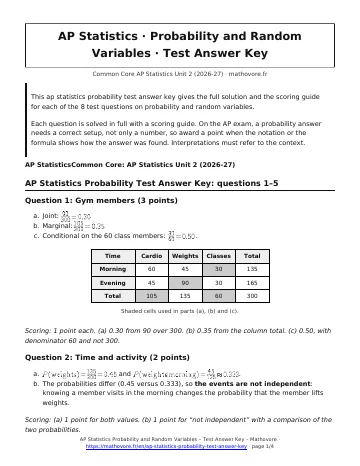
See every chapter on the AP Statistics math page.