Key takeaway: This AP Statistics probability test presents eight free-response questions, 20 points in all, in roughly 45 minutes. Show your work, give probabilities as decimals or fractions, and explain conclusions in context. A calculator is allowed. Questions 1 and 2 share one table of gym members. The rest cover the addition rule, a tree diagram, a simulation, a random variable, an expected-value game and drawing without replacement.
This test has 8 free-response questions worth 20 points in total and takes about 45 minutes. Show your work, give probabilities as decimals or fractions, and explain conclusions in context. A calculator is allowed. Questions 1 and 2 use the same table.
- Grade: AP Statistics
- Chapter: Probability and Random Variables
- Common Core: AP Statistics Unit 2 (2026-27)
- Time: 45 minutes
- Total: 20 points (Question 1: 3 pts; Question 2: 2 pts; Question 3: 2 pts; Question 4: 3 pts; Question 5: 2 pts; Question 6: 3 pts; Question 7: 2 pts; Question 8: 3 pts)
AP Statistics Probability Test: questions 1–5
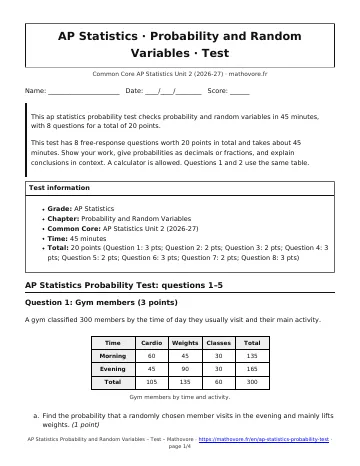
1. Gym members (3 points)
A gym classified 300 members by the time of day they usually visit and their main activity.
- Find the probability that a randomly chosen member visits in the evening and mainly lifts weights. (1 point)
- Find the probability that a randomly chosen member mainly does cardio. (1 point)
- Given that a member mainly takes classes, find the probability that the member visits in the morning. (1 point)
2. Time and activity (2 points)
Use the table of 300 gym members from Question 1 (morning: 60 cardio, 45 weights, 30 classes; evening: 45 cardio, 90 weights, 30 classes).
- Find \(P(\text{weights})\) and \(P(\text{weights}|\text{morning})\). (1 point)
- Are the events “mainly lifts weights” and “visits in the morning” independent? Justify your answer. (1 point)
3. Bakery customers (2 points)
At a bakery, 55% of customers buy bread, 30% buy muffins, and 70% buy bread or muffins (or both).
- Find the probability that a customer buys both. (1 point)
- Are buying bread and buying muffins mutually exclusive? Are they independent? Justify both answers. (1 point)
4. Late bus (3 points)
The probability that it rains on a school day is 0.3. Jamal’s bus is late with probability 0.2 on a rainy day and with probability 0.05 on a day without rain.
- Find the probability that it rains and the bus is late. (1 point)
- Find the probability that the bus is late. (1 point)
- Given that the bus is late, find the probability that it rained. (1 point)
5. Guessing on a quiz (2 points)
A quiz has 4 questions, each with 5 answer choices, and a student guesses every answer.
- Describe how to simulate one trial using random digits. (1 point)
- The student’s number of correct answers was simulated in 40 trials (see the figure). Estimate the probability of getting at least 2 correct. (1 point)
AP Statistics Probability Test: questions 6–8
6. Online orders (3 points)
The number of online orders \(X\) a small shop receives in one hour has the distribution below.
- Find the value of \(k\). (1 point)
- Find the mean of \(X\). (1 point)
- Find the standard deviation of \(X\). (1 point)
7. Carnival wheel (2 points)
A carnival wheel has 8 equal sections: 1 pays $20, 2 pay $5, and 5 pay nothing. It costs $4 to spin.
- Find the mean winnings per spin. (1 point)
- Find the mean net gain per spin and interpret it in context. (1 point)
8. Socks (3 points)
A drawer holds 6 black socks and 4 white socks. Two socks are drawn at random without replacement.
- Find the probability that both socks are black. (1 point)
- Find the probability that exactly one sock is black. (1 point)
- Are the events “first sock is black” and “second sock is black” independent? Justify. (1 point)

What does the AP statistics probability test ask first?
Question 1 sorts 300 gym members by visit time and main activity for 3 points. Next, question 2 uses the same table, with 60 morning cardio members and 45 morning weights members, to find a conditional probability. Then question 3 gives a bakery where 55% buy bread, 30% buy muffins and 70% buy one or both. Therefore the overlap equals 0.15.
Which questions combine several skills?
Question 4 mixes weather and a late bus: the chance of rain is 0.3, and the bus is late with probability 0.2 on rainy days. Draw a tree before you compute. Meanwhile, question 6 gives a distribution of online orders, so find a mean and a standard deviation, then explain the mean. Also, question 5 asks you to design a simulation of guessing on four questions with 5 choices each.
How do the game questions work?
Question 7 describes a carnival wheel with 8 equal sections. One pays $20, two pay $5 and five pay nothing, and a spin costs $4. Compute the average payout, then subtract the cost. In contrast, question 8 draws two socks from 6 black and 4 white without replacement, so the second probability changes. As a result, both questions test whether you track what stays fixed.
How can you manage your time?
To begin, give each 2-point question roughly two minutes. Next, set aside six minutes for every 3-point question. Then use the leftover time to check that every answer includes a setup, not only a number. Because the AP exam awards points for notation, write \(P(A\text{ and }B)\) before you substitute.
What should you do once the test is done?
Mark each lost point as a setup issue, an arithmetic issue or a context issue. Then redo the biggest category with different numbers. Later, read the worked solutions and compare their notation with yours.

See every chapter on the AP Statistics math page.