


This free-response test covers chi-square tests for homogeneity and independence. Show the formulas, the numbers and a conclusion in context. A calculator with chi-square probability functions is allowed. The test is worth 20 points.
- Grade: AP Statistics
- Chapter: Chi-Square Tests for Homogeneity and Independence
- Common Core: AP Statistics Unit 3 (2026-27)
- Time: 45 minutes
- Total: 20 points (Question 1: 2 pts; Question 2: 2 pts; Question 3: 2 pts; Question 4: 2 pts; Question 5: 2 pts; Question 6: 4 pts; Question 7: 2 pts; Question 8: 2 pts; Question 9: 2 pts)
Question 1: Expected count and df (2 points)
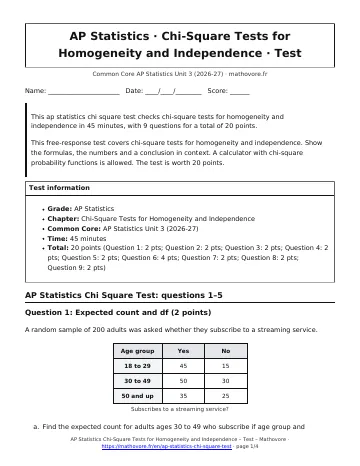
A random sample of 200 adults was asked whether they subscribe to a streaming service.
- Find the expected count for adults ages 30 to 49 who subscribe if age group and subscription are independent. (1 point)
- Find the degrees of freedom for a chi-square test. (1 point)
Question 2: Name the test and hypotheses (2 points)
A district drew a random sample of 150 students from each of three high schools (Northside, Eastside and Westside) and recorded whether each student usually walks, rides the bus or is driven to school.
- Name the appropriate chi-square test. (1 point)
- State the null and alternative hypotheses in context. (1 point)
Question 3: Check the conditions (2 points)
The students in the previous question gave the following counts. Each school enrolls more than 2,000 students.
Determine whether the conditions for the chi-square test are met. (2 points)
Question 4: Statistic and df (2 points)
Use the counts in the previous question. Calculate the value of the chi-square statistic and the degrees of freedom. (2 points)
Question 5: P-value and conclusion (2 points)
A chi-square test for the school data gives \(\chi^{2}\approx 7.00\) with 4 degrees of freedom.
- Find the p-value. (1 point)
- State a conclusion in context at the \(\alpha=0.05\) level. (1 point)
Question 6: Complete test for an experiment (4 points)
Sofia randomly assigned 180 adults with trouble sleeping to three groups of 60. Each group used a different bedtime app, and Sofia recorded whether each person fell asleep within 20 minutes.
| App | Fell asleep | Did not |
|---|---|---|
| Sound | 41 | 19 |
| Story | 30 | 30 |
| Timer | 22 | 38 |
Carry out a chi-square test at the \(\alpha=0.05\) level to decide whether the apps differ in how quickly people fall asleep. (4 points)
Question 7: Largest contribution (2 points)
For the school data in the third question, identify the cell that contributes the most to the chi-square statistic. State whether its observed count is above or below the expected count, and what that means in context. (2 points)
Question 8: Association and causation (2 points)
A random sample of 400 teenagers was classified by hours of sleep (under 7, 7 to 8, over 8) and by grade-point average (below 3.0, 3.0 or higher). A chi-square test of independence gave a p-value of 0.003.
- State the conclusion about association in context at \(\alpha=0.05\). (1 point)
- Explain why the result does not show that sleeping more causes higher grades. (1 point)
Question 9: Effect of sample size (2 points)
A chi-square test is run on a 2 by 2 table with counts 20, 30, 30 and 20 (rows: 20 and 30, then 30 and 20).
- Calculate \(\chi^{2}\). (1 point)
- Each count is multiplied by 3 (60, 90, 90, 60) with the same percentages. Find the new \(\chi^{2}\) and explain the change. (1 point)

See every chapter on the AP Statistics math page.