Key takeaway: This AP Statistics binomial test answer key lists every full setup and the point rubric for the 20-point test. Give partial credit for a sound method with small rounding drift. Require context in every conclusion, as the AP exam does. The key tracks AP Statistics Unit 2, and it flags the condition checks that graders look for first.
Each solution shows the full setup followed by a scoring guide that awards the points. Award partial credit when the method is correct but arithmetic or rounding is slightly off, and require context in every conclusion, as on the AP exam.
AP Statistics Binomial Test Answer Key: questions 1–5
1. Binomial setting (2 points)
Binary: each student walks or does not. Independent: the sample of \(25\) is less than \(10\%\) of \(2{,}400\) (the limit is \(240\)), so the trials are approximately independent. Number fixed: \(n=25\). Same probability: \(p=0.30\) for each randomly chosen student.
\(X\) is binomial with \(n=25\), \(p=0.30\).
Scoring: 1 point for justifying the BINS conditions, including the 10% condition for independence; 1 point for \(n=25\) and \(p=0.30\).
2. Binomial probabilities (3 points)
- \(P(X=4)={_{10}C_{4}(0.4)^{4}(0.6)^{6}=210(0.0256)(0.046656)\approx\) 0.2508
- \(P(X\le 2)=P(0)+P(1)+P(2)=0.0060+0.0403+0.1209\approx\) 0.1673 (the shaded bars)
- \(P(X\ge 3)=1-P(X\le 2)=1-0.1673=\) 0.8327
Scoring: 1 point per part, correct setup and value. For (c), 1 point requires use of the complement or a correct sum.
3. Mean and spread (2 points)
- \(\mu=300(0.2)=60\); \(\sigma=\sqrt{300(0.2)(0.8)}=\sqrt{48}\approx 6.928\).
- \(60\pm 2(6.928)\) gives about \(46.1\) to \(73.9\). Roughly \(95\%\) of days with \(300\) emails should have between about \(46\) and \(74\) spam emails.
Scoring: (a) 1 point for both values; (b) 1 point for the interval and a context statement.
4. Reading a binomial graph (2 points)
- The tallest bar is at \(X=3\), with probability 0.3456.
- \(P(X\ge 4)=0.2592+0.0778=\) 0.3370.
Scoring: (a) 1 point for 3 and its probability; (b) 1 point for adding the two bars.
5. Normal probabilities (3 points)
- \(z=\frac{11.5-12.0}{0.3}=-1.67\); area to the left is 0.0475.
- \(z_{1}=\frac{11.8-12.0}{0.3}=-0.67\) (area \(0.2514\)) and \(z_{2}=\frac{12.4-12.0}{0.3}=1.33\) (area \(0.9082\)). The proportion is \(0.9082-0.2514=\) 0.6568.
Scoring: (a) 1 point. (b) 1 point for both z-scores, 1 point for subtracting the areas to get 0.6568.
AP Statistics Binomial Test Answer Key: questions 6–8
6. Percentile cutoff (2 points)
The cutoff has \(95\%\) of the area to its left, so \(z\approx 1.645\).
\(x=250+1.645(40)=250+65.8=\) 315.8 milliseconds.
Scoring: 1 point for the correct z-score; 1 point for converting to a time with the correct units.
7. Comparing z-scores (2 points)
Reading: \(z=\frac{68-60}{5}=1.6\). Science: \(z=\frac{590-520}{50}=1.4\).
Reading, because \(1.6> 1.4\): his reading score is farther above its mean in standard-deviation units.
Scoring: 1 point for both z-scores, 1 point for the correct conclusion with justification.
8. Normal approximation (4 points)
- \(np=180(0.35)=63\ge 10\) and \(n(1-p)=180(0.65)=117\ge 10\).
- \(\mu=63\); \(\sigma=\sqrt{180(0.35)(0.65)}=\sqrt{40.95}\approx 6.399\).
- \(z=\frac{72-63}{6.399}=1.41\); \(P(X\ge 72)\approx 1-0.9207=\) 0.0793.
- It is somewhat uncommon (about 7.9% of days) but not very unusual: \(z=1.41\) is inside \(2\) standard deviations of the mean.
Scoring: (a) 1 point for both checks; (b) 1 point; (c) 1 point for standardizing and correct tail area; (d) 1 point for a conclusion supported by the probability or z-score.
Scoring summary
20 points: add the points of every question of this ap statistics binomial test answer key.
How do you score questions 1 to 4?
First, question 1 earns one point for naming independence and one for the 10% condition, since 25 is far below 10% of 2,400. Next, question 2 earns its three points for the distribution, the setup and the value. Then question 3 awards a single point for the mean and another for the spread. Finally, question 4 gives both points for reading the graph correctly.
What do the normal questions award?
Question 5 gives one point for the z-score, one for the area and one for the context sentence. Likewise, question 6 awards a point for the z-value from the table and a point for converting back to milliseconds. In question 7, the z-scores decide the winner. So a student who reports only raw scores earns at most one point.
How is the four-point approximation question graded?
Award one point for checking that \(np\) and \(n(1-p)\) are both at least 10. Award one point for the mean and the standard deviation. Next, give a point for the standardized value, and a point for the final probability with context. However, withhold the last point if the answer never names the app orders. Accept equivalent rounding within 0.001.
Which scoring notes help in reteaching?
Mark the most common slip on the board, such as skipping the 10% check. After that, hand back a short set of three conditions-only items. In addition, ask students to rewrite one conclusion in a full sentence. As a result, context becomes a habit.
How do you grade a borderline response fairly?
First, look for the method before the number. Next, ask whether a different but valid route reaches the same value. Then award the method points even when a rounding slip changes the last digit. Also, check the units in every sentence. Because of that, two graders reach the same total. Finally, note the reason beside each deduction.
How can teachers use the scoring notes?
Tally the points lost by category: conditions, calculation and context. Then plan one short reteaching block around the largest tally. Finally, give a quick retest on that category alone, and compare the two tallies.

Printable PDF · Test Answer Key
AP Statistics Binomial and Normal Distributions test answer key
Download the PDF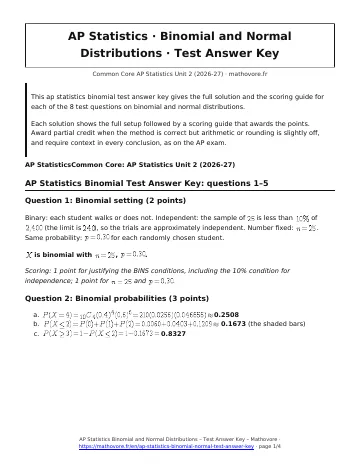
See every chapter on the AP Statistics math page.