Key takeaway: This algebra 1 linear test answer key presents the solution to each of the nine questions, with partial credit noted under every one. Award full credit for any valid method, even if it differs from the printed steps, and require units in context problems.
The test totals 20 points. Look for a correct setup first, and then check the arithmetic.
Use this key to score the test out of 20 points. Each solution shows the full work and a scoring guide that explains how partial credit is awarded. Award full credit for any correct method, and deduct only the points listed when a step is missing or wrong.
Algebra 1 Linear Test Answer Key: questions 1–5
1. Variables on both sides (2 points)
Subtract \(3x\): \(2x-8=12\). Add 8: \(2x=20\). Divide: \(x=10\). Check: \(42=42\).
Scoring: 1 point for collecting variable terms and constants, 1 point for the correct solution.
2. Distribute and combine (2 points)
Distribute: \(6x-3-4=5x+2\), so \(6x-7=5x+2\). Subtract \(5x\) and add 7: \(x=9\). Check: \(3(17)-4=47\) and \(5(9)+2=47\).
Scoring: 1 point for distributing and combining correctly, 1 point for the correct solution.
3. Fractions on both sides (2 points)
Multiply every term by 4: \(3x+8=2x-4\). Subtract \(2x\) and 8: \(x=-12\). Check: \(-9+2=-7\) and \(-6-1=-7\).
Scoring: 1 point for clearing the denominators, 1 point for the correct solution.
4. Justify each step (3 points)
Steps and reasons are shown in the figure: distribute, subtract \(2x\), add 4, divide by 2. \(x=7\). Check: \(4(6)=24\) and \(2(7)+10=24\).
Scoring: 1 point for the correct solution, 2 points for the reasons (1 point if two of the four reasons are correct).
5. Solve using a graph (2 points)
- The lines cross at \((2,3)\), so \(x=2\).
- Add \(2x\): \(3x+1=7\); so \(3x=6\) and \(x=2\). Both sides equal 3.
Scoring: 1 point for reading the x-coordinate, 1 point for a correct algebraic check.
Algebra 1 Linear Test Answer Key: questions 6–9
6. How many solutions? (2 points)
- Right side: \(6x-4\), so \(6x-4=6x-4\) is always true: infinitely many solutions.
- Subtract \(5x\): \(1=-3\) is false: no solution.
Scoring: 1 point for each part, including the explanation.
7. Rearranging formulas (2 points)
- \(2A=bh\), so \(b=\frac{2A}{h}\).
- Subtract \(3x\): \(-2y=12-3x\). Divide by \(-2\): \(y=\frac{3}{2}x-6\).
Scoring: 1 point for each part.
8. Text messages (3 points)
- \(20+0.05t=27.50\)
- Subtract 20: \(0.05t=7.50\). Divide: \(t=150\).
- Sofia sent 150 text messages. Check: \(20+0.05(150)=27.50\).
Scoring: 1 point for a correct equation, 1 point for solving, 1 point for interpreting the answer in context.
9. Garden perimeter (2 points)
- \(2(w+w+7)=62\)
- Simplify: \(4w+14=62\), so \(w=12\). Width 12 ft, length 19 ft.
Scoring: 1 point for the equation, 1 point for both dimensions.
Scoring summary
20 points: add the points of every question of this algebra 1 linear test answer key.
What answers does the algebra 1 linear test answer key list?
The first group of answers are whole numbers. Question 1 gives \(x=10\), and question 2 gives \(x=9\). Next, question 3 gives \(x=-12\). Then question 4 gives \(x=7\), with the distributive, subtraction and division properties as reasons. Meanwhile, question 5 reads \(x=2\) from the graph.
Later, question 9 gives a width of 12 feet and a length of 19 feet.
How should partial credit work?
In question 4, award one point per justified step cluster. In question 6, the first equation has infinitely many solutions, and the second has none. However, a student who simplifies correctly but names the wrong case earns one point. In question 8, award a point for \(20+0.05t=27.50\), a point for solving, and a point for 150 texts.
Also, accept equivalent forms, such as \(t=150\) and \(150=t\).
What do missed questions suggest?
Errors on 1 and 2 point to sign slips. By contrast, errors on 3 point to fraction work, and errors on 6 point to special cases. Hence, assign a short drill matched to the missed skill.
What keeps scoring fair across papers?
First, read the setup before the answer. Next, mark each line with a check or a cross. Then add the points. Also, compare two papers with the same error, so both receive equal credit. Because students may use different orders, accept any logical route. For example, some students distribute first, while others divide first. Both are valid, so award both.
Meanwhile, watch for lucky answers. A correct x with no work earns little, because the standards ask for justification. Conversely, a clear method with a late slip earns most of the points. Therefore, balance the process against the result. Finally, write one short comment on each paper, such as check your signs, so students know what to fix.
What is a sensible next step?
Return papers with the first wrong step marked, then let students fix one problem alone. Next, pair students who missed the same item. Finally, set the quiz about a week away, so the repairs get a fair trial.

Printable PDF · Test Answer Key
Algebra 1 Linear Equations and Literal Equations test answer key
Download the PDF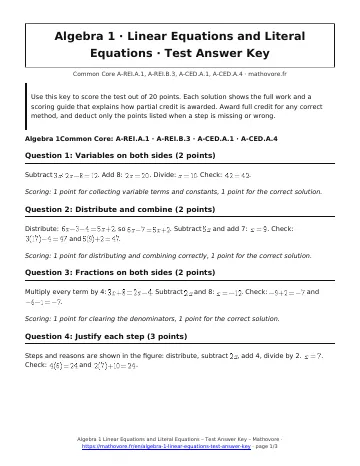
See every chapter on the Algebra 1 math page.