
Key takeaway: This precalculus expected value decisions test is a printable PDF of 8 questions covering distributions, expected value and decisions. It checks whether you can find a missing probability, compute an average payoff, and use it to accept or reject a deal. The items follow S-MD.A.3 and S-MD.B.5. Show every product and every sum. A calculator is allowed, and the paper fits into about 45 minutes.
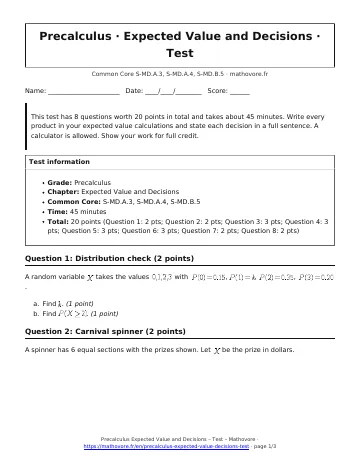
This test has 8 questions worth 20 points in total and takes about 45 minutes. Write every product in your expected value calculations and state each decision in a full sentence. A calculator is allowed. Show your work for full credit.
- Grade: Precalculus
- Chapter: Expected Value and Decisions
- Common Core: S-MD.A.3, S-MD.A.4, S-MD.B.5
- Time: 45 minutes
- Total: 20 points (Question 1: 2 pts; Question 2: 2 pts; Question 3: 3 pts; Question 4: 3 pts; Question 5: 3 pts; Question 6: 3 pts; Question 7: 2 pts; Question 8: 2 pts)
Precalculus Expected Value Decisions Test: questions 1–5
1. Distribution check (2 points)
A random variable \(X\) takes the values \(0, 1, 2, 3\) with \(P(0)=0.15\), \(P(1)=k\), \(P(2)=0.35\), \(P(3)=0.20\).
- Find \(k\). (1 point)
- Find \(P(X \ge 2)\). (1 point)
2. Carnival spinner (2 points)
A spinner has 6 equal sections with the prizes shown. Let \(X\) be the prize in dollars.
- Write the probability distribution of \(X\). (1 point)
- Find \(E(X)\). (1 point)
3. Red lights on the way to school (3 points)
Over 80 trips, Priya counted the red lights on her route to school.
- Write the empirical distribution of the number of red lights. (1 point)
- Find the expected number of red lights per trip. (1 point)
- Predict the total number of red lights in 200 trips. (1 point)
4. Card game at the fair (3 points)
A game uses 10 cards. One card pays $12, three cards pay $3 each, and six cards pay nothing. A player pays $2 to draw one card.
- Find the expected payout. (1 point)
- Find the expected net result per game. (1 point)
- Is the game fair? If not, state who it favors and the fair price. (1 point)
5. Phone insurance (3 points)
Aisha’s phone is worth $450. There is a \(6\%\) chance it must be replaced this year. Insurance that pays for a replacement costs $35 per year.
- Find the expected loss without insurance. (1 point)
- Based only on expected value, should she buy the insurance? Explain. (1 point)
- Find the replacement probability, to the nearest tenth of a percent, at which the two options have equal expected cost. (1 point)
Precalculus Expected Value Decisions Test: questions 6–8
6. Two penalty kicks (3 points)
Noah scores on each penalty kick with probability \(0.6\), independent of the other kick. He takes two kicks. Let \(X\) be the number of goals.
- Write the probability distribution of \(X\). (2 points)
- Find \(E(X)\). (1 point)
7. TV warranty (2 points)
A $500 TV has a warranty that costs $80. Each year, the chance of a $350 repair is \(10\%\).
- Find the expected repair cost. (1 point)
- Decide whether the warranty is worth buying by expected value. (1 point)
8. Entry fee for a game (2 points)
A game pays $8 with probability \(0.25\), $3 with probability \(0.5\), and nothing otherwise.
- Find the expected payout. (1 point)
- Maya pays $4 to play 100 times . Predict her total net result. (1 point)

What do the first items test?
Item 1 leaves a probability \(k\) unknown in a list for the values 0 to 3. Use the sum rule to solve it. Next, a carnival spinner with six equal sections gives a table of prizes in item 2. After that, item 3 turns a bar graph of 80 trips into red-light probabilities, and you find the average count.
Which items mix payoff and cost?
A card game with 10 cards pays $12 once, $3 three times and nothing six times , while a player pays $2. Subtract the price from the expected prize to judge the game. Phone insurance follows, with a $450 phone and a 6% chance of replacement. Therefore compare the expected loss with the premium before you decide.
How should you finish?
Two penalty kicks with success probability 0.6 produce a distribution for 0, 1 and 2 goals. The TV warranty costs $80 against a 10% chance of a $350 repair. The last item asks for an entry fee that makes a game fair, which means a net of zero. Include a one-line conclusion on each decision.
Budget about five minutes for each 3-point item.
How can you prepare for this paper?
Practice writing every expected value as a table with three columns: value, probability and product. Then add the product column. This layout makes missing terms obvious, so slips become rare.

See every chapter on the Precalculus math page.