This precalculus counting probability quiz asks 10 multiple-choice questions on counting, permutations, combinations and probability, and each answer comes with a short explanation.
Ten multiple-choice questions on counting, permutations and combinations, dice and card probability, the multiplication rule and expected value. Exactly one option is correct, and each explanation points out the typical mistake.
Two fair dice are rolled. What is the probability that the sum is 9?
A bag has 3 red and 2 blue marbles. Two are drawn without replacement. What is the probability that both are red?
The graph shows the distribution of \(X\). What is \(E(X)\)?
🎉 Quiz complete!
How does this quiz work?
Read each question, choose one answer among A, B, C and D, then check it: a short explanation appears after every answer. Your score out of 10 is shown at the end, and you can restart the quiz as often as you like.
What should you review before the quiz?
Reread the key facts of the lesson and the worked example. If a question is hard, go back to the matching part of the lesson, then try the quiz again. Write your work on scrap paper: most mistakes come from skipping a step, not from the idea itself.
Remember:
- Standards S-CP.B.8, S-CP.B.9, S-MD.A.1 and S-MD.A.2: use the multiplication rule, permutations and combinations, and expected value.
- Permutations \(_{n}P_{r}=\frac{n!}{(n-r)!}\); combinations \(_{n}C_{r}=\frac{n!}{r!\,(n-r)!}\).
- General multiplication rule: \(P(A\text{ and }B)=P(A)\cdot P(B\mid A)\).
- Expected value: \(E(X)=\sum x\cdot P(X=x)\); a game is fair when the expected net result is $0.
- Two dice have 36 equally likely outcomes, and a standard deck has 52 cards.
How to use this precalculus counting probability quiz
Retake this precalculus counting probability quiz until every answer is right, then move on to the worksheet and the test.

Printable PDF · Quiz
Precalculus Counting, Permutations, Combinations and Probability quiz
Download the PDF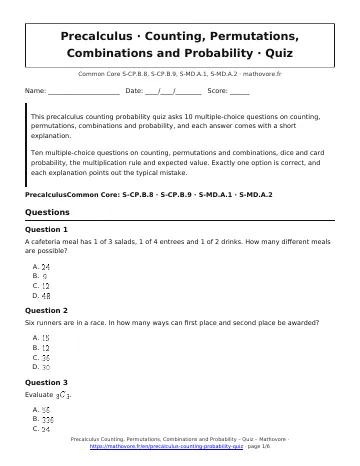
See every chapter on the Precalculus math page.