Key takeaway: This precalculus sequences series limits worksheet has 25 printable problems, from short sums to multi-step word problems. It covers sigma notation, arithmetic and geometric series, repeating decimals, the binomial theorem and informal limits. Standards A-SSE.B.4, A-APR.C.5 and F-BF.A.2 guide the sequence of tasks. A separate answer key explains every result, so you can check your own work after one honest attempt.
These 25 problems practice sigma notation, arithmetic and geometric series, infinite sums, the binomial theorem and informal limits (A-SSE.B.4, A-APR.C.5, F-BF.A.2). They run from short evaluations to multi-step word problems.
Show each step, keep fractions exact, and check every limit with a table of values.
Precalculus Sequences Series Limits Worksheet: problems 1–5
1. Evaluate a sum
Evaluate \(\sum_{k=1}^{5}(3k-1)\).
2. Sums of powers
Evaluate each sum.
- \(\sum_{k=1}^{4}k^{2}\)
- \(\sum_{k=0}^{3}2^{k}\)
3. Write in sigma notation
Write each sum in sigma notation.
- 3 + 6 + 9 + 12 + 15
- 2 + 4 + 8 + 16 + 32
4. Explicit and recursive rules
Write an explicit rule and a recursive rule for each sequence, then find the requested term.
- 5, 9, 13, 17, … ; find \(a_{20}\)
- 2, 6, 18, 54, … ; find \(a_{6}\)
5. Find the nth term
An arithmetic sequence has \(a_{1}=7\) and common difference \(d=4\).
- Find \(a_{20}\).
- Which term of the sequence equals 103?
Precalculus Sequences Series Limits Worksheet: problems 6–10
6. Arithmetic series
Find the sum of the first 15 terms of the arithmetic series \(12+19+26+\) … .
7. Decreasing series
Find \(100+97+94+\) … \(+4+1\).
8. Finite geometric series
Find each sum.
- \(3+6+12+\) … , first 8 terms
- \(81+27+9+3+1\) using the geometric series formula
9. Does it converge?
Decide whether each infinite geometric series converges. If it does, find its sum.
- 8 + 4 + 2 + 1 + …
- 5 + 10 + 20 + 40 + …
- 9 − 3 + 1 − 1/3 + …
- 2 + 2.2 + 2.42 + 2.662 + …
10. Infinite geometric sum
Find each sum.
- \(12+4+\frac{4}{3}+\frac{4}{9}+\) …
- \(\sum_{k=0}^{\infty}5(0.2)^{k}\)
Precalculus Sequences Series Limits Worksheet: problems 11–15
11. Repeating decimals
Write each repeating decimal as a fraction in lowest terms using an infinite geometric series.
- \(0.\overline{27}\)
- \(0.\overline{6}\)
12. Pascal's triangle
The triangle shows rows 0 through 6 with three entries missing.
- Find the three missing entries.
- Write row 7.
13. Expand a binomial
Expand each binomial.
- \((x+2)^{5}\)
- \((x-3)^{3}\)
14. Binomial with a coefficient
Expand \((2x-1)^{4}\).
15. Find a specific term
Use the binomial theorem.
- Find the coefficient of \(x^{3}\) in \((x+3)^{7}\).
- Find the term containing \(x^{2}\) in \((2x+1)^{6}\).
Precalculus Sequences Series Limits Worksheet: problems 16–20
16. Limit of a sequence
Let \(a_{n}=\frac{3n+1}{n+2}\).
- Find \(a_{10}\), \(a_{100}\) and \(a_{1000}\) to 4 decimal places.
- What is \(\lim_{n\to\infty}a_{n}\)?
17. Limit from a graph
The graph shows \(f(x)=\frac{x^{2}-9}{x-3}\).
- Is \(f(3)\) defined?
- Find \(\lim_{x\to 3}f(x)\).
18. Limit by factoring
Find each limit.
- \(\lim_{x\to 3}\frac{x^{2}+x-12}{x-3}\)
- \(\lim_{x\to 5}\frac{x^{2}-25}{x-5}\)
19. When does it converge?
Consider \(\sum_{k=0}^{\infty}(\frac{x}{3})^{k}\).
- For which values of x does the series converge?
- Find the sum when \(x=1\).
- Find the sum when \(x=-\frac{3}{2}\).
20. Theater seats
The bar chart shows the number of seats in rows 1 to 6 of the school auditorium, and the pattern continues. Find the total number of seats in rows 1 through 6, then in rows 1 through 20.
Precalculus Sequences Series Limits Worksheet: problems 21–25
21. Doubling savings
Mei saves 1 cent on day 1, 2 cents on day 2, 4 cents on day 3, and keeps doubling for 12 days. Find the total she saves, in dollars.
22. Salary raises
Jamal starts a job at $40,000 a year and gets a $2,500 raise every year. Write a recursive rule for his salary, then find his salary in year 10 and his total earnings over the first 10 years.
23. Bouncing ball
A ball is dropped from 10 feet and rebounds to 60% of its previous height on every bounce, as sketched. Find the total distance the ball travels before it comes to rest.
24. Medicine in the body
Ethan takes a 100 mg dose every morning. Overnight his body removes 80% of the drug, so 20% remains. Find the amount in his body just after the dose on day 3, and the long-run amount just after a dose.
25. Cleaning a pond
A filter removes 6 pounds of algae the first week, and each week after that it removes one third as much as the week before. The graph shows the total removed after n weeks. Estimate the long-run total from the graph, then find it exactly.

What do the first ten problems build?
Problem 1 asks for \(\sum_{k=1}^{5}(3k-1)\), which equals 40. Next, a countdown from 100 to 1 in steps of 3 appears in problem 7, so you must find the number of terms before you add. Finally, two infinite series meet in problem 9: the one with ratio \(\frac{1}{2}\) converges, while the one starting \(5+10+\cdots\) does not.
How do you expand the binomials in problems 12 to 15?
First, problem 12 fills missing entries of Pascal’s triangle. Then \((2x-1)^4\) in problem 14 needs care, because each power of 2 and each minus sign matters. After that, problem 15 asks for the coefficient of \(x^3\) in \((x+3)^7\), and that coefficient uses \(\binom\,{7}{3}\cdot3^4\).
Which word problems use geometric series?
Savings double for 12 days in problem 21, starting at 1 cent. In problem 23, a ball drops from 10 feet with a 60% rebound, so add the falls and the rises separately. Likewise, problem 24 follows a 100 mg daily dose, and problem 25 removes algae at one third of the previous rate.
How does the precalculus sequences series limits worksheet introduce limits?
Problem 16 tabulates \(a_n=\frac{3n+1}{n+2}\) for \(n=10, 100, 1000\). The values climb toward 3. Next, problems 17 and 18 ask you to factor a numerator to cancel a zero, which explains why a hole in a graph still has a limit.
How can you split the 25 problems over a week?
Do problems 1 to 8 on day one and 9 to 15 on day two. Leave the limits and applications for later days. Meanwhile, mark each slow problem with a star. Review only the starred ones before you open the answer key.

Printable PDF · Worksheet
Precalculus Series, Binomial Theorem and an Introduction to Limits worksheet
Download the PDF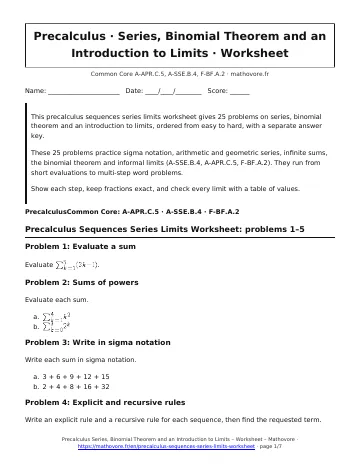
See every chapter on the Precalculus math page.