Key takeaway: This grade 1 measuring length lesson teaches first graders to tell which object is longer, shorter or the same length. Children line objects up at one end, and then they measure with same-size units laid end to end.
Every unit must touch the next one. So no gaps and no overlaps are the two golden rules.
Length tells how long something is. To compare objects, line them up at one end and see which one reaches farther. To measure, lay same-size units, such as cubes or paper clips, end to end with no gaps and no overlaps. Count the units. The count is the length, and a longer object needs more units.
Grade 1 Measuring Length Lesson: key facts
- Line up objects at one end to see which is longer, which is shorter, or if they are the same length.
- To order three objects, find the shortest and the longest. The last one is in the middle.
- A third object, like a string, can compare two objects that cannot sit side by side.
- Length units must be the same size and laid end to end with no gaps and no overlaps.
- The number of units that cover an object is its length, such as 7 cubes.
How do you compare lengths?
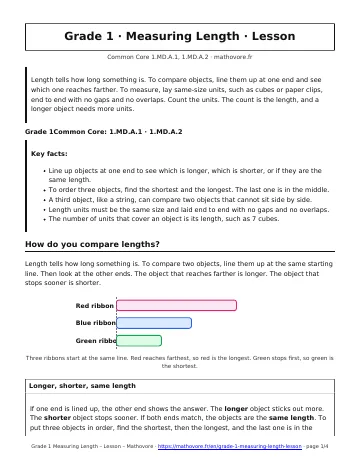
Length tells how long something is. To compare two objects, line them up at the same starting line. Then look at the other ends. The object that reaches farther is longer. The object that stops sooner is shorter.
If one end is lined up, the other end shows the answer. The longer object sticks out more. The shorter object stops sooner. If both ends match, the objects are the same length. To put three objects in order, find the shortest, then the longest, and the last one is in the middle.
How do you compare when objects cannot sit side by side?
Sometimes a shelf is too big to move next to a book. Use a third object to help. A string works well. Cut the string to match the book. Then hold the same string next to the shelf. The shelf is longer than the string, and the string is as long as the book. So the shelf is longer than the book.
How do you measure length with units?
A length unit is a small object you use again and again, such as a cube or a paper clip. All the units in one measurement must be the same size.
- Put the first unit at the very start of the object.
- Lay the next unit right after it. The units touch.
- Keep going until you reach the other end.
- Count the units. The number is the length.
Here is an example. Seven cubes cover the pencil from end to end. Count 1, 2, 3, 4, 5, 6, 7. The pencil is 7 cubes long.
What mistakes should you avoid?
A measurement is only right when the units are laid end to end with no gaps and no overlaps. The first unit must line up with the start of the object.
A longer object needs more of the same unit. A shorter object needs fewer. If one pencil is 9 cubes long and another is 6 cubes long, the 9-cube pencil is longer.
Measuring Length: frequently asked questions
What is length?
Length tells how long an object is from one end to the other. In first grade, children compare lengths and measure them with small units such as cubes or paper clips.
How do you tell which object is longer?
Line up the objects at the same starting line. Look at where each one ends. The object that reaches farther is longer, and the object that stops sooner is shorter.
Why can there be no gaps or overlaps when measuring?
Gaps leave out part of the length, so the count is too small. Overlaps count some of the length twice, so the count is too big. Units that touch give the true length.
Can a paper clip or a cube be a length unit?
Yes. Any object works as a unit if every unit in the measurement is the same size. Cubes, paper clips, and craft sticks are common choices in first grade.
How can you compare two objects with a third object?
Match the third object, like a string, to the first object. Then hold the string next to the second object. If the second object is longer than the string, it is also longer than the first object.
How do you compare lengths in a grade 1 measuring length lesson?
Place two pencils so their left ends sit on the same line. Next, compare the far ends. Whichever pencil reaches farther is longer. If both ends match, the pencils are the same length. Therefore the starting line matters a lot.
How do you order three objects?
First, find the shortest and the longest. The last object is in the middle. For example, a ribbon, a rope and a string can be ranked this way without any numbers.
What if two things are too far apart to touch?
A string can serve as a go-between. Cut the string to match a desk, and then hold it against the bookshelf. If the string is longer than the shelf, the desk is longer too. In other words, the string carries the length.
How do you measure with units?
Lay cubes or paper clips along the object with the first unit at the very start. Count them. However, a gap adds fake space, and an overlap hides real length. Both mistakes change the count.
What should children try at home?
Pick three household items, such as a spoon, a shoe and a book. Measure each one with paper clips, and then rank them. Afterward, compare your count with a friend who used a different unit.

See every chapter on the Grade 1 math page.