Key takeaway: This grade 1 addition within 20 worksheet has 22 problems with pictures, number lines and story problems. First graders practice counting on, making a ten and using doubles, and a printable answer key is included.
The early problems show ten frames and counters. In contrast, the final six items are tales of cookies, balloons and ducks.
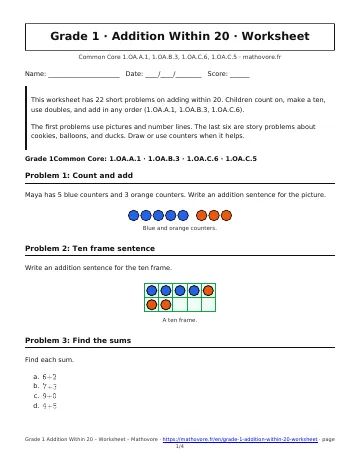
This worksheet has 22 short problems on adding within 20. Children count on, make a ten, use doubles, and add in any order (1.OA.A.1, 1.OA.B.3, 1.OA.C.6).
The first problems use pictures and number lines. The last six are story problems about cookies, balloons, and ducks. Draw or use counters when it helps.
Grade 1 Addition Within 20 Worksheet: problems 1–5
1. Count and add
Maya has 5 blue counters and 3 orange counters. Write an addition sentence for the picture.
2. Ten frame sentence
Write an addition sentence for the ten frame.
3. Find the sums
Find each sum.
- \(6+2\)
- \(7+3\)
- \(9+0\)
- \(4+5\)
4. Small doubles
Find each double.
- \(2+2\)
- \(3+3\)
- \(4+4\)
- \(5+5\)
5. Count on with a number line
Start at 5. Hop 4 times to find \(5+4\). Write the sum.
Grade 1 Addition Within 20 Worksheet: problems 6–10
6. Count on from the bigger number
Find \(3+8\) by starting at the bigger number and counting on.
7. Show a double
Write the double shown by the ten frames.
8. Near doubles
Use a double to help. Find each sum.
- \(7+8\)
- \(6+7\)
9. Make a ten with frames
Jamal has 9 blue counters and 4 orange counters. Write the sum of \(9+4\).
10. Make a ten with numbers
Fill in the missing numbers: \(8+6=8+2+\text{ __ }=10+\text{ __ }=\text{ __ }\)
Grade 1 Addition Within 20 Worksheet: problems 11–15
11. Switch the order
Sofia says \(3+9=12\). Write the same numbers in the other order and give the sum.
12. Circle the twelves
Circle the addition sentences that equal 12: \(6+6\), \(7+4\), \(8+4\), \(9+2\).
13. Three numbers
Find \(2+7+3\).
14. Three numbers again
Find \(4+6+5\).
15. Two sentences
Use the numbers 8, 5, and 13 to write two different addition sentences.
Grade 1 Addition Within 20 Worksheet: problems 16–20
16. Mixed sums
Find each sum.
- \(9+9\)
- \(10+7\)
- \(8+9\)
- \(7+7\)
17. Cookies at the bake sale
Sofia sold 8 cookies in the morning. She sold 5 more cookies in the afternoon. How many cookies did she sell in all?
18. Balloons
There are 7 red balloons and 6 blue balloons. How many balloons are there in all?
19. Missing stickers
Jamal had 9 stickers. He got some more stickers. Now he has 14 stickers. How many stickers did he get?
20. Zoo animals
At the zoo, Liam saw 5 monkeys, 4 zebras, and 6 lions. How many animals did he see in all?
Grade 1 Addition Within 20 Worksheet: problems 21–22
21. Ducks in the pond
Some ducks were in the pond. Then 6 more ducks swam in. Now there are 13 ducks. How many ducks were there at first?
22. Pages read this week
Diego read 6 pages on Monday, 7 pages on Tuesday, and 5 pages on Wednesday. How many pages did he read in all?

What does a 1st grade addition within 20 worksheet include?
Problem 1 shows 5 blue and 3 orange counters, and children write an addition sentence. Problem 3 gives 6 + 2, 7 + 3, 9 + 0 and 4 + 5. Next, problem 4 lists small doubles up to 5 + 5. Because these facts are short, children gain speed early.
How do the strategy problems work?
Problem 5 starts at 5 and hops 4 times on a number line. Problem 6 asks for 3 + 8 from the bigger number. Then problem 10 fills in blanks, so 8 + 6 turns into 8 + 2 + 4, which is 10 + 4. In addition, problem 8 uses 7 + 7 to help with 7 + 8.
Which problems check the order of addends?
Sofia says 3 + 9 = 12 in problem 11. Children flip it to 9 + 3 and see the same total. Problem 12 asks them to circle sums that equal 12 among 6 + 6, 7 + 4, 8 + 4 and 9 + 2. Notice that 7 + 4 is the odd one out.
How do the story problems get harder?
Problems 17 and 18 join two groups, such as 7 red and 6 blue balloons. However, problem 19 hides the change: Jamal had 9 stickers and now has 14. Problems 20 and 22 add three numbers, so children look for a ten first.
What is a good plan for this practice page?
Do the first eight problems on day one with counters nearby. Then finish the stories on day two. After that, check each sum with the answer key and mark any missing-number problem for a second try.

See every chapter on the Grade 1 math page.