


This grade 1 comparing numbers lesson explains comparing two-digit numbers in one printable page, with definitions, a method and a worked example.
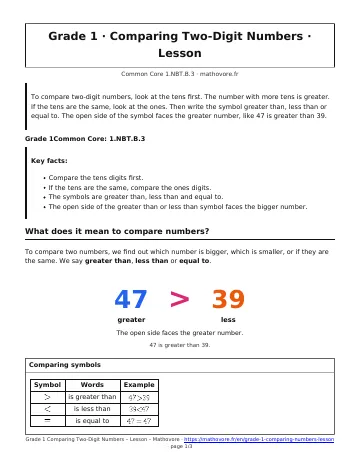
To compare two-digit numbers, look at the tens first. The number with more tens is greater. If the tens are the same, look at the ones. Then write the symbol greater than, less than or equal to. The open side of the symbol faces the greater number, like 47 is greater than 39.
Grade 1 Comparing Numbers Lesson: key facts
- Compare the tens digits first.
- If the tens are the same, compare the ones digits.
- The symbols are greater than, less than and equal to.
- The open side of the greater than or less than symbol faces the bigger number.
What does it mean to compare numbers?
To compare two numbers, we find out which number is bigger, which is smaller, or if they are the same. We say greater than, less than or equal to.
| Symbol | Words | Example |
|---|---|---|
| \(>\) | is greater than | \(47 > 39\) |
| \(< \) | is less than | \(39 < 47\) |
| \(=\) | is equal to | \(47 = 47\) |
How do you compare two-digit numbers?
- Look at the tens digits first. The number with more tens is greater.
- If the tens are the same, look at the ones. The number with more ones is greater.
- Write the symbol. The open side of the symbol faces the greater number.
Example: compare 47 and 39. The tens are 4 and 3. Since 4 tens is more than 3 tens, \(47 > 39\). We did not need the ones.
What if the tens are the same?
Compare 52 and 58. Both have 5 tens. Now look at the ones: 2 and 8. Since 2 is less than 8, \(52 < 58\).
Can a number line help?
On a number line, numbers go up as you move to the right. The number farther to the right is greater. Look at 43 and 47. Point 47 is to the right of point 43, so \(47 > 43\).
Why do the tens matter most?
One ten is the same as ten ones. So one more ten is a big jump. Look at 40 and 39. The number 39 has 9 ones, but 40 has 4 tens. Four tens is more than three tens, so \(40 > 39\). Always check the tens first, and you will not be fooled by big ones digits.
When are two numbers equal?
Two numbers are equal when they have the same tens and the same ones. 3 tens and 5 ones is the same as 35, so \(35 = 35\). Be careful: 35 and 53 are not the same. The digits are in different places.
Comparing Two-Digit Numbers: frequently asked questions
How do you compare two-digit numbers in first grade?
Look at the tens first. The number with more tens is greater. If the tens match, the number with more ones is greater.
Which symbol means greater than?
The symbol > means greater than. The open side faces the bigger number, as in 62 > 41.
Why do we look at the tens before the ones?
A ten is worth 10 ones, so one more ten beats any number of ones. That is why 40 is greater than 39.
How can I tell that two numbers are equal?
They are equal when both the tens and the ones are the same. We use the equal sign, like 56 = 56.
Is 29 greater than 31 because 9 is more than 1?
No. Always look at the tens first. 2 tens is less than 3 tens, so 29 is less than 31.
How to use this grade 1 comparing numbers lesson
Use this grade 1 comparing numbers lesson before the worksheet, then check what you learned with the quiz.

See every chapter on the Grade 1 math page.