Key takeaway: This grade 1 adding tens lesson shows first graders how to add and subtract tens within 100. Students learn that adding tens changes only the tens digit, a skill from the Common Core base-ten strand.
Each example pairs a short rule with a picture of tens and ones. As a result, children see why 27 + 30 is 57 before they practice on their own.
To add a one-digit number to a two-digit number, add the ones and keep the tens: 34 + 5 = 39. To add tens, change only the tens digit: 27 + 30 = 57. For 10 more or 10 less, change the tens digit by 1. To subtract tens: 7 tens – 3 tens = 4 tens.
Grade 1 Adding Tens Lesson: key facts
- Add the ones to the ones and keep the tens: 34 + 5 = 39.
- When you add tens, only the tens digit changes: 27 + 30 = 57.
- 10 more is one row down on a hundred chart. 10 less is one row up.
- Subtract tens like objects: 7 tens – 3 tens = 4 tens, so 70 – 30 = 40.
How do you add a one-digit number to a two-digit number?
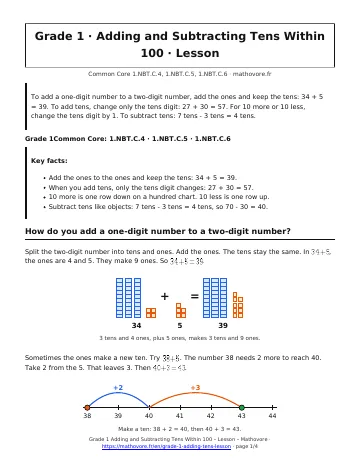
Split the two-digit number into tens and ones. Add the ones. The tens stay the same. In \(34 + 5\), the ones are 4 and 5. They make 9 ones. So \(34 + 5 = 39\).
Sometimes the ones make a new ten. Try \(38 + 5\). The number 38 needs 2 more to reach 40. Take 2 from the 5. That leaves 3. Then \(40 + 3 = 43\).
How do you add tens to a two-digit number?
Tens add to tens. The ones do not change. For \(27 + 30\), think 2 tens plus 3 tens. That is 5 tens. The 7 ones stay. So \(27 + 30 = 57\).
When you add a number of tens, only the tens digit changes. The ones digit stays the same. Example: \(46 + 20 = 66\).
How do you find 10 more or 10 less?
On a hundred chart, 10 more is one row down. 10 less is one row up. The ones digit stays the same. Only the tens digit changes by 1. You can do this in your head without counting by ones.
| Number | 10 less | 10 more |
|---|---|---|
| 52 | 42 | 62 |
| 67 | 57 | 77 |
| 81 | 71 | 91 |
How do you subtract tens?
Treat tens like objects. In \(70 – 30\), you have 7 tens. Take away 3 tens. 4 tens are left. That is 40.
- Look at the tens and the ones in each number.
- Add or subtract the tens, or add the ones.
- Put the tens and the ones back together.
- Check with a picture or a hundred chart.
Example. Ethan has 52 marbles and finds 7 more. The ones are 2 and 7, and they make 9. The tens stay at 5. So \(52 + 7 = 59\). Ethan has 59 marbles.
Adding and Subtracting Tens Within 100: frequently asked questions
How do you add 38 + 5?
Make a ten. The number 38 needs 2 more to make 40. Take 2 from the 5 and 3 is left. Then \(40 + 3 = 43\).
What is 10 more than a number?
Add 1 to the tens digit. The ones digit stays the same. 10 more than 64 is 74. On a hundred chart, move one row down.
How do you subtract 30 from 80?
Think of 80 as 8 tens. Take away 3 tens and 5 tens are left. So \(80 – 30 = 50\).
Why do the ones stay the same when you add tens?
Tens and ones are different place values. Adding 3 tens makes 3 more tens, so only the tens digit grows. In \(46 + 30 = 76\), the 6 ones stay.
Do I have to count by ones to find 10 less?
No. Look at the tens digit and make it 1 smaller. For 10 less than 82, the tens go from 8 to 7, so the answer is 72.
What does a grade 1 adding tens lesson explain?
Adding tens means putting whole groups of ten together. For example, 2 tens and 3 tens make 5 tens, so 20 + 30 = 50. Next, try a harder case: 27 + 30. The 7 ones do not move, but the 2 tens grow to 5 tens. Therefore the answer is 57.
How does a hundred chart help with 10 more and 10 less?
On a hundred chart, each row holds ten numbers. Moving one row down gives 10 more, and moving one row up gives 10 less. Start at 45 and step down once to land on 55. However, children often change the ones digit by mistake. Remind them that the ones digit stays put, because only whole tens move.
How do you add ones to a number with two digits?
First, add the ones to the ones. Then keep the tens as they are. In 34 + 5, the ones make 4 + 5 = 9, so the answer is 39. A number line shows the same idea when the ones cross a new ten, as in 38 + 5. Count up 2 to reach 40, and then count 3 more to reach 43.
Why is subtracting tens like subtracting objects?
Think of 7 tens take away 3 tens. Seven rods minus three rods leaves four rods, so 70 – 30 = 40. In the same way, 90 – 60 = 30. This works because the unit is a ten instead of a one.
Where should students go after this lesson?
Next, read the same numbers aloud as tens and ones before writing any sum. After that, use the matching worksheet to practice with blocks and charts. Finally, take the short quiz to check that every child can say how many tens are left.

See every chapter on the Grade 1 math page.