Key takeaway: This grade 1 addition worksheet answer key lists all 22 worked solutions for the sums within 20 page. Each answer names the strategy, so parents and teachers can see how a first grader got there.
Read a solution aloud with the child. Then ask the child to try a similar fact without help.
Here are the full worked answers for the Grade 1 addition worksheet. Each answer shows the strategy: counting on, making a ten, or using a double. Read each step with the child, then let the child try a similar problem alone.
Grade 1 Addition Worksheet Answer Key: problems 1–5
1. Count and add
Count the blue ones: 5. Count the orange ones: 3. Put them together: \(5+3=8\).
\(5+3=8\)
2. Ten frame sentence
There are 4 blue counters and 3 orange counters. \(4+3=7\).
\(4+3=7\)
3. Find the sums
- \(6+2=8\)
- \(7+3=10\)
- \(9+0=9\). Adding 0 changes nothing.
- \(4+5=9\)
8, 10, 9, 9
4. Small doubles
- \(2+2=4\)
- \(3+3=6\)
- \(4+4=8\)
- \(5+5=10\)
4, 6, 8, 10
5. Count on with a number line
Hop one step at a time: 6, 7, 8, 9. You land on 9.
\(5+4=9\)
Grade 1 Addition Worksheet Answer Key: problems 6–10
6. Count on from the bigger number
The bigger number is 8. Start at 8 and count on 3: 9, 10, 11.
\(3+8=11\)
7. Show a double
Each frame shows 6. Six plus six is a double.
\(6+6=12\)
8. Near doubles
- \(7+7=14\), and one more is 15. \(7+8=15\).
- \(6+6=12\), and one more is 13. \(6+7=13\).
15 and 13
9. Make a ten with frames
The first frame needs 1 more. Move 1 orange counter. Now the first frame has 10 and the second has 3. \(10+3=13\).
\(9+4=13\)
10. Make a ten with numbers
Split 6 into 2 and 4. \(8+2=10\). Then \(10+4=14\).
4, 4, 14
Grade 1 Addition Worksheet Answer Key: problems 11–15
11. Switch the order
Switch 3 and 9. The sum stays the same.
\(9+3=12\)
12. Circle the twelves
\(6+6=12\), \(7+4=11\), \(8+4=12\), \(9+2=11\).
\(6+6\) and \(8+4\)
13. Three numbers
Find two numbers that make 10: \(7+3=10\). Then add 2: \(10+2=12\).
12
14. Three numbers again
\(4+6=10\). Then \(10+5=15\).
15
15. Two sentences
The parts are 8 and 5. The sum is 13. Switch the parts for the second sentence.
\(8+5=13\) and \(5+8=13\)
Grade 1 Addition Worksheet Answer Key: problems 16–20
16. Mixed sums
- \(9+9=18\)
- \(10+7=17\)
- \(8+8=16\), and one more is 17. \(8+9=17\)
- \(7+7=14\)
18, 17, 17, 14
17. Cookies at the bake sale
Add the parts: \(8+5\). Make a ten: \(8+2=10\), then \(10+3=13\).
13 cookies
18. Balloons
Think of the double \(6+6=12\). Seven is one more than 6, so add 1: 13.
13 balloons
19. Missing stickers
Think: 9 plus what number makes 14? Count on from 9: 10, 11, 12, 13, 14. That is 5 counts. Check: \(9+5=14\).
5 stickers
20. Zoo animals
Add 4 and 6 first because they make 10: \(4+6=10\). Then \(10+5=15\).
15 animals
Grade 1 Addition Worksheet Answer Key: problems 21–22
21. Ducks in the pond
Think: what number plus 6 makes 13? Try 7: \(7+6=13\). It works.
7 ducks
22. Pages read this week
\(6+7=13\). Then \(13+5=18\). Check by another order: \(5+7=12\), and \(12+6=18\).
18 pages
What are the answers on the grade 1 addition worksheet?
First, problem 3 gives 8, 10, 9 and 9. Next, problem 4 gives 4, 6, 8 and 10. After that, problem 16 gives 18, 17, 17 and 14. Finally, problem 13 gives 12 and problem 14 gives 15.
How do you check the story problems?
Sofia sold 8 + 5 = 13 cookies. Then the balloons give 7 + 6 = 13. In problem 20, 5 + 4 + 6 makes 15 animals, because 4 + 6 is a ten. For problem 22, Diego read 6 + 7 + 5 = 18 pages.
Why are the missing-addend problems tricky?
Problem 19 asks how many stickers Jamal got after having 9 and ending with 14. Count up from 9 to 14, so the answer is 5. Likewise, problem 21 starts with some ducks, and 6 swim in to make 13. Therefore 7 ducks were there first. Children who write 19 added when they should have counted up.
What should you do when a sum is wrong?
First, ask the child to draw counters on a ten frame. Then compare the drawing with the solution step. For example, an answer of 14 for 7 + 8 often means the child used 7 + 7 and forgot the extra one.
How can families use these solutions?
Cover the key, let your child say a strategy, and then reveal it. After that, praise the thinking before the number. Later in the week, repeat only the missed facts with real counters or coins.

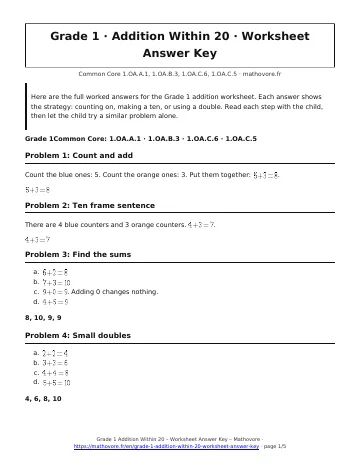
See every chapter on the Grade 1 math page.