


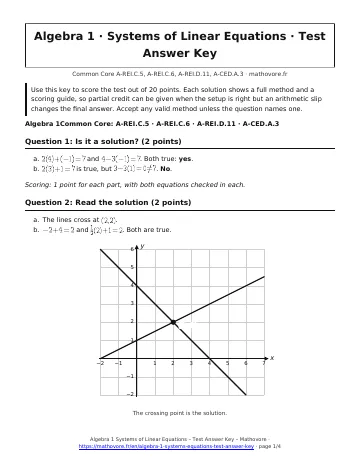
Question 1: Is it a solution? (2 points)
- \(2(4)+(-1)=7\) and \(4-3(-1)=7\). Both true: yes.
- \(2(3)+1=7\) is true, but \(3-3(1)=0\neq 7\). No.
Scoring: 1 point for each part, with both equations checked in each.
Question 2: Read the solution (2 points)
- The lines cross at \((2, 2)\).
- \(-2+4=2\) and \(\frac{1}{2}(2)+1=2\). Both are true.
Scoring: 1 point for the point, 1 point for checking both equations.
Question 3: Solve by graphing (2 points)
Line 1 passes through \((0, -1)\) and \((2, 1)\). Line 2 passes through \((0, 5)\) and \((2, 1)\). They cross at \((2, 1)\).
Scoring: 1 point for both lines graphed correctly, 1 point for the solution.
Question 4: Substitution (2 points)
Substitute: \(3x+2(4x-7)=8\), so \(11x-14=8\) and \(x=2\). Then \(y=4(2)-7=1\).
Check: \(3(2)+2(1)=8\).
The solution is \((2, 1)\).
Scoring: 1 point for \(x=2\), 1 point for \(y=1\).
Question 5: Opposite coefficients (2 points)
Add the equations: \(7x=-14\), so \(x=-2\). Then \(5(-2)+3y=-1\) gives \(3y=9\) and \(y=3\).
Check: \(2(-2)-3(3)=-13\).
The solution is \((-2, 3)\).
Scoring: 1 point for \(x=-2\), 1 point for \(y=3\).
Question 6: Multiply first (2 points)
Multiply the first equation by \(3\) and the second by \(2\): \(9x+6y=30\) and \(10x+6y=34\).
Subtract: \(x=4\). Then \(12+2y=10\) gives \(y=-1\).
Check: \(5(4)+3(-1)=17\).
The solution is \((4, -1)\).
Scoring: 1 point for a correct elimination setup with \(x=4\), 1 point for \(y=-1\).
Question 7: Count the solutions (2 points)
- \(6x+2y=4\) gives \(y=-3x+2\), the same line. Infinitely many solutions.
- \(4x-2y=6\) gives \(y=2x-3\). The slopes are equal (\(2\)) and the intercepts differ (\(-3\) and \(5\)). No solution.
Scoring: 1 point per part, for the correct count with a valid reason.
Question 8: Explain elimination (2 points)
- A solution makes \(3x+y=11\) and \(2x-y=4\) both true. Adding equal amounts to both sides of equations keeps them true, so the sum \(5x=15\) is also true for that pair.
- \(x=3\). Then \(3(3)+y=11\) gives \(y=2\). Check: \(2(3)-2=4\). The solution is \((3, 2)\).
Scoring: 1 point for an explanation based on equal quantities added to equal quantities, 1 point for \((3, 2)\).
Question 9: Ticket problem (2 points)
Let \(s\) be student tickets and \(a\) adult tickets: \(s+a=150\) and \(6s+10a=1100\).
Substitute \(s=150-a\): \(900-6a+10a=1100\), so \(4a=200\) and \(a=50\). Then \(s=100\).
Check: \(6(100)+10(50)=1100\).
100 student tickets and 50 adult tickets.
Scoring: 1 point for a correct system, 1 point for the two answers.
Question 10: Gym memberships (2 points)
- Gym A: \(C=20m+30\). Gym B: \(C=35m\).
- \(20m+30=35m\), so \(30=15m\) and \(m=2\). Cost: \(35(2)=70\), and \(20(2)+30=70\). After 2 months, both cost \(\$70\).
Scoring: 1 point for both equations, 1 point for \(m=2\) and \(\$70\).
20 points
See every chapter on the Algebra 1 math page.