This grade 5 decimal operations lesson explains operations with decimals in one printable page, with definitions, a method and a worked example.
Decimal operations work like whole-number operations once place value is respected. To add or subtract, line up the decimal points. To multiply, multiply as whole numbers and count decimal places. To divide, make the divisor a whole number by multiplying both numbers by 10 or 100, then divide.
Grade 5 Decimal Operations Lesson: key facts
- Line up decimal points before adding or subtracting.
- Write zeros in empty places, such as 2.8 as 2.80, to keep columns even.
- A product has as many decimal places as both factors together.
- Multiplying the divisor and dividend by the same power of 10 keeps the quotient.
- Estimate first, then use the inverse operation to check.
How do you add and subtract decimals?
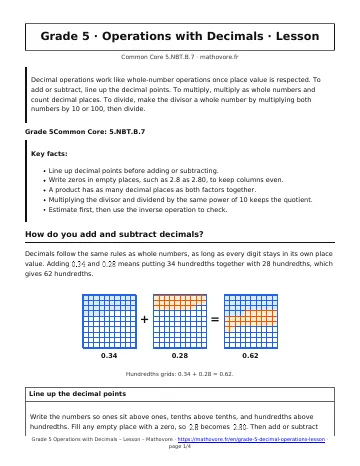
Decimals follow the same rules as whole numbers, as long as every digit stays in its own place value. Adding \(0.34\) and \(0.28\) means putting 34 hundredths together with 28 hundredths, which gives 62 hundredths.
Write the numbers so ones sit above ones, tenths above tenths, and hundredths above hundredths. Fill any empty place with a zero, so \(2.8\) becomes \(2.80\). Then add or subtract from right to left, regrouping when needed. The decimal point in the answer sits directly below the points above it.
How do you multiply decimals?
A product of two tenths is a number of hundredths. On the grid, the rows show \(0.4\) and the columns show \(0.3\). They overlap in 12 small squares, so \(0.4 \times 0.3 = 0.12\). The product is smaller than both factors because each factor is less than 1.
Follow these steps to multiply without a grid. Example: Grapes cost $0.60 per pound and Jamal buys 2.5 pounds, so find \(2.5 \times 0.6\) dollars.
- Ignore the decimal points and multiply: \(25 \times 6 = 150\).
- Count the decimal places in both factors: 1 + 1 = 2.
- Give the product that many decimal places: \(1.50\), which equals \(1.5\).
- Check with an estimate: \(2.5 \times 0.6\) is close to \(3 \times 0.5 = 1.5\).
How do you divide decimals?
Division asks how many groups fit, or how big each group is. Six tenths split into groups of two tenths make 3 groups, so \(0.6 : 0.2 = 3\).
When the divisor is a decimal, multiply the divisor and the dividend by the same power of 10 until the divisor is a whole number. The quotient does not change.
| Operation | Key move |
|---|---|
| Add or subtract | Line up decimal points |
| Multiply | Multiply as whole numbers, then count decimal places |
| Divide | Make the divisor whole by multiplying both numbers by 10 or 100 |
How can you check a decimal answer?
Estimate with friendly numbers first, then compare. Use the inverse operation too: if \(6.25 – 2.8 = 3.45\), then \(3.45 + 2.8\) must equal \(6.25\).
Operations with Decimals: frequently asked questions
Why do you line up decimal points when adding?
Digits in the same column have the same place value, so only they can be added together. Lining up the points puts tenths with tenths and hundredths with hundredths.
Why is 0.4 × 0.3 smaller than both factors?
Multiplying by a number less than 1 takes only part of the other number. Four tenths of three tenths is 12 hundredths, or 0.12, which is less than 0.3 and 0.4.
How many decimal places does a product have?
Count the decimal places in each factor and add them. For 1.2 × 0.35, multiply 12 × 35 = 420. The factors have 1 + 2 = 3 places, so the product is 0.420, or 0.42.
How do you divide by a decimal like 0.4?
Multiply the divisor and the dividend by 10 so the divisor becomes 4. For 7.2 ÷ 0.4 you divide 72 by 4 and get 18. The quotient stays the same.
How can you tell if a decimal answer is reasonable?
Round each number to a friendly one and compute mentally. If 4.9 × 3.1 is close to 5 × 3 = 15, an answer of 1.519 or 151.9 cannot be right.
How to use this grade 5 decimal operations lesson
Use this grade 5 decimal operations lesson before the worksheet, then check what you learned with the quiz.

See every chapter on the Grade 5 math page.