


This grade 2 subtract within 100 lesson explains subtracting within 100 in one printable page, with definitions, a method and a worked example.
Subtracting within 100 means finding what is left, or the missing part, when both numbers are less than 100. Subtract tens from tens and ones from ones. If the top number has too few ones, trade 1 ten for 10 ones first. This is called regrouping. Check the answer by adding it to the number you subtracted.
Grade 2 Subtract Within 100 Lesson: key facts
- Subtract ones from ones and tens from tens.
- If there are not enough ones, trade 1 ten for 10 ones (regroup).
- Regrouping does not change the value: 52 is the same as 4 tens and 12 ones.
- You can count up on a number line to find the difference.
- Check a subtraction by adding the answer to the number you subtracted.
What does it mean to subtract?
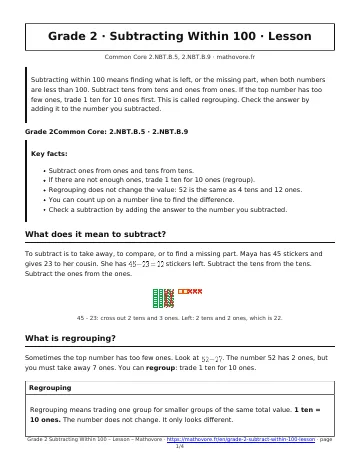
To subtract is to take away, to compare, or to find a missing part. Maya has 45 stickers and gives 23 to her cousin. She has \(45 – 23 = 22\) stickers left. Subtract the tens from the tens. Subtract the ones from the ones.
What is regrouping?
Sometimes the top number has too few ones. Look at \(52 – 27\). The number 52 has 2 ones, but you must take away 7 ones. You can regroup: trade 1 ten for 10 ones.
Regrouping means trading one group for smaller groups of the same total value. 1 ten = 10 ones. The number does not change. It only looks different.
Now 52 is 4 tens and 12 ones. It is still 52, because \(40 + 12 = 52\).
How do you subtract with regrouping?
- Look at the ones. Is the top digit smaller than the bottom digit?
- If yes, trade 1 ten for 10 ones. The tens digit goes down by 1. The ones digit goes up by 10.
- Subtract the ones.
- Subtract the tens.
- Check by adding the answer to the number you took away.
Worked example: \(52 – 27\). Ones: \(2\) is less than \(7\), so trade. Now we have 4 tens and 12 ones. Then \(12 – 7 = 5\) and \(4 – 2 = 2\). The answer is \(25\).
How can a number line help?
You can count up from the small number to the big number. For \(81 – 38\), start at 38. Jump 2 to reach 40. Jump 40 to reach 80. Jump 1 to reach 81. Add the jumps: \(2 + 40 + 1 = 43\). So \(81 – 38 = 43\).
How do you check a subtraction?
Subtraction and addition are partners. If \(52 – 27 = 25\), then \(25 + 27\) must be 52. Add back to check.
Why do these strategies work?
Regrouping works because the total stays the same. Counting up works because the jumps add up to the gap between the two numbers. Another trick: \(81 – 38\) is close to \(81 – 40 = 41\). You took away 2 too many, so add 2 back: \(41 + 2 = 43\).
Subtracting Within 100: frequently asked questions
What is regrouping in subtraction?
Regrouping means trading 1 ten for 10 ones so that you have enough ones to subtract. For example, 52 becomes 4 tens and 12 ones. The number stays 52.
Why do we trade a ten for 10 ones?
One ten is worth exactly 10 ones. Trading gives you more ones to take away, and the total value does not change. That is why the answer is still correct.
Can I always subtract the smaller digit from the bigger digit?
No. In 52 – 27 the ones are 2 and 7. If you do 7 – 2 = 5 you get 35, which is wrong. The top number is 52, so you must regroup. The right answer is 25.
How do I subtract when the ones digit is 0?
Trade 1 ten for 10 ones. For 60 – 27, think of 60 as 5 tens and 10 ones. Then 10 – 7 = 3 and 5 – 2 = 3, so the answer is 33.
How can I check my subtraction?
Add your answer to the number you subtracted. If you get the starting number, you are right. For 52 – 27 = 25, check that 25 + 27 = 52.
How to use this grade 2 subtract within 100 lesson
Use this grade 2 subtract within 100 lesson before the worksheet, then check what you learned with the quiz.

See every chapter on the Grade 2 math page.