


This grade 1 addition within 20 lesson explains addition within 20 in one printable page, with definitions, a method and a worked example.
Addition puts two or more groups together to find how many in all. The answer is called the sum. In Grade 1, children add within 20 by counting on, making a ten, and using doubles. Adding in a different order gives the same sum, so \(4+9\) and \(9+4\) both equal 13.
Grade 1 Addition Within 20 Lesson: key facts
- Addition puts groups together. The answer is the sum, like \(5+3=8\).
- Counting on: start at the bigger number, then count up the smaller one.
- Making a ten: move counters to fill a ten frame, then add the rest.
- Doubles such as \(6+6=12\) help with near doubles such as \(6+7=13\).
- Order does not matter: \(8+5\) and \(5+8\) both equal 13.
What does it mean to add?
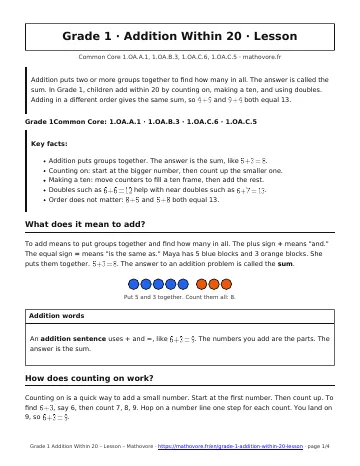
To add means to put groups together and find how many in all. The plus sign + means "and." The equal sign = means "is the same as." Maya has 5 blue blocks and 3 orange blocks. She puts them together. \(5+3=8\). The answer to an addition problem is called the sum.
An addition sentence uses + and =, like \(6+3=9\). The numbers you add are the parts. The answer is the sum.
How does counting on work?
Counting on is a quick way to add a small number. Start at the first number. Then count up. To find \(6+3\), say 6, then count 7, 8, 9. Hop on a number line one step for each count. You land on 9, so \(6+3=9\).
Tip: start with the bigger number. For \(2+8\), start at 8 and count on 2: 9, 10. The sum is 10.
How do you make a ten?
Ten is an easy number to work with. A ten frame holds 10 counters. To find \(8+5\), put 8 counters in a frame. The frame needs 2 more to be full. Take 2 from the 5. Now the frame is full, and 3 are left.
- Look at the bigger number: 9 in \(9+4\).
- Ask how many more make 10. Nine needs 1.
- Split 4 into 1 and 3.
- Add \(9+1=10\).
- Add the rest: \(10+3=13\). So \(9+4=13\).
What are doubles?
A double adds the same number twice. \(4+4=8\), \(6+6=12\), and \(7+7=14\) are doubles. Doubles are easy to remember. Use them to find nearby sums. \(7+8\) is one more than \(7+7\), so it is 15.
Does the order of the numbers matter?
No. You can add numbers in any order and get the same sum. \(4+9=13\) and \(9+4=13\). When you add three numbers, look for two that make 10 first. For \(3+7+5\), add \(3+7=10\), then \(10+5=15\).
Switching the numbers does not change the sum. Pick the order that makes the problem easiest.
Addition Within 20: frequently asked questions
What is the sum in an addition problem?
The sum is the answer when you add. In \(7+5=12\), the sum is 12. It tells how many there are in all.
What is the easiest way to add 9 + 6?
Make a ten. Nine needs 1 more to make 10, so take 1 from the 6. Then \(10+5=15\). The sum of \(9+6\) is 15.
Is 3 + 8 the same as 8 + 3?
Yes. Adding in a different order gives the same sum. Both \(3+8\) and \(8+3\) equal 11. Starting with 8 and counting on 3 is the quicker way.
How do you add three numbers?
Look for two numbers that make 10 and add them first. In \(4+6+5\), add \(4+6=10\), then \(10+5=15\).
What is a doubles fact?
A doubles fact adds a number to itself, like \(8+8=16\). Near doubles are one more or one less. \(8+9\) is 8 + 8 and 1 more, which is 17.
How to use this grade 1 addition within 20 lesson
Use this grade 1 addition within 20 lesson before the worksheet, then check what you learned with the quiz.

See every chapter on the Grade 1 math page.