Key takeaway: This precalculus complex identities volume test takes about 45 minutes and contains 8 questions that sum to 20 points. It measures factoring over the complex numbers, powers of \(i\), and the volume of a sphere through Cavalieri’s principle (N-CN.C.8, G-GMD.A.2). Leave results exact unless a question names a decimal; a calculator helps only there. The printable PDF carries every figure.
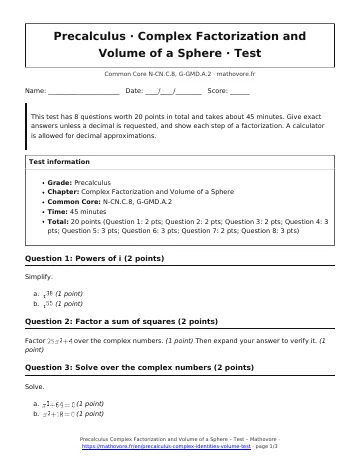
This test has 8 questions worth 20 points in total and takes about 45 minutes. Give exact answers unless a decimal is requested, and show each step of a factorization. A calculator is allowed for decimal approximations.
- Grade: Precalculus
- Chapter: Complex Factorization and Volume of a Sphere
- Common Core: N-CN.C.8, G-GMD.A.2
- Time: 45 minutes
- Total: 20 points (Question 1: 2 pts; Question 2: 2 pts; Question 3: 2 pts; Question 4: 3 pts; Question 5: 3 pts; Question 6: 3 pts; Question 7: 2 pts; Question 8: 3 pts)
Precalculus Complex Identities Volume Test: questions 1–5
1. Powers of i (2 points)
Simplify.
- \(i^{38}\) (1 point)
- \(i^{55}\) (1 point)
2. Factor a sum of squares (2 points)
Factor \(25x^{2}+4\) over the complex numbers. (1 point) Then expand your answer to verify it. (1 point)
3. Solve over the complex numbers (2 points)
Solve.
- \(x^{2}+64=0\) (1 point)
- \(x^{2}+18=0\) (1 point)
4. Fourth-degree factorization (3 points)
Factor \(x^{4}-256\) completely over the complex numbers.
5. Quadratic with no real zeros (3 points)
The graph of \(y=x^{2}-6x+25\) is shown.
- Explain from the graph why the quadratic has no real zeros. (1 point)
- Factor \(x^{2}-6x+25\) over the complex numbers. (2 points)
Precalculus Complex Identities Volume Test: questions 6–8
6. Matching cross-sections (3 points)
A hemisphere of radius \(5\) ft and a cylinder of radius \(5\) ft and height \(5\) ft with a cone removed are each cut by a plane \(3\) ft above their base.
- Find the area of the cross-section of the hemisphere. (1 point)
- Find the area of the cross-section of the cylinder with the cone removed. (1 point)
- State what Cavalieri’s principle concludes if this holds at every height. (1 point)
7. Volume from a cylinder and a cone (2 points)
A cylinder and a cone each have radius \(6\) in. and height \(6\) in.
- Find the volume of the cylinder with the cone removed. (1 point)
- Use that result to find the volume of a sphere of radius \(6\) in. (1 point)
8. Spherical tank (3 points)
A spherical storage tank has a diameter of \(20\) ft.
- Find its exact volume. (1 point)
- Find its volume to the nearest tenth of a cubic foot. (1 point)
- Find the capacity in gallons to the nearest gallon, using 1 cubic foot = 7.48 gallons. (1 point)

What do the early questions check?
First, you simplify \(i^{38}\) and \(i^{55}\) in question 1. Then comes \(25x^{2}+4\) in question 2, which must be factored and expanded as proof. After that, question 3 solves \(x^{2}+64=0\) and \(x^{2}+18=0\), where the second answer needs a simplified radical. Because each part is worth only 1 point, move quickly through these.
Which questions carry more weight?
A 3-point factorization of \(x^{4}-256\) anchors question 4. Splitting it twice takes care, so write the intermediate difference of squares. Next, the graph of \(y=x^{2}-6x+25\) appears in question 5, and you explain why no real zeros exist. For full credit, mention that the curve never touches the x-axis, and note the discriminant of \(-64\).
How do the volume questions fit together?
In question 6, a hemisphere of radius 5 feet meets a cylinder minus a cone at a given height. Then a cylinder and cone with radius 6 inches and height 6 inches appear in question 7. Finally, a spherical tank has diameter 20 feet in question 8, so halve it before you cube. Always add units to all three answers.
Plan your time this way: about 20 minutes on algebra, 15 on volume and 10 on checking.
How can you prepare in the days before?
Practice the cycle of powers of \(i\) until it feels automatic. Meanwhile, rehearse the Cavalieri argument aloud in three sentences. If you can explain why two slices have equal area, the formula will stay with you under pressure.

See every chapter on the Precalculus math page.