This precalculus sequences series worksheet answer key solves all 25 problems of the series, binomial theorem and an introduction to limits worksheet step by step.
Every solution below shows the formula used, the substitution and the final value in bold. Use it to find the exact step where a mistake crept in, especially for ratios, term counts and signs in binomial expansions.
Precalculus Sequences Series Worksheet Answer Key: problems 1–5
Problem 1: Evaluate a sum
Substitute \(k=1,2,3,4,5\) into \(3k-1\): 2, 5, 8, 11, 14.
\(2+5+8+11+14=\)40
Problem 2: Sums of powers
- \(1+4+9+16=\)30
- \(1+2+4+8=\)15
Problem 3: Write in sigma notation
- Each term is \(3k\) for \(k=1\) to 5: \(\sum_{k=1}^{5}3k\)
- Each term is \(2^{k}\) for \(k=1\) to 5: \(\sum_{k=1}^{5}2^{k}\)
Problem 4: Explicit and recursive rules
- Common difference 4. Explicit: \(a_{n}=5+4(n-1)=4n+1\). Recursive: \(a_{1}=5\), \(a_{n}=a_{n-1}+4\). \(a_{20}=4(20)+1=\)81
- Common ratio 3. Explicit: \(a_{n}=2\cdot 3^{n-1}\). Recursive: \(a_{1}=2\), \(a_{n}=3a_{n-1}\). \(a_{6}=2\cdot 3^{5}=2\cdot 243=\)486
Problem 5: Find the nth term
- \(a_{20}=7+4(19)=7+76=\)83
- \(7+4(n-1)=103\Rightarrow 4(n-1)=96\Rightarrow n-1=24\), so term 25
Precalculus Sequences Series Worksheet Answer Key: problems 6–10
Problem 6: Arithmetic series
\(d=7\), so \(a_{15}=12+7(14)=110\).
\(S_{15}=\frac{15(12+110)}{2}=15\cdot 61=\)915
Problem 7: Decreasing series
\(d=-3\). Solve \(100-3(n-1)=1\): \(n-1=33\), so \(n=34\) terms.
\(S_{34}=\frac{34(100+1)}{2}=17\cdot 101=\)1,717
Problem 8: Finite geometric series
- \(r=2\): \(S_{8}=\frac{3(1-2^{8})}{1-2}=\frac{3(-255)}{-1}=\)765
- \(r=\frac{1}{3}\), \(n=5\): \(S_{5}=\frac{81(1-\frac{1}{243})}{\frac{2}{3}}=81\cdot\frac{242}{243}\cdot\frac{3}{2}=\)121
Problem 9: Does it converge?
- \(r=\frac{1}{2}\), \(|r| < 1\): converges to \(\frac{8}{1-1/2}=\)16
- \(r=2\): diverges
- \(r=-\frac{1}{3}\): converges to \(\frac{9}{1+1/3}=\frac{9}{4/3}=\)27/4
- \(r=1.1\): diverges
Problem 10: Infinite geometric sum
- \(r=\frac{1}{3}\): \(\frac{12}{1-1/3}=12\cdot\frac{3}{2}=\)18
- \(\frac{5}{1-0.2}=\frac{5}{0.8}=\)6.25
Precalculus Sequences Series Worksheet Answer Key: problems 11–15
Problem 11: Repeating decimals
- \(0.27+0.0027+\) … has \(a_{1}=0.27\), \(r=0.01\): \(\frac{0.27}{0.99}=\frac{27}{99}=\)3/11
- \(a_{1}=0.6\), \(r=0.1\): \(\frac{0.6}{0.9}=\)2/3
Problem 12: Pascal's triangle
Each entry is the sum of the two above it: row 5 is 1, 5, 10, 10, 5, 1 and row 6 is 1, 6, 15, 20, 15, 6, 1.
- The missing entries are 10, 15 and 20.
- Row 7: 1, 7, 21, 35, 35, 21, 7, 1
Problem 13: Expand a binomial
- Row 5 is 1, 5, 10, 10, 5, 1: \(x^{5}+5\cdot 2x^{4}+10\cdot 4x^{3}+10\cdot 8x^{2}+5\cdot 16x+32=\)\(x^{5}+10x^{4}+40x^{3}+80x^{2}+80x+32\)
- Row 3 is 1, 3, 3, 1 with \(b=-3\): \(x^{3}+3(-3)x^{2}+3(9)x+(-27)=\)\(x^{3}-9x^{2}+27x-27\)
Problem 14: Binomial with a coefficient
Row 4 is 1, 4, 6, 4, 1 with \(a=2x\) and \(b=-1\).
\((2x)^{4}+4(2x)^{3}(-1)+6(2x)^{2}(1)+4(2x)(-1)+1=\)\(16x^{4}-32x^{3}+24x^{2}-8x+1\)
Problem 15: Find a specific term
- The \(x^{3}\) term is \(C(7,3)\,x^{3}\,3^{4}=35\cdot 81\,x^{3}\). The coefficient is 2,835.
- \(C(6,2)(2x)^{2}(1)^{4}=15\cdot 4x^{2}=\)\(60x^{2}\)
Precalculus Sequences Series Worksheet Answer Key: problems 16–20
Problem 16: Limit of a sequence
- \(a_{10}=\frac{31}{12}\approx 2.5833\); \(a_{100}=\frac{301}{102}\approx 2.9510\); \(a_{1000}=\frac{3001}{1002}\approx 2.9950\)
- Divide top and bottom by \(n\): \(\frac{3+1/n}{1+2/n}\to\frac{3}{1}\). The limit is 3.
Problem 17: Limit from a graph
- No. Substituting \(x=3\) gives \(\frac{0}{0}\), which is why the graph has an open circle.
- Values near 3 approach the height of the hole: 6.
Problem 18: Limit by factoring
- \(\frac{(x+4)(x-3)}{x-3}=x+4\) for \(x\neq 3\), so the limit is 7.
- \(\frac{(x+5)(x-5)}{x-5}=x+5\) for \(x\neq 5\), so the limit is 10.
Problem 19: When does it converge?
- The ratio is \(\frac{x}{3}\). Convergence needs \(|\frac{x}{3}| < 1\), so \(-3 < x < 3\).
- \(r=\frac{1}{3}\): \(\frac{1}{1-1/3}=\)3/2
- \(r=-\frac{1}{2}\): \(\frac{1}{1+1/2}=\)2/3
Problem 20: Theater seats
The seats rise by 3 each row, so \(a_{n}=4+3(n-1)\).
Rows 1 to 6: \(S_{6}=\frac{6(4+19)}{2}=\)69 seats.
Row 20 has \(a_{20}=4+57=61\) seats, so \(S_{20}=\frac{20(4+61)}{2}=\)650 seats.
Precalculus Sequences Series Worksheet Answer Key: problems 21–25
Problem 21: Doubling savings
Geometric with \(a_{1}=0.01\), \(r=2\), \(n=12\).
\(S_{12}=\frac{0.01(1-2^{12})}{1-2}=0.01(4095)=\)$40.95
Problem 22: Salary raises
Recursive: \(a_{1}=40000\), \(a_{n}=a_{n-1}+2500\).
Year 10: \(a_{10}=40000+9(2500)=\)$62,500.
Total: \(S_{10}=\frac{10(40000+62500)}{2}=\)$512,500.
Problem 23: Bouncing ball
Down 10 ft first. After that each bounce goes up and down: heights 6, 3.6, 2.16, … form a geometric series with \(a_{1}=6\), \(r=0.6\).
Up-and-down total: \(2\cdot\frac{6}{1-0.6}=2\cdot 15=30\).
Distance: \(10+30=\)40 feet.
Problem 24: Medicine in the body
Day 1: 100 mg. Day 2: \(100+0.2(100)=120\) mg. Day 3: \(100+0.2(120)=124\) mg, so 124 mg.
Day \(n\) is \(100(1+0.2+0.2^{2}+\) … \()\). The long-run total is \(\frac{100}{1-0.2}=\)125 mg.
Problem 25: Cleaning a pond
The points level off near 9 pounds.
Exactly: \(a_{1}=6\), \(r=\frac{1}{3}\), so the total is \(\frac{6}{1-1/3}=6\cdot\frac{3}{2}=\)9 pounds.
How to use this precalculus sequences series worksheet answer key
Read this precalculus sequences series worksheet answer key after trying each problem yourself, and redo any problem you missed.

Printable PDF · Worksheet Answer Key
Precalculus Series, Binomial Theorem and an Introduction to Limits worksheet answer key
Download the PDF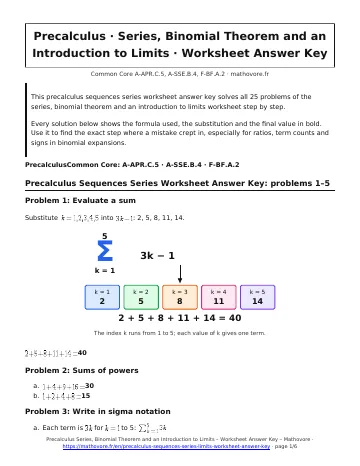
See every chapter on the Precalculus math page.