
This precalculus sequences series limits lesson explains series, binomial theorem and an introduction to limits in one printable page, with definitions, a method and a worked example.
A series is the sum of the terms of a sequence, written compactly with sigma notation. Arithmetic series add a constant difference, geometric series multiply by a constant ratio, and an infinite geometric series converges to a first term divided by one minus r exactly when the absolute value of r is less than 1.
Precalculus Sequences Series Limits Lesson: key facts
- Standards A-SSE.B.4, A-APR.C.5 and F-BF.A.2: sum finite and infinite geometric series, use the binomial theorem, and write sequences recursively and explicitly.
- Arithmetic series: \(S_{n}=\frac{n(a_{1}+a_{n})}{2}\). Finite geometric series: \(S_{n}=\frac{a_{1}(1-r^{n})}{1-r}\).
- An infinite geometric series with \(|r| < 1\) has sum \(\frac{a_{1}}{1-r}\); otherwise it diverges.
- Binomial theorem: \((a+b)^{n}=\sum_{k=0}^{n}C(n,k)\,a^{n-k}b^{k}\), with coefficients from Pascal\’s triangle.
- A limit describes the value approached: \(\lim_{x\to 2}\frac{x^{2}-4}{x-2}=4\) even though the function is undefined at 2.
What is a series and how does sigma notation write it?
A sequence is a list of numbers; a series is the sum of those numbers. Sigma notation packs a long sum into one line: \(\sum_{k=1}^{5}(2k+1)\) tells you to substitute k = 1, 2, 3, 4, 5 into \(2k+1\) and add, giving \(3+5+7+9+11=35\). The number under the sigma is where the index starts and the number above it is where it stops.
How do you add an arithmetic series?
Explicit rule \(a_{n}=a_{1}+(n-1)d\); recursive rule \(a_{n}=a_{n-1}+d\) with \(a_{1}\) given. The sum of the first \(n\) terms is \(S_{n}=\frac{n(a_{1}+a_{n})}{2}\).
The formula works because the first and last terms, the second and second-to-last, and so on, all have the same sum. For 3, 5, 7, 9, 11, 13 every pair adds to 16, and there are 3 pairs, so the total is 48.
When does an infinite geometric series have a sum?
For a geometric sequence with ratio \(r\), \(S_{n}=\frac{a_{1}(1-r^{n})}{1-r}\) when \(r\neq 1\). If \(|r| < 1\), the partial sums settle down and \(\sum_{k=0}^{\infty}a_{1}r^{k}=\frac{a_{1}}{1-r}\). If \(|r|\ge 1\), the series diverges.
Cutting a square in half again and again shows why \(\frac{1}{2}+\frac{1}{4}+\frac{1}{8}++\frac{1}{16}+\frac{1}{32}\) approaches 1 (here \(a_{1}=\frac{1}{2}\) and \(r=\frac{1}{2}\), so the sum is \(\frac{1/2}{1-1/2}=1\)). The graph of partial sums for 1 + 1/2 + 1/4 + … climbs toward 2 and never passes it.
How does the binomial theorem expand a power?
The coefficients of \((a+b)^{n}\) are row n of Pascal\’s triangle. The general rule is \[(a+b)^{n}=\sum_{k=0}^{n}C(n,k)\,a^{n-k}b^{k},\quad C(n,k)=\frac{n!}{k!\,(n-k)!}.\]
Worked example, expand \((x+2)^{4}\).
- Read row 4: 1, 4, 6, 4, 1.
- Powers of \(x\) fall from 4 to 0 while powers of 2 rise from 0 to 4.
- Multiply: \(1\cdot x^{4}+4\cdot 2x^{3}+6\cdot 4x^{2}+4\cdot 8x+1\cdot 16\).
- Result: \(x^{4}+8x^{3}+24x^{2}+32x+16\).
What is a limit?
A limit describes the value a sequence or function approaches, even when it never reaches it. For a sequence, \(\lim_{n\to\infty}\frac{1}{n}=0\). For a function, \(\lim_{x\to 2}\frac{x^{2}-4}{x-2}=4\), because the quotient equals \(x+2\) for every \(x\neq 2\), so the graph has a hole at \((2,4)\). The limit ignores what happens exactly at \(x=2\).
| x | 1.9 | 1.99 | 1.999 | 2.001 | 2.01 | 2.1 |
|---|---|---|---|---|---|---|
| f(x) | 3.9 | 3.99 | 3.999 | 4.001 | 4.01 | 4.1 |
Series, Binomial Theorem and an Introduction to Limits: frequently asked questions
What is the difference between a sequence and a series?
A sequence is an ordered list of numbers such as 3, 5, 7, 9. A series is the sum of the terms, such as 3 + 5 + 7 + 9 = 24. A partial sum adds only the first n terms.
When does an infinite geometric series have a sum?
It has a sum only when the common ratio satisfies \(|r| < 1\). Then the terms shrink fast enough for the total to settle at \(\frac{a_{1}}{1-r}\). If \(|r|\ge 1\), the partial sums grow without bound or keep swinging.
How do I find one specific term in a binomial expansion?
Use the general term \(C(n,k)\,a^{n-k}b^{k}\). For the coefficient of \(x^{3}\) in \((x+3)^{7}\), set \(k=4\): \(C(7,3)\cdot 3^{4}=35\cdot 81=2835\).
Why can a limit exist when the function is undefined at that point?
A limit looks only at values of the function near the point, not at the point itself. The function (x² − 4)/(x − 2) is undefined at x = 2, yet its values get as close to 4 as you like as x approaches 2.
How do I turn a repeating decimal into a fraction?
Write it as an infinite geometric series. For \(0.\overline{27}\), use \(a_{1}=0.27\) and \(r=0.01\): \(\frac{0.27}{0.99}=\frac{3}{11}\).
How to use this precalculus sequences series limits lesson
Use this precalculus sequences series limits lesson before the worksheet, then check what you learned with the quiz.

Printable PDF · Lesson
Precalculus Series, Binomial Theorem and an Introduction to Limits lesson
Download the PDF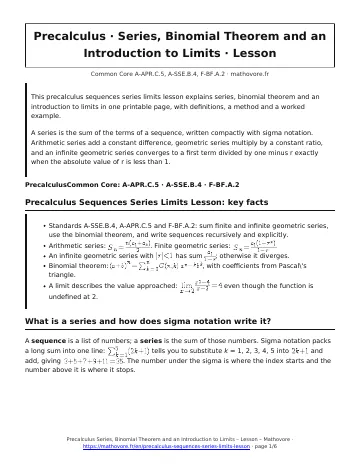
- Series, Binomial Theorem and an Introduction to Limits worksheet (25 problems)
- Series, Binomial Theorem and an Introduction to Limits quiz (10 questions)
- Series, Binomial Theorem and an Introduction to Limits test (45 minutes)
- Previous lesson: Conic Sections: Parabolas, Ellipses and Hyperbolas
- Next lesson: Counting, Permutations, Combinations and Probability
See every chapter on the Precalculus math page.