


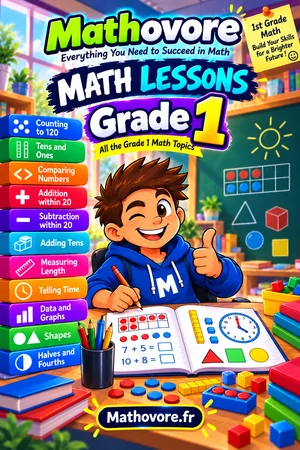
Key takeaway: Grade 1 math on Mathovore has 13 chapters about counting to 120, tens and ones, addition and subtraction within 20, measuring, time and shapes. Each chapter gives a short lesson, a practice sheet, a unit test and an online quiz, with keys.
Grade 1 math chapters
Counting and Numbers to 20
Skills you build: Lay the foundation for all later number work by counting objects accurately. Children touch each item once, learn that the last number said tells the total, and use ten frames to see 13 as a full ten plus three. They also name one more and one less.
Counting to 120
Skills you build: Extend counting past 100 with confidence. Learners start at any number and count forward, read and write numerals up to 120, and spot patterns in the columns and rows of a hundred chart. They also tell how many hundreds, tens, and ones form numbers like 112.
Tens and Ones
Skills you build: See two-digit numbers as groups of tens and leftover ones. Students bundle ten ones into a ten, read the digits in numbers from 11 to 99, and write numbers like 60 as six tens and zero ones. Base-ten blocks and drawings make each number concrete.
Comparing Two-Digit Numbers
Skills you build: Decide which of two numbers is bigger by looking at place value instead of guessing. Young mathematicians check the tens digit first, then the ones, and record the result with the greater than, less than, and equal symbols. Pairs like 47 and 74 make the order of digits clear.
Addition Within 20
Skills you build: Build quick, flexible addition skills for sums up to 20. Children count on from the larger number, fill ten frames to make a ten, use doubles and near doubles, and notice that swapping the addends gives the same total. Counters and number sentences connect each strategy to the answer.
Subtraction Within 20
Skills you build: Take away, compare, and find missing parts with numbers up to 20. Students count back, rewrite a problem like 13 - 8 as a missing addend, and match two groups to see the difference. Fact families link each subtraction fact to its partner addition fact.
The Equal Sign and Word Problems
Skills you build: Understand the equal sign as a balance, not just a signal to find an answer. Students judge whether equations like 6 + 2 = 5 + 3 are true, find unknown numbers in any position, and solve short stories by adding or subtracting, including sums of three numbers.
Adding and Subtracting Tens Within 100
Skills you build: Work with tens as units you can combine. Learners add a one-digit number to a two-digit number, add multiples of 10 such as 27 + 30, and subtract tens from numbers like 70. Hundred charts and bundles of ten sticks show why only one digit changes.
Measuring Length
Skills you build: Measure how long things are without a ruler at first. Learners line up objects at one end to compare, order three items from shortest to longest, and use a string to compare objects that cannot sit together. Then they lay same-size units end to end and count them.
Telling Time to the Hour and Half Hour
Skills you build: Read analog and digital clocks to the hour and half hour. Learners tell the hour hand from the minute hand, recognize that a minute hand pointing straight up means o'clock and pointing down means half past, and write times such as 4:30 on a digital display.
Organizing and Reading Data
Skills you build: Collect information and turn it into something easy to read. Learners sort objects, record results with tally marks, and build picture graphs and bar graphs. They then read those displays to answer how many in each group and how many more or fewer one category has.
2D and 3D Shapes
Skills you build: Describe and sort flat and solid shapes by what they are made of. Learners count sides and corners to tell triangles, squares, and rectangles apart, recognize cubes, cones, and cylinders, and ignore color or size. They also combine shapes to build new ones.
Halves and Fourths
Skills you build: Learn to cut shapes into equal shares and name them. Children split circles and rectangles into two or four equal parts, call them halves, fourths, or quarters, and see that more shares mean smaller pieces. They also explain how the parts rebuild one whole.
What math do 1st graders learn?
First grade builds the base for all later arithmetic. Children count to 120, read and write numbers, and learn that two-digit numbers are made of tens and ones. They also add and subtract within 20 using objects, drawings and number sentences.
Four Common Core domains guide the year: Operations and Algebraic Thinking, Number and Operations in Base Ten, Measurement and Data, and Geometry. The code 1.NBT.A.1 tags the first place value chapter.
In what order should Grade 1 math chapters be studied?
Start with counting and numbers to 20, then count to 120. Place value follows, because tens and ones explain every two-digit number. Comparing two-digit numbers uses three signs for more, fewer and the same.
Addition and subtraction within 20 come next, along with the meaning of the equal sign and simple word problems. Adding and subtracting tens within 100 extends those facts.
The last chapters cover measuring length, reading a clock on the hour and half hour, reading simple data, and naming flat and solid shapes. Halves and fourths introduce fractions in a gentle way.
What should a child know before 1st grade math?
A child should count objects up to 20 and recognize numerals. Kindergarten skills such as comparing groups and naming basic shapes also help. If counting still feels slow, spend a few days on the first chapter.
Short, playful practice works best at this age. Songs, games and everyday counting all count as practice. Five or ten minutes a day beats one long session.
How can parents use Grade 1 math worksheets at home?
Sit beside your child and read each instruction aloud. Let the child use counters, coins or drawings, because concrete objects make number sentences real. Praise the method, not just the answer.
After each sheet, check the key together. Circle one problem to retry tomorrow. This tiny habit builds confidence fast.
What are common first grade math trouble spots?
Reversing digits, mixing up addition and subtraction signs, and counting on from the wrong number are typical. A number line on the table helps. So does saying the problem in words before writing it.
What comes after Grade 1 math?
Grade 2 extends place value to 1,000 and adds fluency within 100. Money, skip counting and arrays appear soon after. A confident first grader moves into that year with ease.
Grade 1 math: tips for parents
How big is the Grade 1 course?
The course has 13 chapters, starting with counting to 20 and ending with halves and fourths.
Do young children need a calculator?
No. First graders should use objects and mental strategies.
Are the worksheets printable?
Yes, as PDFs in US Letter size.
Are there tests for 6-year-olds?
Yes, but they are short unit checks that a parent or teacher can read aloud.