Key takeaway: This grade 1 measuring test answer key shows the correct work for each question, and every scoring note says how many points to give. Partial credit is fine when a child has the right idea but makes a small counting slip.
Focus on the method. For example, a child who lines up the ends correctly has shown the main skill.
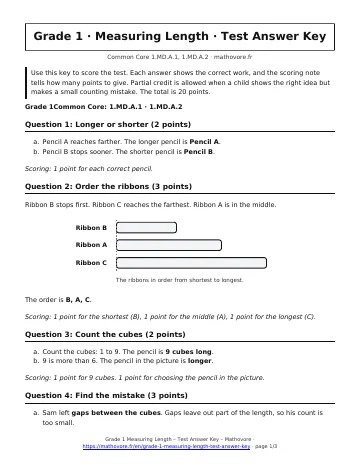
Use this key to score the test. Each answer shows the correct work, and the scoring note tells how many points to give. Partial credit is allowed when a child shows the right idea but makes a small counting mistake. The total is 20 points.
Grade 1 Measuring Test Answer Key: questions 1–5
1. Longer or shorter (2 points)
- Pencil A reaches farther. The longer pencil is Pencil A.
- Pencil B stops sooner. The shorter pencil is Pencil B.
Scoring: 1 point for each correct pencil.
2. Order the ribbons (3 points)
Ribbon B stops first. Ribbon C reaches the farthest. Ribbon A is in the middle.
The order is B, A, C.
Scoring: 1 point for the shortest (B), 1 point for the middle (A), 1 point for the longest (C).
3. Count the cubes (2 points)
- Count the cubes: 1 to 9. The pencil is 9 cubes long.
- 9 is more than 6. The pencil in the picture is longer.
Scoring: 1 point for 9 cubes. 1 point for choosing the pencil in the picture.
4. Find the mistake (3 points)
- Sam left gaps between the cubes. Gaps leave out part of the length, so his count is too small.
- Sam can lay the cubes so they touch, with the first cube at the left end.
Scoring: 2 points for naming the gaps and saying why this is wrong (1 point for naming only). 1 point for a correct fix.
5. Use a third object (2 points)
The string matches Ava’s desk. Ben’s desk is shorter than the string. So Ava’s desk is longer.
Ava’s desk is longer.
Scoring: 2 points for Ava’s desk. 1 point if the answer is wrong but the work shows the string was used.
Grade 1 Measuring Test Answer Key: questions 6–8
6. Longest and shortest (2 points)
- 13 is the biggest number. The plane is the longest.
- 5 is the smallest number. The bus is the shortest.
Scoring: 1 point for each correct toy.
7. Count the clips (3 points)
- The crayon is 6 paper clips long.
- The spoon is 9 paper clips long.
- 9 is more than 6, so the spoon is longer.
Scoring: 1 point for each part.
8. Toy trains (3 points)
- 8 is more than 5, so Noah’s train is longer.
- \(5 + 3 = 8\). Ella’s train is 8 cubes long.
- Both trains are 8 cubes long. The answer is yes.
Scoring: 1 point for each part. In part (c), give the point for a yes that matches the answer to part (b).
Scoring summary
20 points: add the points of every question of this grade 1 measuring test answer key.
What are the answers on the measuring test?
First, the toy plane, at 13 cubes, is the longest. Next, Ava’s desk beats Ben’s, since the string matches Ava’s and tops Ben’s. Then comes Noah’s 8-cube train, which outruns Ella’s 5-cube train. Finally, Sam’s mistake is that he left gaps between the cubes.
How do you award partial credit?
Give 1 point for naming the gaps and another for a repair, such as pushing the cubes together. Similarly, a child who orders the ribbons but swaps two letters can keep points for the method. Write a short note on the page.
What mistakes appear most?
One common slip is counting cubes beyond the end of the object. Another is comparing ends that do not start at the same line. For both, ask the child to redraw the picture with a clear starting line.
What should you do after scoring?
Group students by mistake type, and plan five minutes of cube practice for each group. Next, repeat one missed item with new numbers. A short quiz at the end of the week can confirm growth.

See every chapter on the Grade 1 math page.