


Use this key to score the test out of 20 points. Each solution shows the full work, and the scoring note tells how the points are awarded. Give partial credit only where the note allows it, and accept any equivalent form of a correct equation.
Question 1: Slope and direction (2 points)
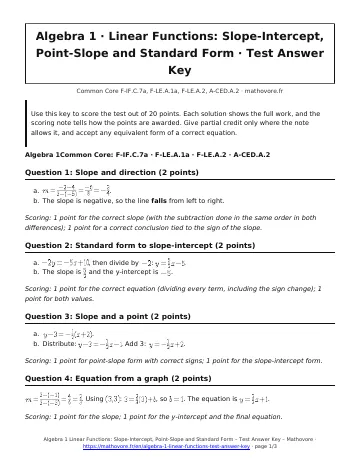
- \(m=\frac{-2-4}{3-(-5)}=\frac{-6}{8}=-\frac{3}{4}\).
- The slope is negative, so the line falls from left to right.
Scoring: 1 point for the correct slope (with the subtraction done in the same order in both differences); 1 point for a correct conclusion tied to the sign of the slope.
Question 2: Standard form to slope-intercept (2 points)
- \(-2y=-5x+10\), then divide by \(-2\): \(y=\frac{5}{2}x-5\).
- The slope is \(\frac{5}{2}\) and the y-intercept is \(-5\).
Scoring: 1 point for the correct equation (dividing every term, including the sign change); 1 point for both values.
Question 3: Slope and a point (2 points)
- \(y-3=-\frac{1}{2}(x+2)\).
- Distribute: \(y-3=-\frac{1}{2}x-1\). Add 3: \(y=-\frac{1}{2}x+2\).
Scoring: 1 point for point-slope form with correct signs; 1 point for the slope-intercept form.
Question 4: Equation from a graph (2 points)
\(m=\frac{3-(-1)}{3-(-3)}=\frac{4}{6}=\frac{2}{3}\). Using \((3,3)\): \(3=\frac{2}{3}(3)+b\), so \(b=1\). The equation is \(y=\frac{2}{3}x+1\).
Scoring: 1 point for the slope; 1 point for the y-intercept and the final equation.
Question 5: Graph from standard form (2 points)
If \(y=0\), then \(x=4\). If \(x=0\), then \(y=6\). Plot \((4,0)\) and \((0,6)\) and draw the line through them.
Scoring: 1 point for both correct intercepts; 1 point for a straight line drawn through them.
Question 6: Parallel and perpendicular (2 points)
- The slope is \(-\frac{3}{4}\). \(y-1=-\frac{3}{4}(x-8)\) gives \(y-1=-\frac{3}{4}x+6\), so \(y=-\frac{3}{4}x+7\).
- The negative reciprocal of \(-\frac{3}{4}\) is \(\frac{4}{3}\).
Scoring: 1 point for the parallel line (same slope, passing through the point); 1 point for the negative reciprocal.
Question 7: Classify pairs of lines (2 points)
- The first slope is 2. For \(4x-2y=6\): \(-2y=-4x+6\), so \(y=2x-3\) and the slope is 2. Equal slopes and different intercepts: parallel.
- \(3x+4y=8\) gives \(y=-\frac{3}{4}x+2\), slope \(-\frac{3}{4}\). \(4x-3y=9\) gives \(y=\frac{4}{3}x-3\), slope \(\frac{4}{3}\). The product is \(-\frac{3}{4}\cdot\frac{4}{3}=-1\), so the lines are perpendicular.
Scoring: 1 point for each correct classification supported by both slopes.
Question 8: Bakery order (3 points)
- \(\frac{86-38}{10-4}=\frac{48}{6}=8\). The price is $8 per box.
- \(38=8(4)+b\), so \(b=6\) (the delivery fee). \(C=8b+6\).
- \(C=8(15)+6=126\). It costs $126.
Scoring: 1 point for each part; in part (b) the delivery fee of $6 must be found, not guessed.
Question 9: Draining tank (3 points)
- Every 5 minutes the volume drops by 15 gallons (120, 105, 90, 75), so the rate is \(\frac{-15}{5}=-3\) gallons per minute.
- The starting amount is 120, so \(g=-3t+120\).
- \(0=-3t+120\), so \(t=40\). The tank is empty after 40 minutes.
Scoring: 1 point for each part; part (a) needs the unit and the negative sign.
20 points
See every chapter on the Algebra 1 math page.