This ap statistics chi square test checks chi-square tests for homogeneity and independence in 45 minutes, with 9 questions for a total of 20 points.
This free-response test covers chi-square tests for homogeneity and independence. Show the formulas, the numbers and a conclusion in context. A calculator with chi-square probability functions is allowed. The test is worth 20 points.
- Grade: AP Statistics
- Chapter: Chi-Square Tests for Homogeneity and Independence
- Common Core: AP Statistics Unit 3 (2026-27)
- Time: 45 minutes
- Total: 20 points (Question 1: 2 pts; Question 2: 2 pts; Question 3: 2 pts; Question 4: 2 pts; Question 5: 2 pts; Question 6: 4 pts; Question 7: 2 pts; Question 8: 2 pts; Question 9: 2 pts)
AP Statistics Chi Square Test: questions 1–5
Question 1: Expected count and df (2 points)
A random sample of 200 adults was asked whether they subscribe to a streaming service.
- Find the expected count for adults ages 30 to 49 who subscribe if age group and subscription are independent. (1 point)
- Find the degrees of freedom for a chi-square test. (1 point)
Question 2: Name the test and hypotheses (2 points)
A district drew a random sample of 150 students from each of three high schools (Northside, Eastside and Westside) and recorded whether each student usually walks, rides the bus or is driven to school.
- Name the appropriate chi-square test. (1 point)
- State the null and alternative hypotheses in context. (1 point)
Question 3: Check the conditions (2 points)
The students in the previous question gave the following counts. Each school enrolls more than 2,000 students.
Determine whether the conditions for the chi-square test are met. (2 points)
Question 4: Statistic and df (2 points)
Use the counts in the previous question. Calculate the value of the chi-square statistic and the degrees of freedom. (2 points)
Question 5: P-value and conclusion (2 points)
A chi-square test for the school data gives \(\chi^{2}\approx 7.00\) with 4 degrees of freedom.
- Find the p-value. (1 point)
- State a conclusion in context at the \(\alpha=0.05\) level. (1 point)
AP Statistics Chi Square Test: questions 6–9
Question 6: Complete test for an experiment (4 points)
Sofia randomly assigned 180 adults with trouble sleeping to three groups of 60. Each group used a different bedtime app, and Sofia recorded whether each person fell asleep within 20 minutes.
| App | Fell asleep | Did not |
|---|---|---|
| Sound | 41 | 19 |
| Story | 30 | 30 |
| Timer | 22 | 38 |
Carry out a chi-square test at the \(\alpha=0.05\) level to decide whether the apps differ in how quickly people fall asleep. (4 points)
Question 7: Largest contribution (2 points)
For the school data in the third question, identify the cell that contributes the most to the chi-square statistic. State whether its observed count is above or below the expected count, and what that means in context. (2 points)
Question 8: Association and causation (2 points)
A random sample of 400 teenagers was classified by hours of sleep (under 7, 7 to 8, over 8) and by grade-point average (below 3.0, 3.0 or higher). A chi-square test of independence gave a p-value of 0.003.
- State the conclusion about association in context at \(\alpha=0.05\). (1 point)
- Explain why the result does not show that sleeping more causes higher grades. (1 point)
Question 9: Effect of sample size (2 points)
A chi-square test is run on a 2 by 2 table with counts 20, 30, 30 and 20 (rows: 20 and 30, then 30 and 20).
- Calculate \(\chi^{2}\). (1 point)
- Each count is multiplied by 3 (60, 90, 90, 60) with the same percentages. Find the new \(\chi^{2}\) and explain the change. (1 point)

How to use this ap statistics chi square test
Take this ap statistics chi square test without notes, then grade it with the test answer key out of 20 points.

Printable PDF · Test
AP Statistics Chi-Square Tests for Homogeneity and Independence test
Download the PDF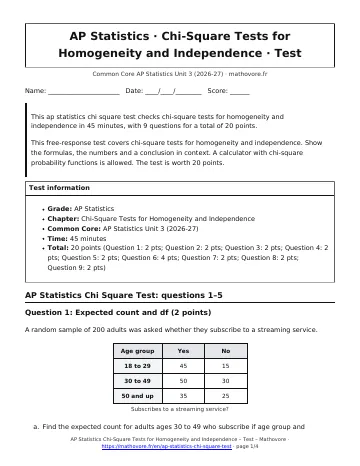
See every chapter on the AP Statistics math page.