
This precalculus inverse trig lesson explains inverse trigonometric functions and trigonometric equations in one printable page, with definitions, a method and a worked example.
An inverse trigonometric function undoes a trig function on a restricted domain: sin⁻¹ x returns an angle in [−π/2, π/2], cos⁻¹ x returns an angle in [0, π], and tan⁻¹ x returns an angle in (−π/2, π/2). They are used to solve equations such as sin x = 1/2.
Precalculus Inverse Trig Lesson: key facts
- Sine, cosine, and tangent are not one-to-one, so each needs a restricted domain before it has an inverse.
- sin⁻¹ and cos⁻¹ have domain [−1, 1]; tan⁻¹ accepts every real number.
- sin⁻¹(sin x) equals x only when x is in [−π/2, π/2]; the same idea holds for the other two functions on their ranges.
- A calculator gives only one solution; symmetry and the period supply the rest.
- In applied problems, keep only the solutions that lie in the interval of the situation.
Why must the domains of sine, cosine, and tangent be restricted?
A function has an inverse only if every output comes from exactly one input. Sine repeats, so the line \(y=\frac{1}{2}\) meets its graph infinitely often. To build an inverse we keep one piece of the graph that is one-to-one and still reaches every output.
What are arcsin, arccos, and arctan?
- \(y=\sin^{-1}x\) (arcsin): domain \( [-1,1] \), range \( [-\frac{\pi}{2},\frac{\pi}{2}] \).
- \(y=\cos^{-1}x\) (arccos): domain \( [-1,1] \), range \( [0,\pi] \).
- \(y=\tan^{-1}x\) (arctan): domain all real numbers, range \( (-\frac{\pi}{2},\frac{\pi}{2}) \).
The notation \(\sin^{-1}x\) means arcsin, not \(\frac{1}{\sin x}\). The output is always an angle in radians.
| x | sin⁻¹ x | cos⁻¹ x |
|---|---|---|
| \(\frac{1}{2}\) | \(\frac{\pi}{6}\) | \(\frac{\pi}{3}\) |
| \(\frac{\sqrt{2}}{2}\) | \(\frac{\pi}{4}\) | \(\frac{\pi}{4}\) |
| \(\frac{\sqrt{3}}{2}\) | \(\frac{\pi}{3}\) | \(\frac{\pi}{6}\) |
| \(-\frac{1}{2}\) | \(-\frac{\pi}{6}\) | \(\frac{2\pi}{3}\) |
Why is sin⁻¹(sin x) not always x?
The identities \(\sin(\sin^{-1}x)=x\) for \(-1\le x\le 1\) and \(\sin^{-1}(\sin x)=x\) for \(-\frac{\pi}{2}\le x\le\frac{\pi}{2}\) hold only on those intervals. For example \(\sin\frac{5\pi}{6}=\frac{1}{2}\), and the angle in the restricted range with sine \(\frac{1}{2}\) is \(\frac{\pi}{6}\), so \(\sin^{-1}(\sin\frac{5\pi}{6})=\frac{\pi}{6}\).
How do you solve a trigonometric equation?
- Isolate the trigonometric function.
- Apply the inverse to get the reference angle \(\alpha\).
- Use symmetry for the other solution on \( [0,2\pi) \): sine gives \(\alpha\) and \(\pi-\alpha\); cosine gives \(\alpha\) and \(2\pi-\alpha\); tangent gives \(\alpha\) and \(\alpha+\pi\).
- For all solutions, add \(2\pi k\) (sine, cosine) or \(\pi k\) (tangent).
Example. Solve \(2\sin x-1=0\). Then \(\sin x=\frac{1}{2}\), so \(x=\frac{\pi}{6}\) or \(x=\frac{5\pi}{6}\); in general \(x=\frac{\pi}{6}+2\pi k\) or \(x=\frac{5\pi}{6}+2\pi k\). A calculator in radian mode gives decimals; in a real situation keep only the solutions that fit the given interval.
Inverse Trigonometric Functions and Trigonometric Equations: frequently asked questions
Is sin⁻¹ x the same as 1/sin x?
No. The exponent −1 here means the inverse function, also written arcsin x. The reciprocal 1/sin x is called cosecant.
Why does arccos have range [0, π] instead of [−π/2, π/2]?
Cosine is one-to-one and takes every value from 1 down to −1 on [0, π]. On [−π/2, π/2] it would miss negative values, so that interval would not work.
How do I find all solutions of cos x = 0.3?
The calculator gives x ≈ 1.27. The second solution on [0, 2π) is 2π − 1.27 ≈ 5.02. All solutions are x = ±1.27 + 2πk.
Why is tan⁻¹ x never exactly π/2?
Tangent has vertical asymptotes at ±π/2, so its inverse has horizontal asymptotes y = ±π/2. The graph approaches those lines but never reaches them.
Should my calculator be in degrees or radians?
Match the problem. Use radian mode when the interval is written with π and degree mode when angles are given in degrees. Check the mode before every set of problems.
How to use this precalculus inverse trig lesson
Use this precalculus inverse trig lesson before the worksheet, then check what you learned with the quiz.

Printable PDF · Lesson
Precalculus Inverse Trigonometric Functions and Trigonometric Equations lesson
Download the PDF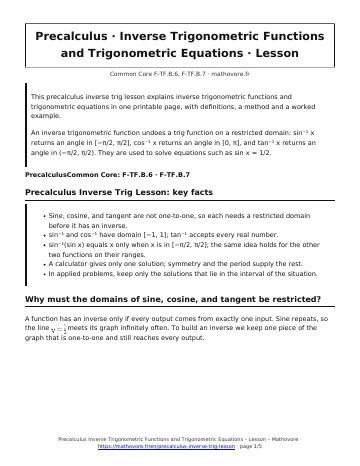
- Inverse Trigonometric Functions and Trigonometric Equations worksheet (24 problems)
- Inverse Trigonometric Functions and Trigonometric Equations quiz (10 questions)
- Inverse Trigonometric Functions and Trigonometric Equations test (45 minutes)
- Previous lesson: Graphs of Trigonometric Functions
- Next lesson: Trigonometric Identities
See every chapter on the Precalculus math page.