



This precalculus functions review worksheet answer key solves all 24 problems of the functions: domain, range, composition and inverses worksheet step by step.
Every problem from the functions worksheet is solved step by step below. Check the domain after each composition and verify each inverse by substituting a point, because those are the two places where most errors happen.
Precalculus Functions Review Worksheet Answer Key: problems 1–5
Problem 1: Evaluate function notation
- \(f(3)=3(9)-6+1=22\), so \(22\)
- \(f(-2)=3(4)+4+1=17\), so \(17\)
- \(f(a+1)=3(a^{2}+2a+1)-2a-2+1=3a^{2}+4a+2\), so \(3a^{2}+4a+2\)
Problem 2: Domain with square roots
- \(2x-6 \ge 0\) gives \(2x \ge 6\) and \(x \ge 3\). Domain: \([3,\infty)\)
- \(10-5x \ge 0\) gives \(-5x \ge -10\); dividing by \(-5\) reverses the inequality, so \(x \le 2\). Domain: \((-\infty,2]\)
Problem 3: Domain with denominators
- \(x^{2}-9=0\) when \(x=3\) or \(x=-3\), so those two values are excluded. Domain: \((-\infty,-3)\) ∪ \((-3,3)\) ∪ \((3,\infty)\)
- \(x^{2}+4 \ge 4\) is never zero, so every real number works. Domain: \((-\infty,\infty)\)
Problem 4: Domain with several restrictions
- \(x+4 \ge 0\) gives \(x \ge -4\), and \(x \neq 2\) removes a zero denominator. Domain: \([-4,2)\) ∪ \((2,\infty)\)
- The logarithm needs \(5-x > 0\), so \(x < 5\). Domain: \((-\infty,5)\)
Problem 5: Domain and range from a graph
- The graph runs from \(x=-1\) (included) to \(x=3\) (excluded). Domain: \([-1,3)\)
- The lowest height is \(0\) (at the closed point) and the peak is \(4\). Range: \([0,4]\)
- The graph is \(-(x-1)^{2}+4\). Solve \(-(x-1)^{2}+4=3\): \((x-1)^{2}=1\), so \(x=0\) or \(x=2\). Answer: \(x=0\) and \(x=2\)
Precalculus Functions Review Worksheet Answer Key: problems 6–10
Problem 6: Composition from tables
- \(g(1)=3\) and \(f(3)=1\), so \(1\)
- \(f(3)=1\) and \(g(1)=3\), so \(3\)
- \(f(1)=2\) and \(f(2)=4\), so \(4\)
- \(g(4)=2\) and \(g(2)=1\), so \(1\)
Problem 7: Composition of polynomials
- \(f(g(x))=(3x-2)^{2}+1=9x^{2}-12x+4+1\), so \(9x^{2}-12x+5\)
- \(g(f(x))=3(x^{2}+1)-2\), so \(3x^{2}+1\)
- \(g(2)=4\) and \(f(4)=17\). Check: \(9(4)-24+5=17\). Answer: \(17\)
Problem 8: Composition from a mapping diagram
- Follow each arrow twice: \(1 \to 3 \to 9\), \(2 \to 5 \to 25\), \(3 \to 7 \to 49\). Answers: \(9, 25, 49\)
- The outputs of \(g\) rise by 2 each step from \(3\), so \(g(x)=2x+1\). The outputs of \(f\) are squares, so \(f(x)=x^{2}\). Then \(f(g(x))=(2x+1)^{2}\); check \((2\cdot 3+1)^{2}=49\).
Problem 9: Domain of a composition (roots)
- \(f(g(x))=\sqrt{x-5}\) needs \(x-5 \ge 0\). Domain: \([5,\infty)\)
- \(g(f(x))=\sqrt{x}-5\) needs \(x \ge 0\). Domain: \([0,\infty)\)
Problem 10: Domain of a composition (rational)
- \(f(g(x))=\frac{1}{x+2}\), and \(x+2 \neq 0\). Domain: \((-\infty,-2)\) ∪ \((-2,\infty)\)
- \(g(f(x))=\frac{1}{x}+2=\frac{2x+1}{x}\), and \(x \neq 0\). Domain: \((-\infty,0)\) ∪ \((0,\infty)\)
Precalculus Functions Review Worksheet Answer Key: problems 11–15
Problem 11: Decompose a function
- The inside is \(2x+5\): \(g(x)=2x+5\), \(f(x)=x^{4}\)
- The inside is \(x-3\): \(g(x)=x-3\), \(f(x)=\frac{1}{x^{2}}\)
- The inside is \(x^{2}+9\): \(g(x)=x^{2}+9\), \(f(x)=\sqrt{x}\). (Other correct splits exist.)
Problem 12: Inverse of a linear function
- Swap: \(x=5y-3\), so \(y=\frac{x+3}{5}\). Answer: \(f^{-1}(x)=\frac{x+3}{5}\)
- Swap: \(x=-\frac{2}{3}y+4\), so \(-\frac{2}{3}y=x-4\) and \(y=-\frac{3}{2}(x-4)=6-\frac{3}{2}x\). Answer: \(g^{-1}(x)=6-\frac{3}{2}x\). Check: \(g(6)=0\) and \(g^{-1}(0)=6\).
Problem 13: Inverse of a rational function
Swap: \(x=\frac{2y+1}{y-3}\). Then \(xy-3x=2y+1\), so \(y(x-2)=3x+1\).
Answer: \(f^{-1}(x)=\frac{3x+1}{x-2}\). Check: \(f(4)=9\) and \(f^{-1}(9)=\frac{28}{7}=4\).
The domain of \(f\) excludes \(x=3\); the domain of \(f^{-1}\) excludes \(x=2\), which is the range of \(f\). Domain of \(f\): \(x \neq 3\); range: \(y \neq 2\).
Problem 14: Verify inverse functions
- \(f(g(x))=(\sqrt[3]{x-4})^{3}+4=x\) and \(g(f(x))=\sqrt[3]{x^{3}+4-4}=x\). Yes, inverses.
- \(f(g(x))=\frac{1}{2}(2x+3)-3=x-\frac{3}{2}\), which is not \(x\). Not inverses; the true inverse is \(2x+6\).
Problem 15: Inverse values from a graph
- \((2,1)\) is on the graph, so \(f(2)=1\)
- The output \(3\) comes from \(x=4\), so \(f^{-1}(3)=4\)
- The output \(-1\) comes from \(x=0\), so \(f^{-1}(-1)=0\)
- The output \(7\) comes from \(x=6\), so \(f^{-1}(7)=6\)
Precalculus Functions Review Worksheet Answer Key: problems 16–20
Problem 16: Inverse values from tables
- The output \(0\) occurs at \(x=2\) and the output \(-2\) at \(x=3\). Answers: \(f^{-1}(0)=2\) and \(f^{-1}(-2)=3\)
- \(f(1)=3\) and \(f^{-1}(3)=1\), so \(1\)
- \(g(1)=4\) and \(g(3)=4\): two inputs share one output, so reversing the table would give two answers for \(4\). \(g\) is not one-to-one.
Problem 17: Horizontal line test
Graph A rises everywhere, so every horizontal line meets it once: invertible. A horizontal line at \(y=1\) meets the parabola in graph B twice, and one at \(y=0.3\) meets graph C three times . Only graph A has an inverse function.
Problem 18: Restrict a domain: vertex form
- The graph fails the horizontal line test: \(f(1)=4\) and \(f(5)=4\).
- Swap: \(x=(y-3)^{2}\). On the restricted domain \(y \ge 3\), so \(y-3=\sqrt{x}\). Answer: \(f^{-1}(x)=3+\sqrt{x}\), domain \([0,\infty)\), range \([3,\infty)\)
- \(f^{-1}(16)=3+\sqrt{16}=7\). Check: \(f(7)=16\). Answer: \(7\)
Problem 19: Restrict a domain: complete the square
Complete the square: \(f(x)=(x+2)^{2}-4\). Swap: \(x=(y+2)^{2}-4\), so \((y+2)^{2}=x+4\). Since \(y \ge -2\), \(y+2=\sqrt{x+4}\).
Answer: \(f^{-1}(x)=-2+\sqrt{x+4}\), domain \([-4,\infty)\) (the range of \(f\)), range \([-2,\infty)\). Check: \(f(1)=5\) and \(f^{-1}(5)=-2+3=1\).
Problem 20: Temperature conversion
- Swap and solve: \(C=\frac{5}{9}(F-32)\) gives \(F-32=\frac{9}{5}C\). Answer: \(F(C)=\frac{9}{5}C+32\)
- \(F(37)=\frac{9}{5}(37)+32=66.6+32=98.6\). Answer: \(98.6^{\circ}\text{F}\)
- \(C(F(C))=\frac{5}{9}(\frac{9}{5}C+32-32)=\frac{5}{9}\cdot\frac{9}{5}C=C\). Verified.
Precalculus Functions Review Worksheet Answer Key: problems 21–24
Problem 21: Coupon and discount order
- \(d(60)=48\) and \(c(48)=43\); \(c(60)=55\) and \(d(55)=44\). Answers: $43 and $44
- \(c(d(p))=0.8p-5\) and \(d(c(p))=0.8(p-5)=0.8p-4\). Answers: \(0.8p-5\) and \(0.8p-4\)
- Taking the discount first and the coupon second gives the lower price. The difference is \((0.8p-4)-(0.8p-5)=1\), so it saves $1 at every price.
Problem 22: Taxi fare inverse
- Solve \(F=2.50+1.80m\) for \(m\): \(m=\frac{F-2.50}{1.80}\). It converts a fare into the number of miles ridden.
- \(m(20.50)=\frac{18.00}{1.80}=10\). Answer: 10 miles
- \(m(11.50)=\frac{9.00}{1.80}=5\). Answer: 5 miles
Problem 23: Growing ripple
- \(A(r(t))=\pi(3t)^{2}\). Answer: \(9\pi t^{2}\)
- \(9\pi(4)^{2}=144\pi\approx 452.4\). Answer: 452.4 square feet
- \(9\pi t^{2}=81\pi\) gives \(t^{2}=9\), and \(t > 0\), so \(t=3\) seconds
Problem 24: Inverse of a composition
- \(f(g(x))=2(x-4)+1=2x-7\). Swap: \(x=2y-7\), so the inverse is \(\frac{x+7}{2}\)
- \(f^{-1}(x)=\frac{x-1}{2}\) and \(g^{-1}(x)=x+4\). Then \(g^{-1}(f^{-1}(x))=\frac{x-1}{2}+4=\frac{x+7}{2}\). Answer: \(\frac{x+7}{2}\)
- They match. The inverse of \(f(g(x))\) undoes \(f\) first and then \(g\): \(g^{-1}(f^{-1}(x))\).
How to use this precalculus functions review worksheet answer key
Read this precalculus functions review worksheet answer key after trying each problem yourself, and redo any problem you missed.

Printable PDF · Worksheet Answer Key
Precalculus Functions: Domain, Range, Composition and Inverses worksheet answer key
Download the PDF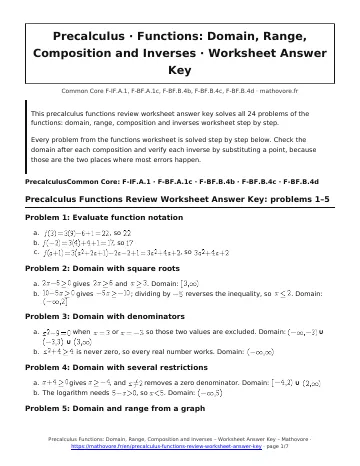
See every chapter on the Precalculus math page.